
The Ultimate Ab Workout for Runners: 6 Moves for 2025

Running is more than just leg strength; it's a full-body effort where your core is the critical link. Every stride you take originates from your center, and a weak core can lead to poor running form, wasted energy, and a higher risk of common running injuries. A dedicated ab workout for runners isn't about chasing a six-pack, it's about building a stable, powerful engine that translates directly to improved endurance, efficiency, and resilience on the road or trail.
This guide moves beyond generic sit-ups to provide a targeted routine designed specifically for the biomechanics of running. You will learn how to build a stronger, more stable foundation to support your mileage and speed goals. A fortified core acts as your body's central powerhouse, transferring force effectively between your upper and lower body and helping you maintain proper posture even as fatigue sets in.
In the following sections, we will break down six essential exercises that address the unique demands placed on a runner's body. These movements focus on three key areas:
Stabilizing the pelvis to prevent excessive side-to-side motion.
Controlling torso rotation for a more efficient stride.
Enhancing the mind-muscle connection needed for maintaining peak performance.
By incorporating this specialized ab workout for runners into your training schedule, you can protect your body from strain and unlock a new level of running potential. Prepare to build the functional strength that will make every run feel stronger and more controlled. Let's dive into the exercises that will fortify your foundation.
1. Plank with Variations
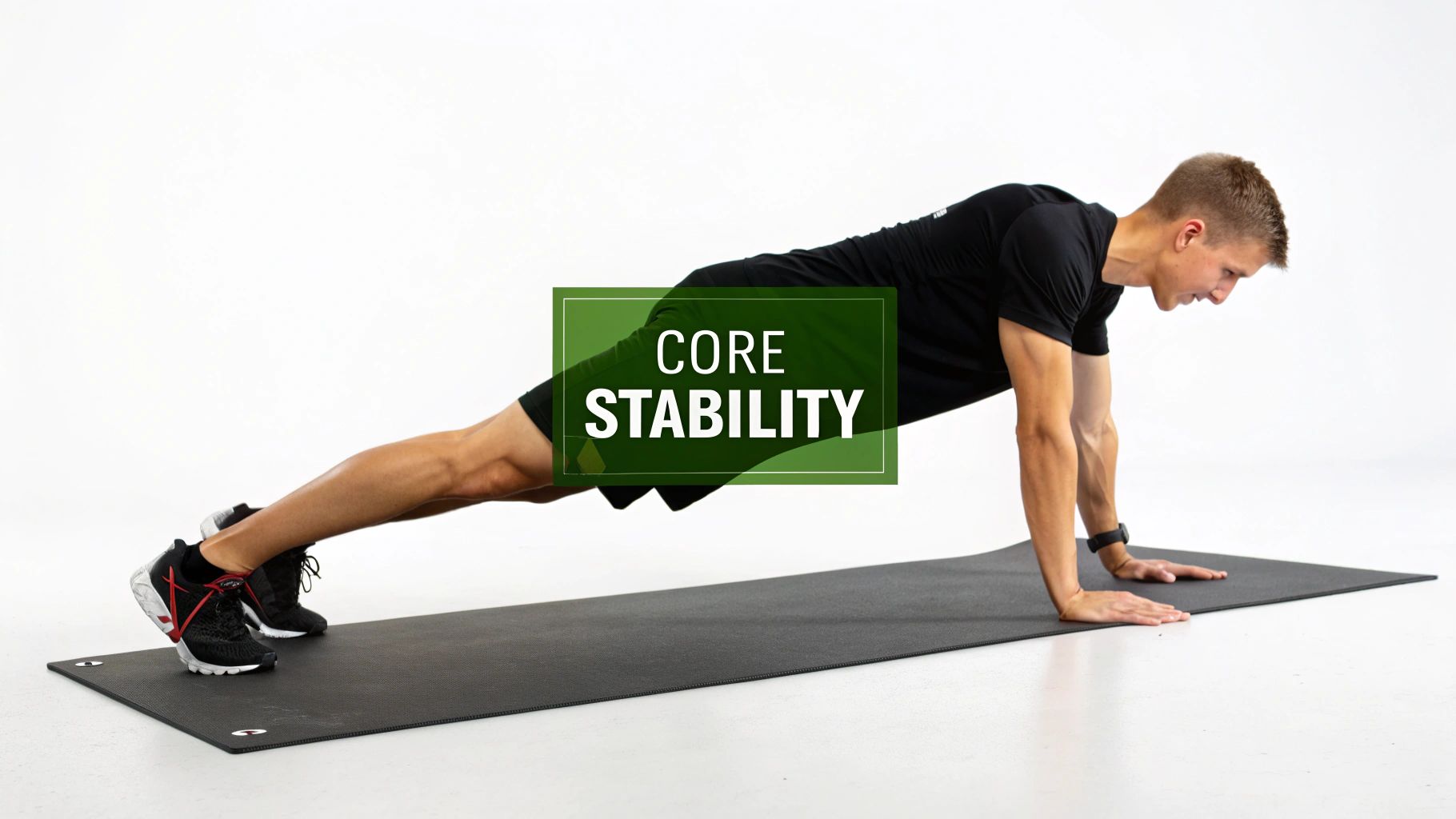
The plank is arguably the cornerstone of any effective ab workout for runners, and for good reason. It’s an isometric exercise, meaning you hold a static position, which builds incredible endurance in your deep core muscles. For a runner, this endurance is non-negotiable; it's what prevents your form from collapsing and your hips from dropping during the final, grueling miles of a long run or race.
Unlike crunches, which primarily target the superficial rectus abdominis, the plank engages the entire core cylinder. This includes the transverse abdominis (your body's natural corset), the obliques (for rotational control), the lower back, and even the glutes and shoulders. This comprehensive engagement directly translates to improved running posture, greater stability, and a more efficient transfer of power from your upper to lower body with each stride.
Why It's Essential for Runners
A strong, stable core acts as a solid platform for your limbs to move. When your core is weak, your body wastes energy by wobbling side-to-side or rotating excessively. This not only slows you down but also increases the risk of common running injuries, particularly in the lower back, hips, and knees.
Renowned physical therapist Stuart McGill has extensively researched the plank's role in creating "spinal stiffness," which is crucial for protecting the back from repetitive impact forces inherent in running.
Elite athletes and top-tier training programs consistently feature planks. For instance, Olympic marathoner Meb Keflezighi credits a rigorous core routine, heavy on planks, for his longevity in the sport. Similarly, Nike Run Club training plans frequently incorporate plank variations to build the functional strength runners need.
How to Perform the Perfect Plank
Mastering the basic plank is the first step before advancing to more dynamic variations.
Setup: Start on your forearms with your elbows directly beneath your shoulders and your hands clasped or flat on the floor. Extend your legs straight back, resting on the balls of your feet.
Engagement: Actively squeeze your glutes and brace your abs as if you're about to be punched in the stomach. Your body should form a straight, rigid line from your head to your heels.
Form Check: Avoid letting your hips sag towards the floor or pike up towards the ceiling. Keep your neck in a neutral position by looking at the floor a few inches in front of your hands.
Breathing: Remember to breathe! Inhale and exhale steadily throughout the hold; holding your breath can increase blood pressure and reduce muscle endurance.
Actionable Tips and Variations
Start with what you can manage, even if it's just 20-30 seconds, and build from there. Focus on perfect form over duration. Once you can comfortably hold a standard plank for 60-90 seconds, you're ready to add more challenging variations to your ab workout.
Side Plank: This variation is critical for runners as it targets the obliques and quadratus lumborum, muscles that prevent your hips from dropping side-to-side (a common gait issue).
Single-Leg or Single-Arm Plank: Lifting one limb off the floor dramatically increases the anti-rotational challenge, forcing your core to work overtime to maintain stability.
Plank with Mountain Climbers: Adding this dynamic element introduces cardio and simulates the knee-drive motion of running, further enhancing its sport-specific benefits.
Plank Jacks: Jumping your feet in and out while holding a plank position builds explosive power and lateral stability.
Incorporate a few of these variations into your routine 2-3 times per week. They are an incredibly efficient way to build a resilient, powerful core that will support you through every mile.
2. Dead Bug Exercise
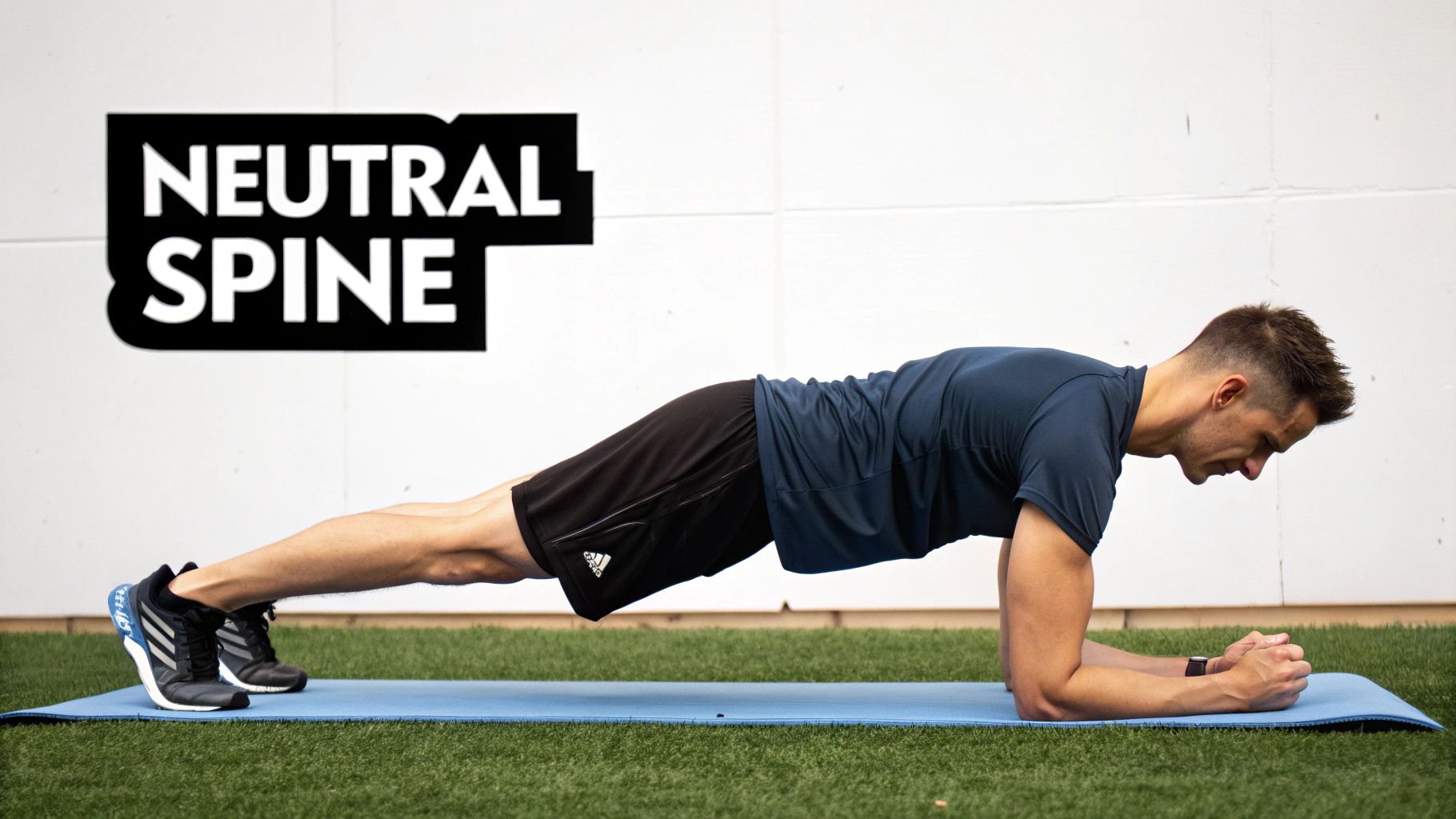
The dead bug might have a peculiar name, but it is one of the most effective exercises in an ab workout for runners. It’s a foundational movement that teaches your body a crucial skill: how to stabilize your core while your limbs are in motion. This directly mimics the coordinated, contralateral (opposite arm, opposite leg) pattern of running, making it exceptionally functional.
While high-intensity exercises build raw strength, the dead bug focuses on control, motor learning, and deep core activation. It strengthens the transverse abdominis and pelvic floor, muscles that are essential for maintaining a neutral spine and preventing the excessive lower back arching (lumbar extension) that can lead to pain and inefficiency on a run. By training your brain and body to keep your torso rock-solid while your arms and legs move, you build a foundation for a powerful and injury-resistant stride.
Why It's Essential for Runners
Running is a dynamic, coordinated movement. If your core can't provide a stable base, energy leaks out through unnecessary twisting and tilting of the pelvis. The dead bug directly combats this by teaching your core to resist extension and rotation. This stability allows for a more efficient transfer of force through your kinetic chain, meaning more power goes into propelling you forward and less is wasted on compensatory movements.
Famed strength coach Mike Boyle and physical therapist Gray Cook have championed the dead bug for its ability to correct faulty movement patterns and build "proximal stability for distal mobility." This means a stable core allows for free and powerful movement of the arms and legs.
This exercise is a staple in both physical therapy settings and elite athletic training programs. It's frequently prescribed by sports medicine doctors for preventing and rehabilitating common running ailments like IT band syndrome, as it reinforces proper pelvic control. Moreover, its principles are embedded in techniques like the Pose Method of running, which emphasizes using core strength to maintain optimal body alignment.
How to Perform the Perfect Dead Bug
The value of the dead bug lies in its precision. Slow, controlled movement is far more important than speed or the number of reps.
Setup: Lie on your back with your knees bent at a 90-degree angle and stacked directly over your hips (tabletop position). Extend your arms straight up towards the ceiling, directly over your shoulders.
Engagement: Actively press your lower back into the floor. You should feel your deep abdominal muscles engage. There should be no arch or space between your lumbar spine and the ground. This is the most critical part of the exercise.
Movement: Exhale slowly as you lower your opposite arm and opposite leg toward the floor. Move with deliberate control, going only as low as you can without your lower back arching away from the floor.
Return and Repeat: Inhale as you bring your arm and leg back to the starting position with the same slow control. Repeat on the other side. This completes one repetition.
Actionable Tips and Variations
The key to the dead bug is honest self-assessment. If you feel your back arching, you've gone too far. Reduce the range of motion until you can maintain perfect form.
Breathing is Key: Coordinate your breath with the movement. Exhale on the exertion (lowering your limbs) and inhale on the return. This helps maintain intra-abdominal pressure and stability.
Start Simple: If the full movement is too challenging, start by only lowering one leg at a time while keeping your arms stationary. Once you master that, progress to the full arm-and-leg movement.
Straight-Leg Progression: To increase the difficulty, perform the exercise with your legs extended straighter. This longer lever creates a greater challenge for your core to resist extension.
Add Resistance: Hold a light dumbbell in each hand or use resistance bands looped around your feet and hands to add another layer of challenge to this core-stabilizing movement.
Integrate the dead bug at the beginning of your core routine or as part of your warm-up. Performing 2-3 sets of 10-12 total repetitions (5-6 per side) will significantly improve your core control and translate to a more stable, efficient running form.
3. Russian Twists
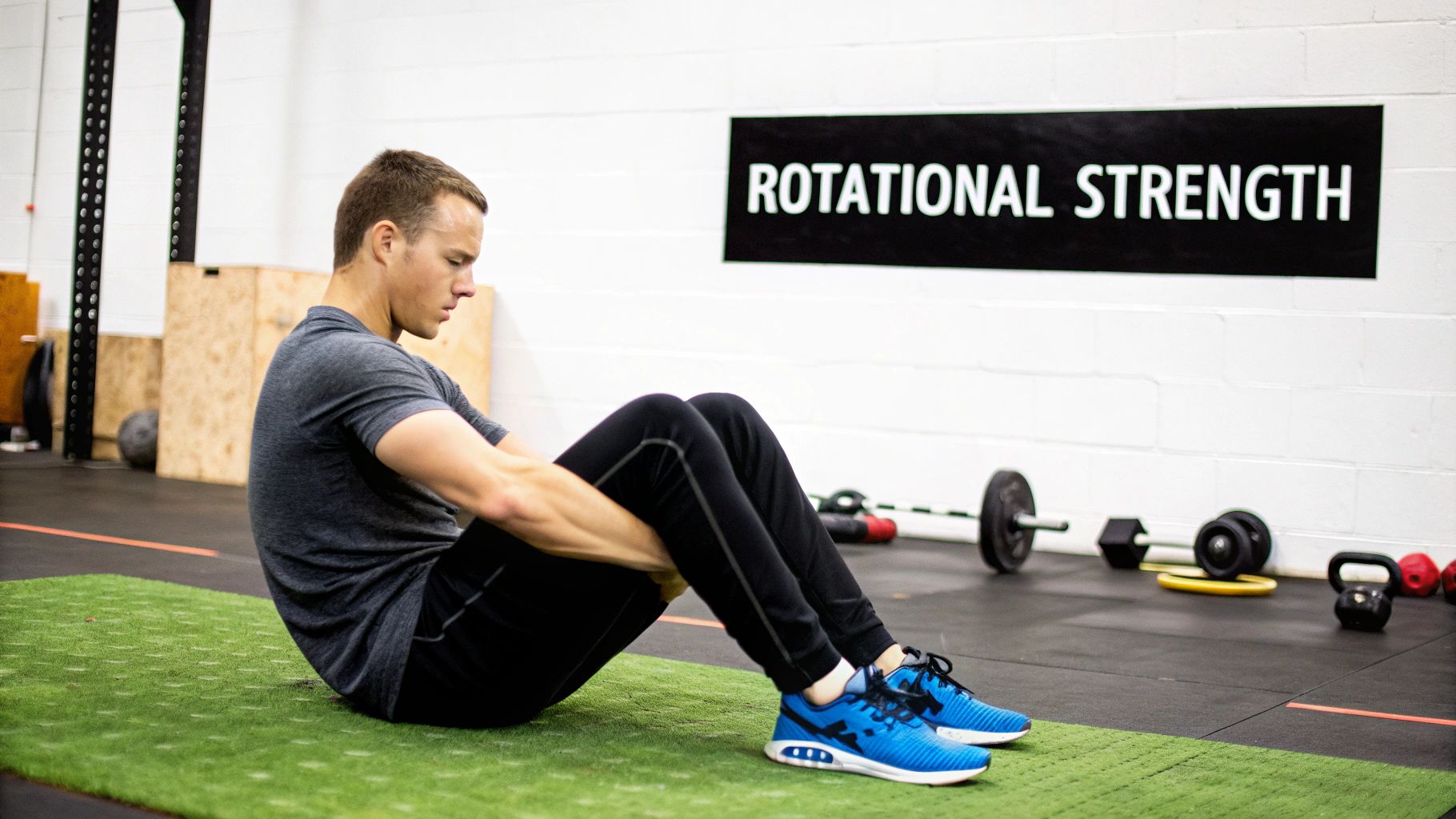
While planks build static endurance, the Russian Twist develops the dynamic, rotational strength crucial for an efficient running stride. This exercise is a cornerstone of a well-rounded ab workout for runners because it directly trains the obliques to control and resist excessive torso rotation. For runners, this translates into maintaining forward momentum and preventing energy leaks that can slow you down and lead to injury.
The twisting motion hones core stability in the transverse plane, which is the plane of movement for rotation. A strong, controlled core prevents your arms and legs from flailing, ensuring that all the power you generate is channeled into moving forward, not wobbling side-to-side. This is particularly vital for trail runners navigating uneven terrain or for any runner trying to maintain form during a finishing kick.
Why It's Essential for Runners
Every time you run, your body naturally rotates. Your arm swing counterbalances your leg stride. Without strong obliques and a stable core, this rotation can become excessive and inefficient. Russian Twists build the muscular control needed to manage this rotation, keeping your pelvis and trunk stable and aligned. This stability is key to preventing lower back pain and improving your running economy.
The rotational power and control developed by this exercise are not just for runners. Its origins trace back to Soviet athletic training, and it was popularized in modern fitness by programs like P9X and is a staple in MMA training, highlighting its effectiveness for developing a powerful, functional core.
Top-tier running programs recognize this benefit. Many collegiate cross-country teams feature Russian Twists in their strength circuits to build resilience against the high mileage. Likewise, running coaches frequently recommend them to marathoners and trail runners who need to maintain core integrity over long distances and varied surfaces.
How to Perform the Perfect Russian Twist
Proper form is critical to target the obliques and protect your lower back. Focus on controlled rotation, not speed.
Setup: Sit on the floor with your knees bent and feet flat on the ground. Lean back slightly until you feel your abdominal muscles engage. Your torso and thighs should form a V-shape.
Engagement: Clasp your hands together in front of your chest or hold a weight. Lift your feet off the floor for a greater challenge, or keep them on the ground for more stability.
Movement: Keeping your back straight and chest up, slowly twist your torso from side to side. Your head and arms should follow your torso. Focus on rotating from your ribs, not just swinging your arms.
Breathing: Exhale as you twist to one side and inhale as you return to the center. Maintain a steady, controlled breathing pattern throughout the exercise.
Actionable Tips and Variations
Start with the bodyweight version to master the form. Prioritize the quality of rotation over the number of reps or the amount of weight used.
Heels Down: If you're new to the exercise or have a sensitive lower back, keep your heels lightly touching the floor. This provides more stability and allows you to focus on the twisting motion.
Add Weight: Once you can perform 15-20 reps per side with perfect form, you can add a medicine ball, dumbbell, or kettlebell to increase the resistance and challenge.
Change Tempo: Slow down the movement to increase the time under tension, making your obliques work harder to control the rotation.
Straight-Leg Twist: For an advanced variation, straighten your legs to create a longer lever, significantly increasing the demand on your lower abs and hip flexors.
Incorporate Russian Twists into your ab workout 2-3 times per week to build the rotational strength that underpins a powerful and injury-resistant running form.
4. Bird Dog Exercise
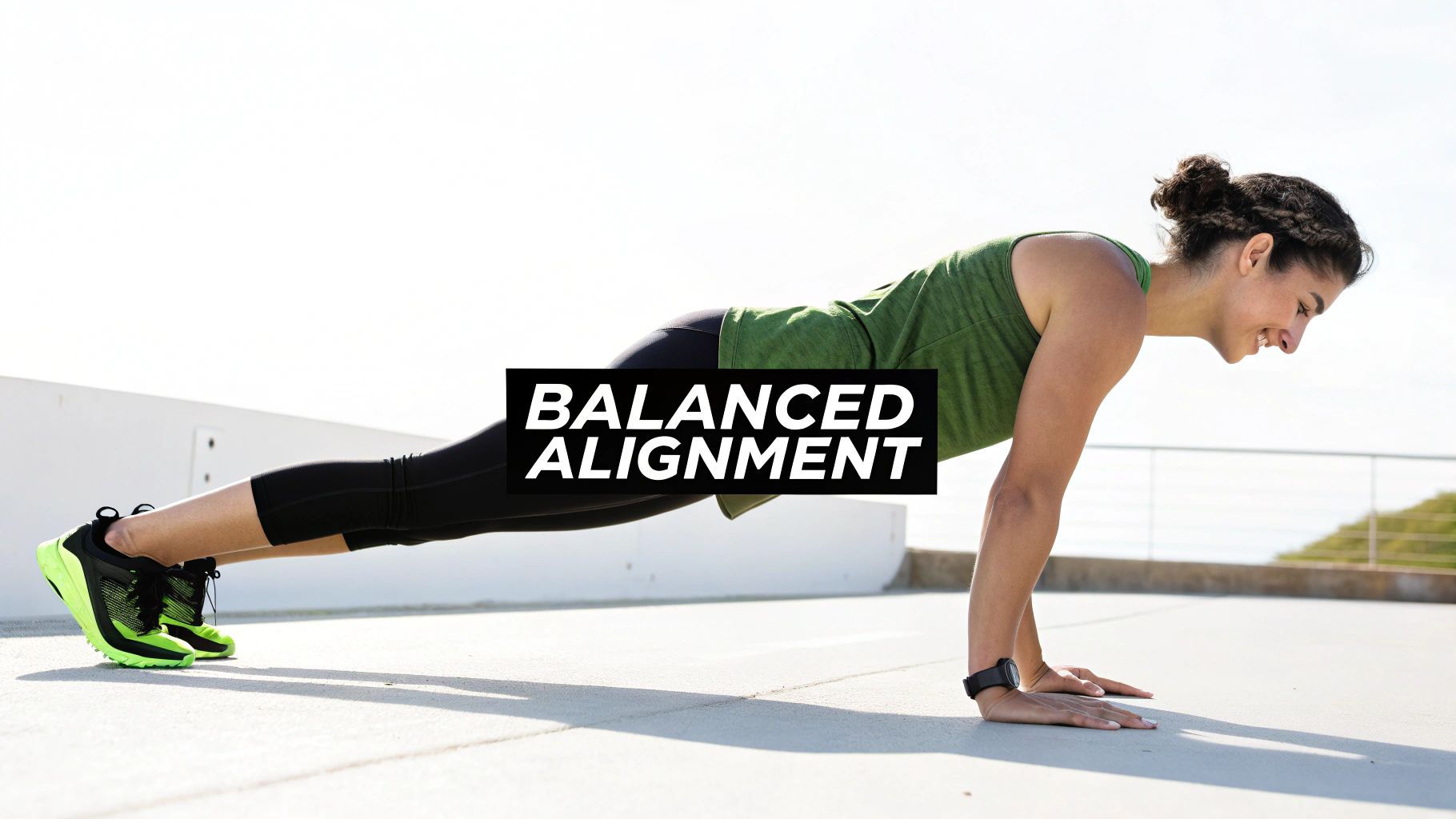
The Bird Dog exercise is a deceptive powerhouse in any runner's core routine. While it may look simple, its power lies in challenging your stability and coordination by moving opposite limbs simultaneously. This exercise is a fundamental part of a complete ab workout for runners because it directly mimics the contralateral movement pattern of running, where your left arm swings forward as your right leg drives, and vice versa. It trains the deep core muscles to stabilize the pelvis and spine while the limbs are in motion.
This controlled, low-impact movement is exceptional for building stability in the lumbar spine, glutes, and the entire posterior chain. Unlike high-intensity exercises, the Bird Dog focuses on deliberate control, teaching your core to fire correctly to prevent excessive torso rotation and pelvic tilt. Mastering this translates directly to a smoother, more efficient running gait where power isn't lost to unnecessary side-to-side or twisting motions.
Why It's Essential for Runners
Running is a series of single-leg stances. The Bird Dog enhances the body's ability to remain stable during these moments, building strength in the smaller, stabilizing muscles around the hips and lower back that are often neglected. This improved proprioception and stability are crucial for navigating uneven terrain and maintaining form when fatigue sets in, significantly reducing the risk of IT band syndrome, runner's knee, and lower back pain.
Physical therapist Gray Cook, a pioneer in functional movement screening, champions the Bird Dog for its ability to correct muscular imbalances and improve the "neural dialogue" between the core and limbs.
This exercise is a staple for a reason. Elite runners incorporate it into their daily warm-ups and activation routines to "wake up" the core and glutes before a run. You will also find it featured prominently in guided workouts on platforms like the Nike Training Club app, where it's used to build foundational, functional strength for athletes of all levels.
How to Perform the Perfect Bird Dog
Precision and control are more important than speed or range of motion. Slow, deliberate movements yield the best results.
Setup: Start on all fours in a tabletop position with your wrists directly under your shoulders and your knees directly under your hips.
Engagement: Brace your core by drawing your navel towards your spine. Create a flat, stable back, as if you could balance a glass of water on it.
Movement: Slowly and simultaneously extend your right arm straight forward and your left leg straight back. Keep your hips and shoulders square to the floor.
Form Check: Avoid arching your lower back or letting your hip on the lifted-leg side rotate open. Extend your arm and leg only as far as you can while maintaining a perfectly neutral spine. Keep your gaze directed down at the floor to maintain a neutral neck.
Hold and Return: Pause for a 2-3 second count at full extension, focusing on squeezing your glute. Slowly return to the starting position with control, then repeat on the opposite side (left arm, right leg). That's one repetition.
Actionable Tips and Variations
The goal is quality over quantity. Aim for 8-12 slow, controlled reps per side. As you get stronger, you can increase the challenge without compromising form.
Isometric Hold: Instead of moving through reps, simply hold the extended position on one side for 10-30 seconds, focusing on stability before switching sides.
Bird Dog Crunches: From the extended position, bring your elbow and knee together under your torso for a controlled "crunch," then extend back out. This adds a dynamic element.
Unstable Surface: For an advanced challenge, perform the exercise with your hands on a foam pad or your knees on a BOSU ball to dramatically increase the stability demand.
Band Resistance: Place a light resistance band around your feet or hands to add resistance to the leg lift or arm extension, further strengthening the glutes and shoulders.
5. Bicycle Crunches
While planks build static endurance, bicycle crunches introduce dynamic, rotational strength, making them a vital component of any well-rounded ab workout for runners. This classic exercise mimics the coordinated, cross-body movement pattern that is fundamental to the running gait, where your opposite arm and leg swing in tandem. This builds not just strength, but also crucial neuromuscular coordination.
Bicycle crunches simultaneously target the rectus abdominis (the "six-pack" muscles) and the internal and external obliques. This comprehensive engagement strengthens your core's ability to resist excessive torso rotation while running, creating a stable foundation that allows your hips and legs to generate power more efficiently. The result is a smoother, more powerful stride with less wasted energy.
Why It's Essential for Runners
Running is a series of controlled, alternating movements. A strong, coordinated core prevents energy leaks and maintains proper form, especially when fatigue sets in. Bicycle crunches directly train this cross-pattern stabilization, helping your body maintain its alignment and reducing the rotational stress placed on your lower back with every footstrike.
A study published by the American Council on Exercise (ACE) ranked the bicycle crunch as one of the most effective exercises for stimulating the rectus abdominis and the obliques, confirming its status as a powerhouse for core development.
This exercise is a staple in the conditioning programs of collegiate track and field teams and is frequently featured in group fitness classes designed for endurance athletes. Its ability to build both strength and motor control makes it invaluable for improving running economy and preventing injuries related to poor core stability, such as IT band syndrome and lower back pain.
How to Perform the Perfect Bicycle Crunch
Proper form is critical to maximize the benefits and avoid straining your neck or back. The goal is controlled rotation, not speed.
Setup: Lie on your back with your knees bent and feet flat on the floor. Place your hands lightly behind your head with your elbows pointing out to the sides.
Engagement: Lift your knees to a 90-degree angle (tabletop position) and lift your shoulder blades off the floor. Engage your abs to press your lower back gently into the mat.
Movement: Slowly begin a "pedaling" motion. As you straighten your right leg, bring your right elbow towards your left knee. Pause briefly, then switch sides, bringing your left elbow towards your right knee as you straighten your left leg.
Form Check: Avoid pulling on your neck with your hands; they are there for light support only. The rotation should come from your torso, not just your elbows. Keep your core braced and your lower back close to the floor throughout the movement.
Breathing: Exhale as you twist and bring an elbow to a knee. Inhale as you return to the center before switching sides. A steady breathing rhythm prevents you from holding your breath and helps power the movement.
Actionable Tips and Variations
Focus on a slow, deliberate tempo. Aim for 2-3 sets of 12-20 repetitions per side, prioritizing perfect form over high numbers. As you get stronger, you can increase the challenge.
Slow-Motion Bicycle Crunches: Perform the exercise as slowly as possible. This increases the time under tension, forcing your obliques and abs to work significantly harder to control the movement.
Elevated Bicycle Crunches: Perform the exercise on a decline bench. This increases the range of motion and the gravitational challenge on your upper abs.
Focus on the Twist: A common mistake is simply bringing the elbow to the knee. Instead, focus on lifting your shoulder blade off the floor and rotating your entire torso. This ensures the obliques are doing the work.
Maintain Elevation: Challenge yourself to keep your feet and shoulder blades off the ground for the entire set. This maintains constant tension on the core muscles.
Integrating bicycle crunches into your routine 2-3 times per week will build the dynamic, rotational strength needed to support a more stable and efficient running form.
6. Mountain Climbers
Mountain climbers are a powerhouse exercise in any ab workout for runners because they uniquely blend core stabilization with cardiovascular conditioning. This dynamic movement, performed from a plank position, directly mimics the knee-drive action of running. It challenges your core to remain locked and stable while your legs move rapidly, building the kind of strength that supports powerful, efficient running form.
More than just a standard crunch, mountain climbers recruit the entire core system. The rectus abdominis and transverse abdominis work to keep your torso from rotating or sagging, while the obliques fire to control lateral movement. At the same time, this exercise elevates your heart rate, improving cardiovascular endurance and simulating the metabolic demands of a tough run. This dual benefit makes it an incredibly efficient addition to your training schedule.
Why It's Essential for Runners
For runners, mountain climbers train the core to function as it does during a run: dynamically. Your core’s job is to provide a stable base while your legs and arms are in motion. By challenging this exact function, mountain climbers improve your ability to maintain a strong posture, especially when you start to fatigue. This stability helps you maintain an efficient stride and a powerful leg turnover rate.
The explosive nature of mountain climbers also helps develop hip flexor strength and speed, which are critical for generating power and improving running cadence or the number of steps you take per minute.
This exercise is a staple in high-intensity interval training (HIIT) circuits for athletes for a reason. Track athletes use it to enhance explosive speed, while military and firefighter fitness tests feature it to assess total-body conditioning and core endurance. Its inclusion in these demanding programs highlights its effectiveness for building functional, performance-oriented fitness.
How to Perform the Perfect Mountain Climber
Proper form is crucial to maximize the core benefits of mountain climbers and prevent strain on the lower back.
Setup: Begin in a high plank position with your hands directly under your shoulders, arms straight. Your body should form a rigid, straight line from your head to your heels.
Engagement: Brace your core and engage your glutes. This is the foundation of the movement and must be maintained throughout.
Motion: Drive your right knee towards your chest, keeping your back flat and your hips low. Return the right foot to the starting position as you simultaneously drive your left knee towards your chest.
Rhythm: Continue alternating knees in a controlled "running" motion. Find a rhythm you can maintain without sacrificing your plank form.
Breathing: Breathe steadily. Exhale as you drive a knee forward and inhale as you return it. Avoid holding your breath.
Actionable Tips and Variations
Start by focusing on control rather than speed. Aim for a set duration (e.g., 30 seconds) or a specific number of reps (e.g., 20 per side). Once you have mastered the form, you can increase the intensity.
Focus on Stability: The primary goal is to keep your hips level and avoid bouncing up and down. Imagine a glass of water on your lower back that you don't want to spill.
Knee Drive: Drive your knees straight toward your chest, not out to the sides. This ensures you are targeting the correct abdominal and hip flexor muscles.
Modify for Beginners: If maintaining a plank is too challenging, perform the exercise with your hands elevated on a stable bench or box. This reduces the load on your core, allowing you to focus on the movement pattern.
Cross-Body Mountain Climbers: Drive your right knee toward your left elbow, and vice versa. This variation places a greater emphasis on the obliques, improving your rotational control.
Incorporate mountain climbers into your routine 2-3 times per week, either as a standalone exercise or as part of a larger circuit. They are an excellent way to build a powerful, responsive core that will propel your running to the next level.
Ab Workout Exercises Comparison for Runners
Exercise | Implementation Complexity 🔄 | Resource Requirements ⚡ | Expected Outcomes 📊 | Ideal Use Cases 💡 | Key Advantages ⭐ |
|---|---|---|---|---|---|
Plank with Variations | Moderate - requires proper form | None | Builds core endurance, improves posture & stability | Core stabilization, endurance training | Versatile, low-impact, improves running posture |
Dead Bug Exercise | Low - beginner friendly | None | Enhances core-limb coordination, neutral spine control | Rehabilitation, motor control, beginners | Scalable, mimics running pattern, injury prevention |
Russian Twists | Moderate - requires control | Optional weights | Develops rotational strength and thoracic mobility | Rotational power, agility, trail running | Builds oblique strength, easy to progress with weight |
Bird Dog Exercise | Low to moderate - form focused | None | Unilateral strength, balance, hip-core integration | Correcting imbalances, stability training | Low impact, improves proprioception and posture |
Bicycle Crunches | Moderate - dynamic coordination | None | Builds strength, endurance, and cross-pattern motion | Core strength & endurance, coordination | Targets multiple muscles, efficient, no equipment |
Mountain Climbers | High - intense and fast paced | None | Combines core strength with cardio, improves cadence | HIIT, aerobic fitness, sprint preparation | Builds endurance and aerobic capacity, functional |
Integrating Core Work Into Your Running Schedule
Crossing the finish line of this guide, you now possess a powerful toolkit of exercises specifically chosen to forge a stronger, more resilient core. We've moved beyond generic sit-ups and explored a comprehensive ab workout for runners that targets every crucial muscle group. From the deep transverse abdominis engaged during a perfect Plank to the rotational power honed with Russian Twists and the stabilizing control mastered through the Dead Bug, each exercise serves a distinct purpose in your athletic development.
The journey from understanding these movements to seeing tangible results on your runs hinges on one key element: intelligent integration. A sporadic, half-hearted approach will yield minimal gains. True transformation requires a thoughtful, consistent plan that complements your existing running schedule without causing burnout or overtraining. The goal is to build a core that supports your running, not a routine that detracts from it.
Crafting Your Core Training Blueprint
Think of this core routine as a non-negotiable part of your training, just like your long runs or speed work. The key is finding a sustainable frequency and timing that works for you.
Frequency: Aim for two to three dedicated core sessions per week. This provides enough stimulus for muscle adaptation and strength gains while allowing for adequate recovery. Performing these on non-consecutive days, for instance, Tuesday and Friday, is ideal.
Timing is Everything: You have a few strategic options for scheduling your ab workout for runners. * Post-Run Power-Up: Tacking your core session onto the end of an easy or moderate run is highly efficient. Your body is already warm and primed for movement, making it an excellent time to focus on strength. * Dedicated Strength Day: If you have a cross-training or strength-focused day, this is the perfect place for your core routine. You can perform it with more energy and focus than you might have after a tough run. * Active Recovery: On your rest or active recovery days, a light core session can be beneficial. It can help increase blood flow and maintain muscle engagement without adding significant stress to your system.
Progressive Overload: The Path to a Stronger Core
Your core, like any other muscle group, needs to be progressively challenged to grow stronger. Sticking with the same number of reps and sets indefinitely will lead to a plateau. To keep making progress, you must apply the principle of progressive overload.
Key Takeaway: True strength isn't built in a single workout. It's the cumulative effect of consistent effort and strategic progression over weeks and months. Your core routine should evolve as you get stronger.
Here’s how to apply this to the exercises we've covered:
Increase Duration: For static holds like the Plank, focus on gradually increasing your hold time. Start with 30 seconds and work your way up to 60 or 90 seconds with perfect form.
Add Repetitions: For dynamic movements like Bicycle Crunches or Bird Dogs, aim to increase the number of repetitions per set. Once you can comfortably complete 15-20 reps with flawless technique, it's time to make it harder.
Introduce Variations: The most effective way to progress is by moving to more challenging variations. If the standard Plank becomes easy, try the Plank with a leg lift. Once Russian Twists are manageable, add a light weight. This ensures you are continually challenging your stability and strength.
Ultimately, a dedicated ab workout for runners is one of the most significant investments you can make in your running performance, longevity, and overall health. A strong, stable core is your secret weapon against injury, your power source for hill climbs, and your anchor for maintaining efficient form when fatigue sets in. By integrating these exercises into your weekly routine and committing to consistent, progressive effort, you are not just building abs; you are building a foundation for becoming a faster, more durable, and more confident athlete.
Elevate your training and recovery with gear designed for peak performance. The supportive, moisture-wicking fabrics from RealOminousAthlete provide the comfort you need to power through every rep of your core workout and every mile of your run. Shop our collection and feel the difference that premium athletic wear can make: RealOminousAthlete.


Comments