
Mental Training for Athletes: Boost Focus, Confidence & Resilience

When you hear "mental training," it's easy to think of abstract concepts. But in reality, it’s the concrete practice of building up psychological skills to boost your performance, handle the immense pressure of competition, and become more resilient. It’s about using proven techniques like visualization, self-talk, and goal-setting to forge a stronger, more focused mindset. This isn't just an add-on; it's as crucial as your physical conditioning for hitting your peak potential.
The Unseen Advantage: How Mental Training Shapes Elite Athletes

When we watch the greats compete, we're seeing the spectacular results of endless hours spent in the gym, on the track, or on the field. What we miss is the equally intense training that happens inside their heads. This is the heart of mental training for athletes—a deliberate, structured approach to building psychological fortitude that turns raw talent into consistent, clutch performance.
It's that hidden edge that lets a point guard drain a buzzer-beater or a tennis player save a match point. Don't think of it as a bonus. It’s a fundamental pillar of preparation, standing right alongside strength, conditioning, and nutrition.
Why Mental Skills Are the Real Game-Changer
At the highest levels of sport, physical abilities often cancel each other out. When you have two athletes with nearly identical speed, strength, and technical prowess, the contest is often won in the mind. Who stays locked in after a mistake? Who keeps their self-belief intact when things start going wrong?
The edge comes from mental toughness. And no, this isn't some innate quality you're either born with or not—it's a set of skills you can train and develop. In fact, studies have shown that athletes who intentionally build their mental toughness don't just perform better; they also report lower stress and better sleep. As detailed in an article from Trine University on mental toughness, this conditioning is directly tied to an athlete's drive and overall psychological well-being.
Ultimately, the real power of mental training is that it unlocks the physical potential you've worked so hard to build. It helps you win the internal battles that can tank your performance before the competition even has a chance.
Mental training closes the gap between what you can do in practice and what you actually deliver when the lights are brightest. It builds the bridge from talent to achievement.
Core Pillars of Mental Training
To really get a handle on what a strong mental game looks like, it helps to break it down. It isn't one single superpower but a collection of skills that all work together. Each one plays a specific role in creating a more focused and resilient competitor.
These are the fundamentals that every solid mental training program is built on. Each skill addresses a different psychological challenge you'll face as an athlete.
Mental Skill | Core Function | On-Field Benefit |
|---|---|---|
Focus Control | Directing attention to what matters and blocking out distractions. | Ignoring crowd noise to sink a free throw; resetting after a bad play. |
Emotional Regulation | Managing feelings like anger or anxiety to stay in control. | Shaking off a bad call from a referee without losing your cool. |
Self-Belief | Maintaining deep confidence in your abilities, even after setbacks. | Stepping up for a penalty kick with confidence, despite a previous miss. |
Pressure Management | Staying calm and executing your plan when the stakes are highest. | Performing your best in a championship game instead of "choking." |
Mastering these skills is what mental training for athletes is all about. It's a proactive process of building mental armor. You're ensuring your mind becomes your greatest asset, not your biggest liability.
Building Your Mental Training Foundation
Getting started with mental training can feel like a massive undertaking, but the truth is, the first few steps are often the most powerful. A solid foundation isn’t built on abstract psychological theories; it’s built on simple, practical tools you can start using right away. This is where you stop wishing you were more focused and start actively training your mind to be exactly that.
The immediate goal is all about building awareness. You can't fix what you don't even notice. Start paying close attention to your internal state during practice, competition, and even recovery. What thoughts immediately pop into your head after a mistake? How does your body physically react to pressure? This honest self-assessment is the real starting line for any effective mental training.
Transform Vague Goals into Powerful Fuel
Every athlete wants to "get better." It's a universal desire, but on its own, it's useless. It's too vague, giving you no real direction and no way to know if you're actually making progress. The cornerstone of a strong mental game is sharpening those fuzzy wishes into concrete, actionable goals. This is where the SMART framework is invaluable.
You’ve probably heard of it, but it’s popular for a reason. It forces you to get crystal clear on what you want and how you'll get there.
Specific: What, exactly, are you trying to accomplish? "Improve my free throws" becomes "Increase my free-throw percentage during games."
Measurable: How will you track it? "Increase my free-throw percentage by 5%."
Achievable: Is this realistic? A 5% jump is tough but doable. A 50% jump is probably setting yourself up for failure.
Relevant: Does this actually matter for your overall performance? For a basketball player, better free-throw shooting is always relevant.
Time-Bound: What’s the deadline? "Increase my free-throw percentage by 5% over the next two months."
Suddenly, a passive hope becomes an active mission. You have a target, a timeline, and a clear benchmark for success.
Master Your Internal Dialogue
Think of your self-talk as the running commentary inside your head. It’s always on, and it directly impacts how you perform. When that voice is negative—"I always blow it in these situations," or "I just can't get this right"—it creates a nasty downward spiral of doubt and poor execution. Foundational mental training is all about learning to catch and reframe those destructive thoughts.
This isn’t about lying to yourself with blind positivity. It's about shifting to productive, realistic self-talk. Miss a shot? Instead of beating yourself up, give yourself a quick, technical cue: "Okay, my follow-through was short. Next one, I extend all the way." This keeps your brain focused on the solution, not stuck on the problem.
Your mind will believe whatever you tell it most. Feed it strength. Feed it truth. Feed it resilience. Your performance will follow.
The journey to becoming an expert in any sport is incredibly complex, demanding both physical and mental dedication. The growing emphasis on sports psychology proves this. By 2015, over 70% of professional sports teams in major markets had hired sports psychologists, recognizing that mental skill is a non-negotiable part of elite performance. You can learn more about this journey in this insightful guide on sports development.
Develop Simple Focus Cues
In the heat of competition, your attention gets pulled in a thousand different directions—the crowd, the score, the last play, what your coach will say. A focus cue is a simple word or short phrase that acts as a mental anchor, instantly yanking your attention back to the present moment.
Your cues need to be personal, short, and action-oriented. For example:
A tennis player might think "bounce" between points to stay light on their feet and ready.
A golfer standing over a critical putt could use the word "smooth" to encourage a fluid, tension-free stroke.
A basketball player at the foul line might say "rhythm" to themselves to kickstart their trusted shooting routine.
The key is to practice these cues relentlessly during training. The more you connect the word to the physical and mental state you want, the more it will work for you on autopilot when the pressure is on. This is how you lay the groundwork for a truly resilient mind.
Advanced Techniques for High-Pressure Situations

When the game is on the line, basic mental skills get you into the arena. But it’s the advanced mental training for athletes that truly lets you win once you’re there. The ability to not just cope but actively thrive in those make-or-break moments is what separates the good from the great.
This is where we move past simply managing stress and start proactively shaping your performance before it even happens. Let’s get into the specific techniques that build a mental fortress against pressure, allowing your best self to show up when it counts the most.
Mastering Multisensory Visualization
I've seen it time and again: athletes think visualization is just about picturing a good outcome. It’s so much more than that. Elite performers don’t just see the ball going in; they feel it leave their fingertips, hear the swish of the net, and smell the gym.
This technique, often called mental rehearsal, uses all your senses to forge a vivid mental blueprint. The amazing thing is, the brain struggles to tell the difference between a powerfully imagined experience and a real one. This means you can build and strengthen the neural pathways for success without ever taking a single physical shot.
So, how do you make this practical? Don't just "see" yourself nailing that game-winning free throw. Instead, close your eyes and bring every sense to the party:
Feel: The specific grain of the basketball in your hands, the solid connection of your feet to the floor, the perfect snap of your wrist.
Hear: The low hum of the crowd, the squeak of your shoes as you set your feet, and that unmistakable swoosh as the ball goes through.
See: The bright orange of the rim against the backboard, your focal point on the foul line, the beautiful arc of the ball.
Smell: The faint, familiar scent of hardwood and sweat—the smell of the game.
This sensory-rich approach makes the rehearsal incredibly potent. You're essentially programming your mind and body for flawless execution under duress. Why? Because in your mind, you've already done it perfectly a thousand times.
Crafting a Bulletproof Pre-Performance Routine
Pressure and anxiety love chaos. They feed on uncertainty. Your best defense is a consistent, well-practiced pre-performance routine. Think of it as creating a bubble of familiarity and control, no matter how wild the environment gets. This isn't about superstition; it's a deliberate sequence of actions designed to trigger your peak performance state.
A truly effective routine has two critical parts: physical cues and mental triggers.
Component | Purpose | Example for a Soccer Player Before a Penalty Kick |
|---|---|---|
Physical Cues | Simple, repeatable actions that ground you and signal to your brain that it’s go-time. | Taking three deliberate steps back from the ball, placing it seam-up, and taking one deep, centering breath. |
Mental Triggers | A focus word or quick mental image that locks in concentration and reinforces confidence. | Silently repeating the word "corner" to direct focus and briefly seeing the net bulge as the ball hits it. |
This combination is powerful because it short-circuits the body's natural panic response. By shifting your focus to your small, controllable routine, you block out the overwhelming external noise—the score, the crowd, the stakes—and anchor yourself in a process you absolutely trust.
"A pre-performance routine doesn’t guarantee a perfect outcome, but it guarantees you'll be in the best possible mental state to achieve one. It replaces hope with focused intention."
Embracing Pressure With a Growth Mindset
The final, and perhaps most critical, piece of the puzzle is a fundamental shift in perspective. Most athletes are conditioned to see pressure as a threat—something to be feared or just barely survived. The best performers I’ve worked with have learned to reframe it as an opportunity.
It’s a chance to showcase their skill. A chance to compete at their highest level. A chance to do something memorable. This mindset—the growth mindset—views challenges not as threats, but as chances to get better.
Instead of the all-too-common thought, "Please don't mess this up," the reframe becomes, "This is exactly why I practice. This is my moment." That simple switch in your internal dialogue can change your entire physiological response, turning crippling anxiety into focused, useful energy.
This shift is vital. As sports psychology experts like Robert B. Andrews point out, an athlete’s reaction to stress can either destroy or build performance. Reactive habits, like slumping your shoulders after a mistake, are performance killers. By consciously choosing to see pressure as an exciting challenge, you build resilience and sidestep those destructive patterns entirely.
This level of mental training isn't a quick fix. It takes consistent, deliberate work. But by weaving in deep visualization, building a rock-solid routine, and fundamentally changing how you see pressure, you give yourself the tools to not just face high-stakes situations, but to own them.
Using Technology to Sharpen Your Mental Edge
Technology isn't just for tracking your 40-yard dash anymore. It’s now one of the most powerful tools in an athlete's arsenal for building mental toughness. The world of mental training for athletes has exploded with tech that can provide a real, measurable advantage. These aren't just flashy gadgets; they are practical instruments that can fast-track your mental skills development.
Think about it this way: instead of just hoping you can stay calm under pressure, you can now see exactly what's happening inside your body with real-time data and learn, concretely, how to control it. This is what turns mental training from a fuzzy idea into a focused, data-backed discipline.
From Biofeedback to Virtual Reality
Let's get practical. Picture a basketball player who struggles with free throws in the final minutes of a game. They can use a small biofeedback sensor clipped to their ear or finger to monitor their heart rate variability (HRV). As they practice their breathing techniques at the line, an app on their phone gives them immediate visual proof when they shift into a calmer, more focused physiological state.
This is active training, not just wishful thinking. The player starts to connect the feeling of being in the zone with the objective data on the screen. They're no longer guessing if they're relaxed—they know. They've trained themselves to find that state on command.
Now, imagine a young quarterback who needs to learn how to read a blitz without getting flattened in practice. With a virtual reality (VR) headset, they can stand in the pocket and face an elite NFL-level pass rush hundreds of times. They get all the mental reps of making reads and decisions, but in an environment where the only consequence of a mistake is a lesson learned.
Reps without the risk: VR is a game-changer for high-volume mental practice, especially for skill positions where physical reps are limited.
Pressure on demand: You can scale the difficulty, allowing an athlete to master one challenge before moving on to the next, building confidence along the way.
Immediate learning: The simulation provides an instant outcome for every decision, creating a tight, rapid feedback loop that accelerates learning.
For an athlete, this kind of tech is like a mirror for the mind. It reflects what’s really going on inside, so you can make precise adjustments that directly translate to better performance.
Making Technology Work for You
The market is flooded with apps and wearables, but the secret is choosing tools that directly support your specific mental goals. Don't fall into the trap of collecting data just for the sake of it. The goal is to use that information to make your training smarter. Even a simple wearable that tracks sleep quality can reveal how your recovery habits are impacting your focus and emotional control the next day.
This tech-driven approach is a huge reason for the recent boom in sports psychology. While the field has deep roots, the late 20th and early 21st centuries saw the introduction of biofeedback, neurofeedback, and VR. By 2020, these were no longer experimental—they were standard issue for many elite programs, producing significant gains. You can explore a brief history of sports psychology's evolution to understand how we got here.
Here’s a quick look at how different athletes might put this into practice:
Athlete Type | Technology Example | Practical Application |
|---|---|---|
Golfer | EEG Neurofeedback Headset | Trains the brain to produce and hold calm, focused "alpha waves" in the critical moments right before a putt. |
Swimmer | Mindfulness & Meditation App | Uses guided audio sessions to lower stress hormones, sharpen focus, and mentally rehearse a race plan during recovery periods. |
Tennis Player | Monitors sleep and recovery scores to help decide when to push harder or ease off, preventing mental burnout during a grueling tournament. |
At the end of the day, technology is an amplifier. It doesn't do the work for you. What it does is provide the crucial feedback and controlled environments to make your mental training for athletes more efficient and incredibly effective. It turns guesswork into a precise, targeted way to build your skills.
Integrating Mental Skills Into Daily Practice
It's one thing to know what visualization is, but it’s another thing entirely to have it ready to go, instinctively, when the pressure is on. The best mental training for athletes isn't another item on your to-do list. Think of it as an amplifier, woven directly into your physical work, that makes every single drill, sprint, and recovery session count for more.
This is how mental skills go from being ideas you read about to habits that drive your performance. It’s about getting your mind to work with your body while you’re grinding, not just thinking about it in the locker room afterward.
Make Practice Your Mental Gym
Your regular training sessions are the perfect laboratory for mental conditioning. Think about those moments in a tough drill when your body is screaming at you to stop. That’s a golden opportunity to sharpen your focus and emotional control, not just go through the motions. You have to build mental muscle right alongside the physical.
A basketball player running conditioning sprints, for example, can use that last, lung-burning sprint to lock in on a focus cue. As fatigue creeps in and their form starts to fall apart, repeating a simple, powerful word like "drive" or "finish" can keep their intensity and technique sharp. This forges a direct link between mental grit and physical output.
In the same way, a swimmer can dedicate the last 200 meters of a punishing set to pure visualization. While their arms are burning, they can vividly imagine themselves in a tight race—feeling the water, hearing the roar of the crowd, and absolutely nailing a perfect turn and finish. Practicing like this under real physical stress makes the skill infinitely more reliable on race day.
The image below lays out a simple, repeatable flow for making this a core part of your process.
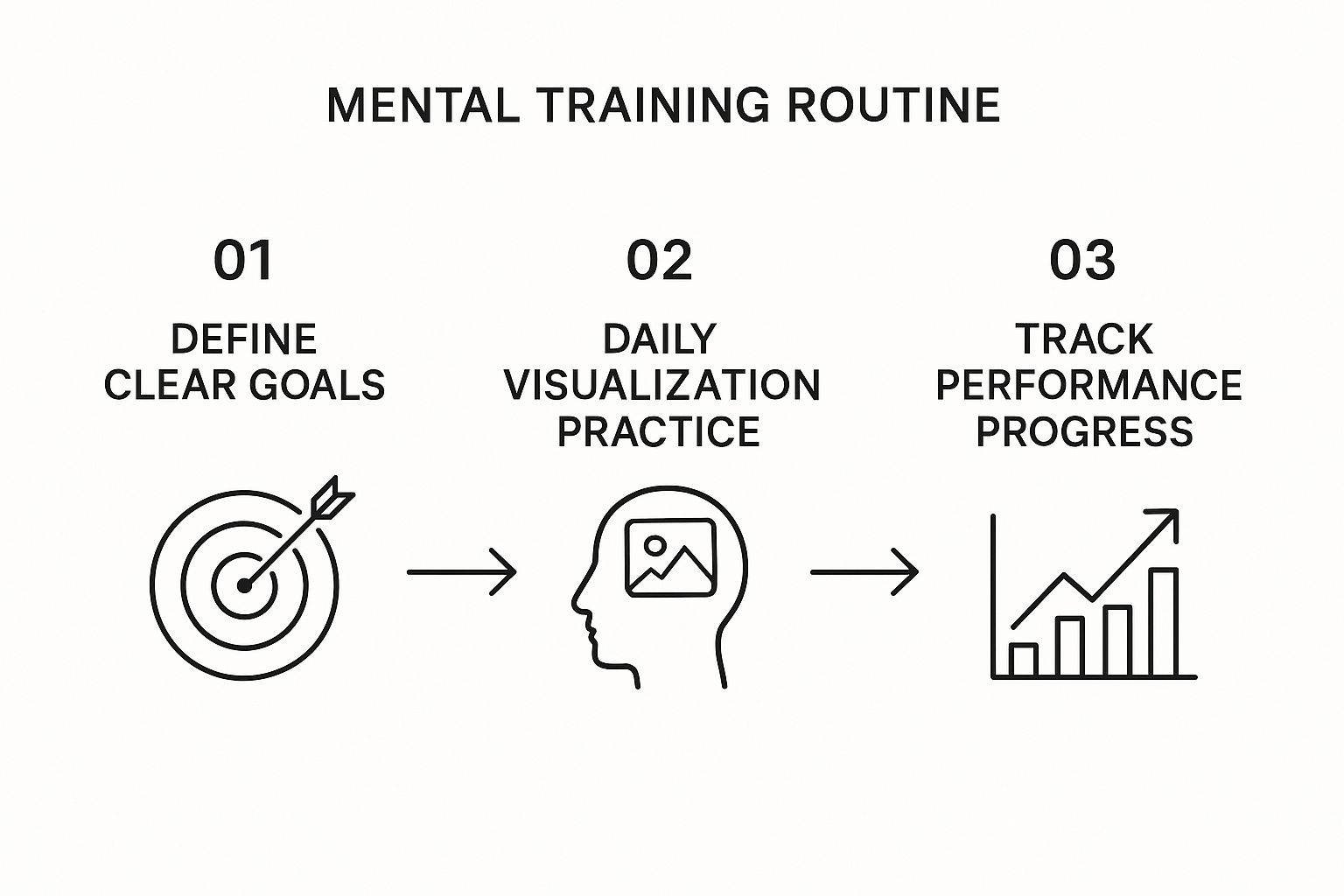
This isn’t random. As the flow shows, effective mental training is a cycle: you set a clear intention, you practice it daily, and you track what’s working so you can refine your approach.
Weave Mental Skills into Warm-Ups and Cool-Downs
The minutes just before and after your main workout are prime real estate for mental training. We often treat these as throwaway time, but they can set the entire tone for your session and help lock in the day’s lessons.
Don't just use your warm-up to get your muscles loose; use it to set a clear mental purpose for the practice ahead. Instead of just going through the motions of stretching, take two minutes for some deep, diaphragmatic breathing. Center yourself and pick one specific goal for the session, like "sharp cuts" or "quick decisions."
Your cool-down is just as critical. It’s the perfect time to use visualization to reinforce success. As you stretch, mentally replay a moment from practice where you executed a skill perfectly. Feel the movement again in your mind's eye, cementing that positive neural pathway. You’re solidifying the connection between what you just did physically and how you want to perform every time.
Mental training isn't something you do *in addition* to practice. It's something you do *during* practice to make every minute count.
Sample Weekly Mental Training Integration Plan
Seeing how this all fits into a full week can make it feel much more achievable. The trick is to attach a small, specific mental exercise to something you're already doing. This isn't about adding hours to your schedule; it's about adding intention to your minutes.
Here's a sample plan showing how you can layer these exercises into a typical training week without it feeling like a burden.
Day | Physical Focus | Mental Training Integration (15-20 mins) |
|---|---|---|
Monday | High-Intensity Drills | During drills, practice focus cues (e.g., "explode," "low") when fatigue hits. During the cool-down, spend five minutes on deep breathing to lower your heart rate and calm your nervous system. |
Tuesday | Technical Skill Work | Before practice, use 5-minute visualization to mentally rehearse the specific skill you're working on, focusing on perfect form and execution. |
Thursday | Scrimmage/Game Sim | Use your pre-performance routine before the scrimmage starts. After, take five minutes to write down one thing that went well mentally (e.g., staying calm after a mistake) and one thing to improve. |
Friday | Light Recovery/Active | Practice a 10-minute mindfulness body scan to check in with your body, notice any soreness or tightness without judgment, and promote mental and physical recovery. |
Sunday | Full Rest Day | Dedicate 15 minutes to goal setting. Review your progress from the past week and set one or two clear, specific process goals for the upcoming week of training. |
This schedule helps embed these skills into your daily habits. Eventually, they stop feeling like exercises and simply become part of who you are as a competitor. This consistent, integrated approach is what builds a mind that is as tough, resilient, and well-conditioned as your body.
Answering Your Questions About Mental Training

As mental training for athletes moves from the sidelines into the spotlight, I hear a lot of the same practical questions from competitors. Athletes everywhere, from high school standouts to seasoned pros, are curious about how this all works in the real world. They're ready to get past the theory and understand the nuts and bolts.
Let's cut through the noise and tackle those questions head-on. Here are some straightforward answers to help you see how mental skills can become your biggest asset.
How Long Does It Take to See Results?
This is usually the first thing athletes want to know. And it's a fair question. While you might feel a flicker of clarity or focus after a single goal-setting or visualization session, real, lasting change takes time.
Think of it like building physical strength—you don’t hit the gym once and walk out with a new personal best. It's a gradual process.
You can expect to see small, tangible shifts within a few weeks of consistent practice. Maybe you bounce back from a mistake a little quicker or your pre-game jitters feel more manageable. For these skills to become second nature, though—to be automatic under pressure—you're looking at a commitment of several months. You're literally building new pathways in your brain, and that takes reps.
Is This Only for Professional Athletes?
Absolutely not. This is probably the biggest myth out there. While pros often have sports psychologists on staff, the principles of mental training for athletes apply to everyone, at every level. In fact, getting these tools in place early can give a young athlete a massive advantage.
Just picture it:
A high school basketball player using breathing exercises to sink a game-winning free throw.
A college runner using positive self-talk to grind through the last mile of a brutal workout.
A weekend golfer using a solid pre-shot routine to finally break 90.
Mental skills aren’t reserved for the elite. They’re for anyone who wants to handle pressure, build unshakeable confidence, and see what they're truly capable of.
How Does Mental Training Help With Injury Recovery?
An injury can be psychologically crushing for an athlete. The road back isn't just about physical healing; it's a mental war against frustration, doubt, and fear. This is where mental skills are an absolute game-changer.
For many athletes, coming back from a severe injury is a terrifying ordeal. They have been cleared to play physically, but their fear of suffering another injury can be debilitating. This fear can cause serious complications with their return to play.
Visualization is a perfect example. An injured athlete can mentally rehearse their movements, keeping those neural connections firing even when they can't physically practice. This makes the return to play feel far less foreign.
Goal-setting also becomes critical. Instead of obsessing over the distant goal of being "100%," you can set small, weekly wins—like hitting a new range of motion or finishing a rehab exercise without pain. This builds momentum and a sense of control when everything feels chaotic. Honestly, managing the mental side of recovery is often what separates an athlete who returns with confidence from one who is plagued by hesitation.
What If I Don't Feel "Mentally Weak"?
The phrase "mental training" can unfortunately sound like it's for athletes who have a "problem." This couldn't be more wrong. The world's best athletes are constantly working on their mental game.
They don't do it because they're weak; they do it to get even stronger. It’s about sharpening an already sharp blade. Michael Jordan had a sports psychologist. Kobe Bryant did, too. They saw mental training as a performance tool, no different than lifting weights or studying film.
The key is to see this as proactive, not reactive. It’s about going from good to great, and from great to unstoppable. Every single athlete has room to improve their focus, resilience, and confidence—no matter how mentally tough they already are.
At RealOminousAthlete, we know that a powerful mindset is the ultimate game-changer. Our gear is built for athletes who understand that victory is first won in the mind. Build your mental edge and find gear that matches your ambition by exploring our collection at https://bearcapes.store.


Comments