
How to Prevent Running Injuries: Proven Strategies for Safe Running

Running injuries aren't a matter of if, but when for far too many of us. But it doesn't have to be that way. The secret to a long, healthy running life isn't some magic pill or fancy gadget; it's about being smarter than the average runner and adopting a proactive approach that balances the stress of training with deliberate recovery.
It really boils down to listening to your body, building real-world strength, and being patient with your progress.
Why Most Runners Get Injured (And How You Can Be Different)
The beautiful simplicity of running is also its biggest pitfall. You can just lace up and head out the door. But this low barrier to entry often masks a huge injury risk, leading to that frustrating cycle of starting, getting hurt, stopping, and starting all over again. I’ve seen it sideline countless runners, from weekend warriors to seasoned marathoners.
Just how common is it? The numbers are pretty eye-opening. A major global study on running-related injuries found that a staggering 57.6% of runners got hurt by the time they logged 1000 km. That number skyrockets to nearly 70% by the 2000 km mark.
Think about that. It’s not bad luck; it’s a pattern. The good news is that most of these injuries stem from predictable and preventable mistakes. We've all been there—ramping up mileage way too fast, skipping strength sessions, or just trying to "run through" that little niggle that turns into a big problem.
To break the cycle, you need to build a foundation of resilience. It's like building a house; you wouldn't put up the walls before pouring a solid foundation. These are the core pillars that will support your running for years to come.
The Four Pillars Of A Resilient Runner
Forget quick fixes. True injury prevention is built on four interconnected habits. When you get these right, everything else falls into place.
H3: Smart Training Load
This is the big one. Your body is amazing at adapting, but it needs time. Piling on miles or intensity too quickly is the fastest way to get an overuse injury like shin splints or runner's knee. Gradual, patient progression is the name of the game.
H3: Functional Strength
Running isn't just a leg sport. A strong core, powerful glutes, and stable hips are your personal suspension system. They absorb impact, keep your form from breaking down when you get tired, and protect your joints. Strength work isn't an add-on; it's essential insurance.
H3: Efficient Running Mechanics
How you run has a massive impact. While there’s no single "perfect" running form, small tweaks can make a world of difference. Things like improving your posture, increasing your cadence (your step rate per minute), and avoiding overstriding can drastically reduce the stress on your body.
H3: Proactive Recovery
You don't get stronger on the run; you get stronger when you recover from it. Sleep is your most powerful performance-enhancing tool. Combine that with smart nutrition and dedicated cool-downs, and you give your body the resources it needs to repair tissue and adapt.
This simple routine is a great place to start for your warm-ups and cool-downs.
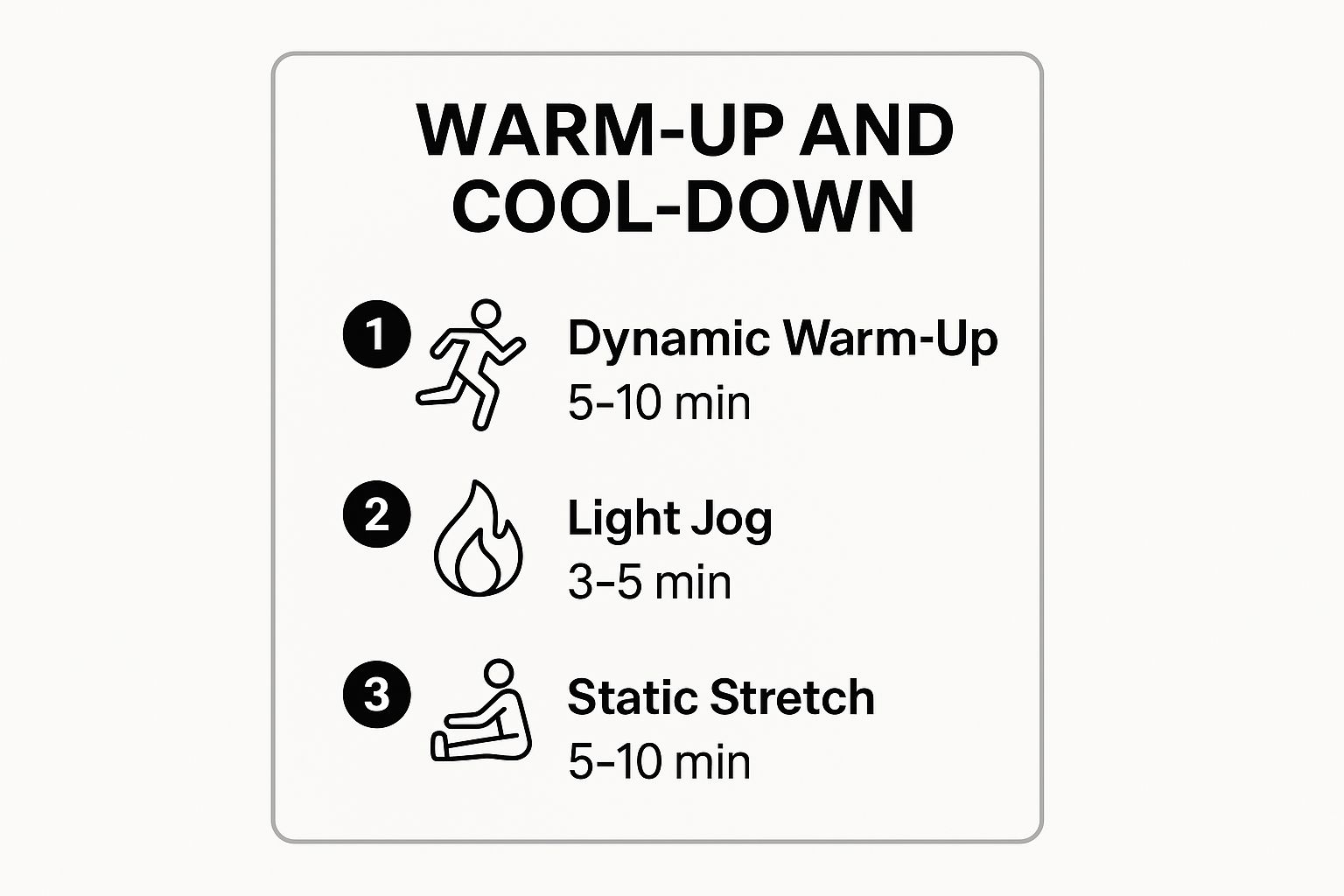
As you can see, spending just a few minutes on dynamic movements before you run and some light stretching afterward can make a huge difference in how you feel and recover.
Your Injury Prevention Framework
To bring it all together, think of your training through this simple framework. Focusing on these areas consistently is what separates runners who are always injured from those who seem to run forever.
Pillar | Why It Matters | Quick Action |
|---|---|---|
Training Load | Prevents overuse injuries by giving tissues time to adapt. | Follow the 10% rule: don't increase your weekly mileage by more than 10%. |
Strength | Creates a stable chassis to absorb impact and maintain form. | Add 2 x 30-minute strength sessions to your week focusing on core, hips, and glutes. |
Mechanics | Reduces stress on joints and improves running economy. | Focus on taking shorter, quicker steps. Try to increase your cadence by 5%. |
Recovery | Allows the body to repair, adapt, and get stronger. | Prioritize 7-9 hours of sleep per night. It's your top recovery tool. |
This isn't about being perfect. It's about being consistent. Nail these four pillars, and you'll be well on your way to enjoying a lifetime of strong, injury-free running.
Build a Training Plan That Respects Your Body

It’s a classic story every runner knows. That initial burst of motivation has you lacing up day after day, pushing a little harder each time. But that same eagerness can be your downfall. The most common path to the sidelines isn't a dramatic fall but the quiet, creeping toll of doing too much, too soon.
Think of a smart training plan as your single greatest defense against running injuries. It’s a roadmap that gradually builds your fitness without overwhelming your body's capacity to adapt and get stronger.
The 10% Rule—and When to Break It
You’ve probably heard of the "10% Rule," the long-standing advice to never increase your weekly mileage by more than ten percent. It’s a solid, conservative guideline that helps prevent reckless jumps in volume. For instance, if you ran 10 miles this week, you’d aim for no more than 11 miles next week. Simple enough.
But let’s be real—it's not a perfect formula for everyone. A newer runner building from 2 miles a week can likely handle more than a 0.2-mile increase. A more advanced approach considers not just how much you run, but how hard you run.
A training plan isn't just a schedule; it's a conversation with your body. Some weeks you'll push forward, and others you'll need to hold back. The goal is consistency over time, not rapid progression at all costs.
Structuring a Balanced Running Week
A truly resilient body is built through variety. If all you do is jog the same 3-mile loop every day, you’re not just setting yourself up for a fitness plateau—you're hammering the same muscles and joints in the exact same way, run after run. A well-rounded week should blend different types of runs to challenge your body in multiple ways, making you a more durable athlete.
Here’s what that looks like in practice:
Easy Runs: This is your bread and butter, making up the bulk of your weekly mileage. The pace should be comfortable enough to hold a full conversation. These runs build your aerobic engine and help your body recover.
Long Runs: Typically done once a week, the long run builds endurance and mental grit. Keep the pace easy and conversational here, too. The goal is time on your feet, not speed.
Tempo Runs: Think "comfortably hard." You can get out a few words, but a full chat is off the table. Tempo work improves your lactate threshold, which is key to holding a faster pace for longer.
Intervals: These are short, intense bursts of fast running followed by recovery periods. They're fantastic for boosting top-end speed and running economy, but they also put a lot of stress on your body. Use them wisely and sparingly.
Learning to Listen to Your Body
Your body is constantly sending you signals. The difference between a long-term healthy runner and an injury-plagued one often comes down to the ability to listen. It's crucial to distinguish between the normal muscle soreness of a good workout and the sharp, targeted pain that’s waving a red flag.
Productive soreness, what experts call Delayed Onset Muscle Soreness (DOMS), usually feels like a dull, generalized ache. It tends to peak 24-48 hours after a tough workout and fades within a few days. Injury pain, on the other hand, is often sharp, specific to one spot, and gets worse as you try to run on it.
This distinction is everything because training load is the number one driver of running injuries. In fact, comprehensive research on running injury rates found that running has an injury rate of 6.3 injuries per 1000 training hours—almost double the average for all sports combined. That statistic alone should tell you why managing your training load isn't just a good idea; it's non-negotiable.
If you feel that "niggle" or a sharp pain starting, the smartest move you can make is to back off. Take an extra rest day. Swap that run for some low-impact cross-training like swimming or cycling. Pushing through pain is a gamble that rarely pays off.
The Power of Strength Training for Durable Runners
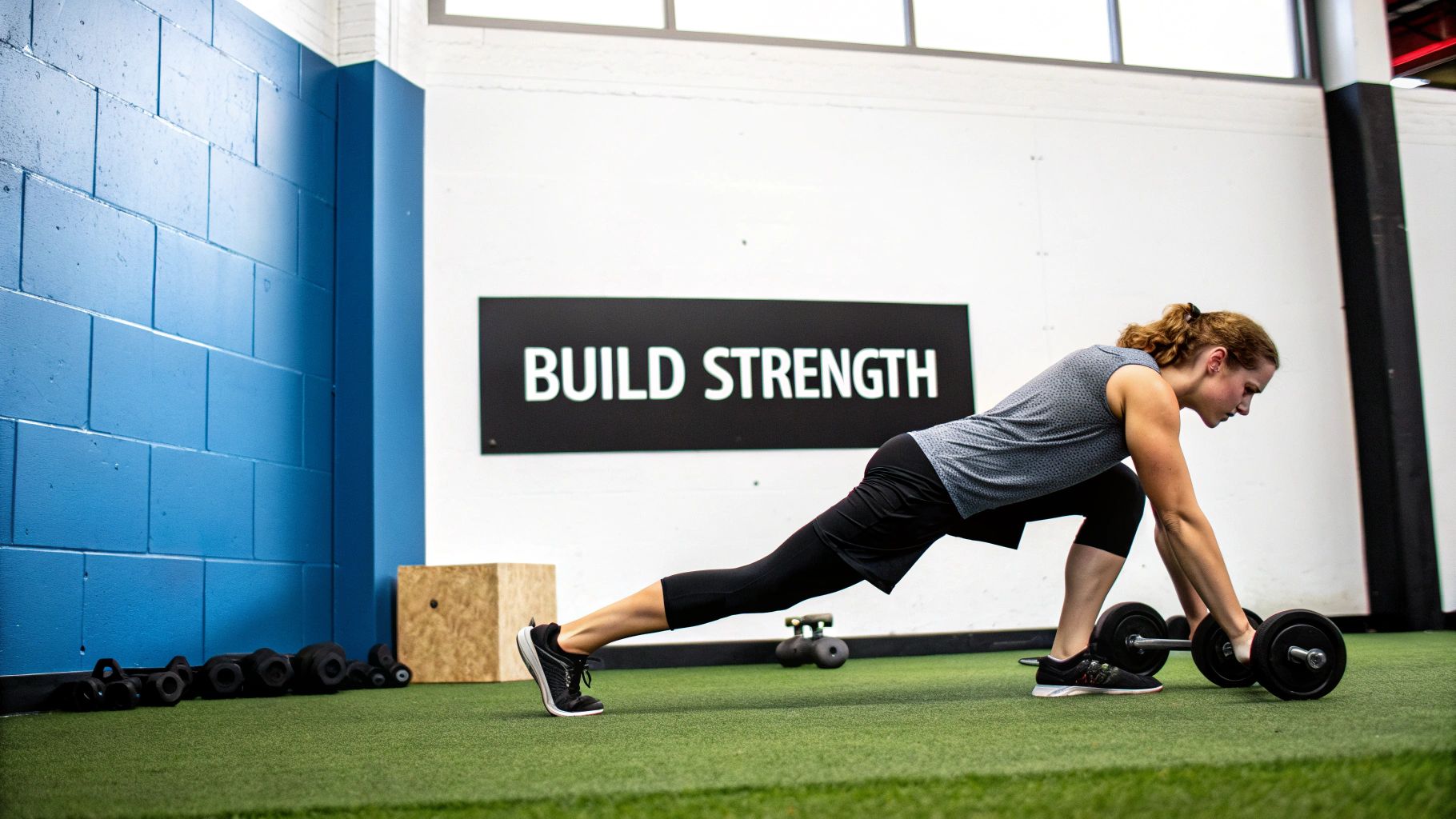
It’s a common trap many runners fall into: thinking the only way to get better at running is to, well, run more. While mileage has its place, skipping strength work is like building a powerful engine on a flimsy chassis. It’s only a matter of time before something breaks.
A strong, stable body is your absolute best defense against the relentless, repetitive impact of running. This isn't about packing on muscle like a bodybuilder. It's about building a resilient frame that can handle the demands of your training, week in and week out.
Just two dedicated 30-minute sessions each week can be a game-changer, dramatically lowering your risk for nagging issues like IT band syndrome, runner's knee, and shin splints.
The proof is in the research. Structured injury prevention programs that include resistance training have been shown to slash sports injuries by an average of 29%. Despite this, it's estimated that less than a third of runners actually do this kind of essential work. You can read more about the effectiveness of these programs to see just how critical it is.
Build Your Body’s Powerhouse
For runners, true strength starts at the center and radiates outward. Think of your hips, glutes, and core muscles as your "powerhouse." This group is responsible for providing stability, generating power, and absorbing shock every time your foot hits the ground.
When these key muscles are weak, your body starts to compensate in ways that lead directly to injury. Weak glutes, for instance, can cause your pelvis to drop with each stride, placing a huge amount of strain on your knees and IT bands. A weak core? That leads to poor posture and sloppy form, especially when you're tired late in a run.
Building functional strength isn't an "extra" you do if you have time. It is a fundamental part of a smart running plan that directly addresses the root causes of most overuse injuries.
Essential Strength Exercises for Runners
You don't need a fancy gym membership or a ton of equipment to start building a more durable body. Some of the most effective exercises for runners can be done right in your living room with just your body weight.
Here are a few foundational movements that I believe every runner should have in their toolkit.
Exercise | Primary Muscle Group Targeted | Injury Prevention Benefit |
|---|---|---|
Squats | Glutes, Quads, Hamstrings | Builds overall leg strength and improves hip mobility for a powerful stride. |
Glute Bridges | Glutes, Hamstrings | Activates and strengthens the glutes, which are often underactive in runners. |
Planks | Core (Abdominals, Obliques) | Develops core stability to maintain good posture and prevent lower back pain. |
Single-Leg Deadlifts | Hamstrings, Glutes, Core | Improves balance and single-leg stability, mimicking the motion of running. |
These exercises are your starting point for building a body that can withstand the demands of the road or trail.
From Bodyweight to the Gym
The first step is to master these movements with perfect form using only your body weight. Consistency over intensity is the key at the beginning.
Here’s a simple circuit you can do at home:
Warm-up: Start with 5 minutes of dynamic stretching like leg swings and torso twists.
Circuit: Go through this sequence 3 times. * 15 Bodyweight Squats * 15 Glute Bridges * 30-second Plank * 10 Single-Leg Deadlifts (on each leg)
Cool-down: Finish with 5 minutes of light, static stretching.
Once that routine starts to feel manageable, it's time to add a little resistance. This principle, known as progressive overload, is how you keep getting stronger. You can hold dumbbells during your squats and deadlifts, or even place a weight plate on your hips during glute bridges to keep challenging your muscles.
Fine-Tuning Your Running Form for Better Efficiency
How you run matters just as much as how much you run. With every single footstrike, impact forces travel right up your body. When your mechanics are inefficient—think slouching posture or feet landing way out in front of you—you create stress hotspots that can lead directly to some of the most common overuse injuries.
I like to compare it to a car with misaligned wheels. Sure, it’ll still drive, but you're putting a ton of uneven wear and tear on the tires and suspension. Your body isn't much different. Fine-tuning your running form is all about improving your personal "alignment" to spread those forces out more evenly. This makes you a more efficient and, more importantly, a more durable runner.
The goal isn't to chase some mythical "perfect" form. Honestly, that doesn't exist; every runner's body is unique. This is about making small, targeted adjustments that can have a surprisingly big impact on keeping you off the sidelines.
Boost Your Cadence to Reduce Impact
One of the single most powerful changes you can make to your form is to increase your cadence. Simply put, that’s just the number of steps you take per minute (spm). Many runners, especially newer ones, have a naturally low cadence—often falling below 170 spm. This almost always goes hand-in-hand with overstriding, which is when you land with your foot far out in front of your body's center of mass.
Overstriding is like hitting the brakes with every single step. It sends a jarring force through your joints and dramatically increases the load on your knees and hips. The fix, thankfully, is surprisingly simple: focus on taking shorter, quicker steps.
Aiming for a modest 5-10% increase in your current cadence can dramatically reduce braking forces and the load on your hips and knees. It's one of the most effective strategies out there for preventing impact-related running injuries.
So, if your watch tells you your current cadence is around 160 spm, just try targeting 168-176 spm. I'll be honest, it’s going to feel weird at first—almost like you're taking choppy "baby steps." But that feeling is a good sign! It means you're encouraging your feet to land more directly underneath your body, which is exactly where you want them.
Practical Drills for Better Form
Making lasting changes to your running form takes conscious practice. It definitely won't happen overnight, but if you sprinkle some simple drills into your routine, you can start to rewire those neuromuscular pathways for good.
Here are a few things I recommend to the runners I coach:
Use a Metronome: This is a game-changer. Just download a free metronome app on your phone. Set it to your target cadence and try to match your footfalls to the beat for short, one-minute intervals during your easy runs.
Focus on Posture: Run tall. I tell my athletes to imagine a string is gently pulling them up from the crown of their head. Keep your gaze fixed on the horizon, let your shoulders relax and drop away from your ears, and keep your chest open. This simple cue helps prevent slouching, which restricts your breathing and wastes a ton of energy.
Check Your Arm Swing: Your arms should swing forward and backward, not side-to-side across your body. Keep your elbows bent at roughly a 90-degree angle and let your hands stay relaxed (no clenched fists!). A controlled arm swing is crucial for driving your legs and maintaining good balance.
These aren't about a complete overhaul of how you run. Think of them as small, sustainable tweaks. Focus on just one element at a time until it starts to feel natural. Once it does, these little adjustments will add up to massive improvements in your efficiency and a much lower risk of getting hurt.
Mastering Recovery to Maximize Your Training

The miles you log are only half the story. Real fitness gains don't happen on the road; they happen in the hours and days afterward as your body repairs itself and adapts. I’ve seen countless runners get sidetracked by flashy gadgets when the most powerful recovery tools are the simple, consistent habits you build.
Truly mastering your recovery is a game-changer for how you prevent running injuries. Without it, you’re just repeatedly breaking your body down, never giving it a chance to rebuild stronger. Let’s cut through the noise and focus on what actually works.
Prioritize Sleep as Your Top Recovery Tool
If there’s only one thing you do for recovery, make it this: get enough sleep. It’s hands-down the most potent performance enhancer and injury-prevention tool you have, and it costs nothing. During deep sleep, your body shifts into repair mode, releasing crucial growth hormones that mend the muscle tissue you’ve stressed during your runs.
When you skimp on sleep, you're short-circuiting this entire process. Consistently getting less than seven hours a night can weaken your immune system, hobble muscle repair, and even tank your mental focus for the next workout.
Aiming for 7-9 hours of quality sleep per night isn't a luxury; it's a non-negotiable part of any serious training plan. Think of it as banking energy and resilience for your next run.
The best way to improve sleep is with a solid routine. Try to go to bed and wake up around the same time every day—yes, even on weekends. Turn your bedroom into a cool, dark, and quiet sanctuary. This simple discipline can make a massive difference in how well your body bounces back.
Fuel Your Body for Repair
Your post-run nutrition is the next critical pillar of smart recovery. After a hard effort, your muscles are desperate for two things: carbohydrates to restock their depleted energy (glycogen) stores and protein to kick-start the repair process.
Don't overthink this. The key is to get something in your system within about 30-60 minutes after you stop running. This "anabolic window" is when your body is primed to absorb and use those nutrients most efficiently.
Some of my go-to refueling options are incredibly simple:
Chocolate Milk: It’s famous for a reason. It has a near-perfect ratio of carbs and protein, plus it helps with rehydration.
Greek Yogurt with Berries: This gives you a great protein punch from the yogurt and fast-acting carbs from the fruit.
A Banana with Peanut Butter: A classic combo that delivers essential potassium, carbs, and a nice dose of protein and healthy fats.
Refueling properly isn’t just about feeling less sore tomorrow. It’s about giving your body the building blocks it needs to repair those tiny muscle tears, which is fundamental to stopping overuse injuries before they start.
Use Mobility for Active Recovery
The final piece of this recovery puzzle is all about smart mobility work. This doesn't mean forcing yourself into painful, static stretches. Instead, it’s about gently encouraging blood flow, easing muscle soreness, and maintaining your range of motion without adding extra stress to your system.
A foam roller can be your best friend here. Just a few minutes of gentle rolling on key areas like your quads, hamstrings, and calves can make a world of difference in how stiff you feel the next day.
It's also worth building some light movement into your rest days. This concept of "active recovery" is often far more beneficial than just sitting on the couch. Things like gentle yoga, walking lunges, or simple leg swings keep the blood flowing, which helps flush out metabolic waste and keeps you from feeling locked up.
Got Questions About Staying Healthy on the Run?
Even the most well-thought-out training plan can't predict every little thing that pops up. When you're out there logging miles, real-world questions about gear, aches, and warm-ups are inevitable. Getting straight answers to these common concerns is what helps you make smart decisions on the fly and ultimately keep running injury-free for the long haul.
Are Expensive Running Shoes an Injury-Proof Guarantee?
This is a big one, and the truth might not be what you expect. While the right pair of shoes is definitely important, the priciest model on the shelf isn't some magic shield against injury. Time and time again, research shows there's no single "best" shoe out there. Things like a hefty price tag or fancy "tech" features just don't line up with lower injury rates.
So, what actually matters? Comfort. It's that simple.
If a shoe feels great on your foot, it's probably the right shoe for you. Your body has its own unique, preferred way of moving, and a comfortable shoe is one that works with that natural motion instead of fighting against it.
Don't get too bogged down by the industry labels like "motion control," "stability," or "neutral." The best approach is to try on several pairs from different brands. Jog around the store a bit. The shoe that feels the most natural—the one you practically forget you're wearing—is your winner. Just remember to swap them out every 300-500 miles, as the foam in the midsole breaks down and stops doing its job.
Is This Real Pain or Just Normal Soreness?
Learning to listen to your body and interpret its signals is a skill that truly separates runners who stay healthy from those who are constantly on the sidelines. Knowing the difference between the good ache of hard work and the bad pain of an injury is absolutely crucial.
Let's break it down:
Good Soreness (DOMS): This is that familiar, dull, generalized ache you feel across an entire muscle group. It usually shows up 24-48 hours after a really tough workout and fades away after a couple of days. You'll feel stiff, sure, but it often eases up once you get moving.
Bad Pain (Injury): This is different. It’s often sharp, located in one specific, pinpointed spot, and gets worse as you try to run on it. It might stick around for days or pop up with every single step.
If you feel a pain that’s sharp enough to make you limp or change your running form, that’s a massive red flag. When in doubt, always play it safe. Taking an extra rest day or two is a much smarter move than pushing through and turning a small annoyance into a full-blown injury.
Should I Stretch Before I Run?
The long-standing debate over pre-run stretching is finally getting clearer. The short answer? No, you probably shouldn't do those classic, static stretches (where you hold a position for 30 seconds) on cold muscles. In fact, some studies show it can actually reduce your power and doesn't do much to prevent injuries.
What you should do is a dynamic warm-up.
Think of it as a dress rehearsal for your run. You're using active, flowing movements to take your joints and muscles through their full range of motion, gently increasing blood flow and prepping them for the work ahead.
A quick 5-10 minute dynamic routine is all you need. Try these:
Leg Swings (forward/backward and side-to-side)
Walking Lunges
High Knees
Butt Kicks
Save the long, relaxing static stretches for after your run. When your muscles are warm and receptive, that's the perfect time to work on flexibility and help your body begin the cool-down process.
At RealOminousAthlete, we know that a smarter runner is a stronger runner. Get the gear designed for durability and performance you need to go the distance. Check out our latest collection and find your new favorite running apparel.


Comments