
How to Increase Vertical Jump A Pro Athlete's Guide

If you're serious about adding inches to your vertical jump, you have to understand what you're actually training. It's not just about doing random leg exercises and hoping for the best. Jumping higher is a science, and it all comes down to combining raw strength with explosive, lightning-fast power.
This isn't about just getting stronger. It's about training your body to use that strength in the blink of an eye.
The Real Science Behind a Higher Jump
So, before we even touch a weight or a plyo box, let’s get into what really separates an average jumper from an elite one. It’s a common misconception that just having strong legs is enough. I’ve seen plenty of guys in the gym who can squat a house but can barely get off the ground.
That’s because they have a massive engine but no way to get that power to the wheels instantly. Your goal is to build that engine and fine-tune the transmission.
To truly boost your vertical, you have to master two distinct but related physical qualities. The table below breaks down exactly what they are and why they're so crucial for your training.
Key Factors for a Higher Vertical Jump
Component | What It Is | Why It's Critical | How You Train It |
|---|---|---|---|
Max Force Production | This is your absolute, raw strength. Think of it as the maximum force your muscles can possibly generate, regardless of time. | More strength gives you a higher ceiling for power. You can't be explosive if you don't have a strong base to begin with. | Heavy, compound lifts like back squats, deadlifts, and lunges build your force-producing foundation. |
Rate of Force Development (RFD) | This is the speed at which you can generate force. It's your ability to tap into your maximum strength almost instantly. | A vertical jump happens in less than half a second. RFD determines how much of your strength you can actually use in that tiny window. | Plyometric exercises like box jumps, depth jumps, and broad jumps train your nervous system to fire muscles rapidly. |
Training both of these components is non-negotiable. One builds your potential, and the other unlocks it. Neglect either one, and you'll hit a plateau fast.
The Stretch-Shortening Cycle: Your Body's Secret Weapon
So, how does your body actually produce force that quickly? The magic lies in a built-in mechanism called the stretch-shortening cycle (SSC). The easiest way to think about it is like stretching a rubber band. The further you stretch it, the more powerfully it snaps back when you let go.
Your muscles and tendons do the exact same thing.
When you dip down right before a jump, your muscles lengthen and load up with elastic energy—this is the "stretch" phase. Then, in a split-second transition, they violently shorten and contract, releasing all that stored energy. That explosive release is the SSC in action, and it's what separates a clumsy hop from a powerful leap.
The secret to a sky-high vertical isn't just being strong, but being strong fast. Your nervous system must be trained to recruit muscle fibers at lightning speed, which is the entire purpose of plyometric training.
The more efficient your SSC becomes, the less energy you waste and the more power you can direct upwards.
The Muscles That Make You Fly
While jumping is definitely a full-body movement, a few key muscle groups do the heavy lifting. Think of them as the primary engines for your launch.
Glutes and Hamstrings: This is your powerhouse. Your glutes are responsible for the violent hip extension that provides the main thrust off the floor.
Quadriceps: Your quads work in tandem with your glutes to explosively straighten your legs, extending the knees with force.
Calves: These provide that final "snap" at the very end of the movement, pushing off your toes to add those last critical inches to your jump.
Knowing this science changes everything. You're no longer just going through the motions. Every heavy squat is building your force potential. Every box jump is sharpening your RFD and making your SSC more efficient. You’re training with purpose, and every single rep is a direct investment in a higher vertical.
Building Your Power Foundation with Strength Training
Let's get one thing straight: trying to jump higher without a solid base of strength is like trying to fire a cannon from a canoe. It just doesn't work. All the explosive technique in the world means very little if you don't have the raw horsepower to get off the ground. This is where dedicated strength training comes in, forming the very bedrock of your athletic potential.
A lot of athletes make the mistake of thinking that just doing some leg exercises is enough. But our goal isn't just to build bigger muscles; it's to build stronger ones that can generate massive force, quickly. This is the raw material you'll later shape into explosive power.
While plyometrics are essential for teaching your body to be fast and springy, a well-designed strength program is what raises your absolute performance ceiling. The research backs this up time and time again.
In fact, a massive 2025 network meta-analysis found that weight resistance exercise delivered the single biggest improvement in vertical jump, boosting it by an average of 9.9 cm over routine training. When compared head-to-head, resistance training improved jump height by 4.8 cm more than plyometrics alone. You can dive into the specifics of this research and see how it can shape your approach.
The takeaway here is simple but crucial: strength is the foundation.
Targeting the Right Muscles with Compound Lifts
To build real, functional strength for athletics, you have to focus on compound movements. These are the big lifts that engage multiple joints and muscle groups at once, closely mimicking how your body actually works when you jump.
Sure, isolation exercises like leg extensions have their place, but they don't teach your body how to coordinate power from your hips, legs, and core. For a higher vertical, your training needs to be built around these cornerstone lifts.
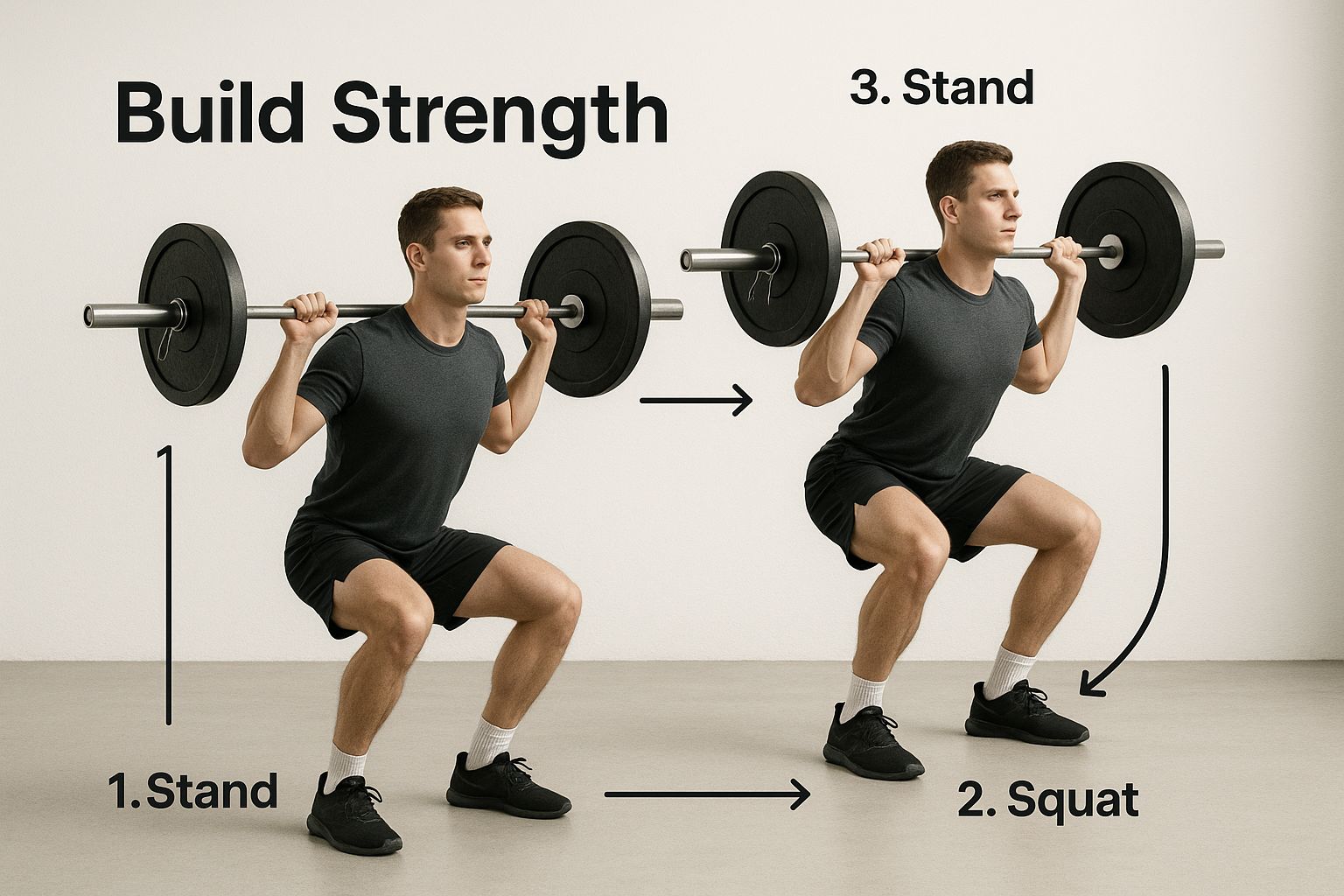
Barbell Back Squats: Often called the king of all exercises for a reason. The back squat is unmatched for building raw strength in your quads, glutes, and core—the primary engines for extending your hips and knees at takeoff.
Deadlifts: This lift is a masterclass in developing your entire posterior chain. That's the network of muscles on the back of your body, including your glutes, hamstrings, and lower back. A powerful hip hinge, which the deadlift trains perfectly, is what truly powers your jump.
Split Squats and Lunges: Don't sleep on these single-leg movements. They're vital for building strength while also cleaning up balance issues and muscle imbalances between your legs. An imbalance is a power leak, and it's also a major injury risk.
By mastering these movements, you’re not just lifting weights; you're forging a more powerful and resilient athletic machine.
Structuring Your Strength Program for Maximum Gains
How you structure your workouts is just as critical as the exercises you pick. The name of the game is progressive overload—the principle of consistently challenging your body to adapt.
This simply means you have to gradually increase the weight, reps, or sets over time. If you don't give your body a reason to get stronger, it won't.
Your body is an adaptation machine. It will only become stronger if you consistently give it a reason to. Simply repeating the same workout week after week is a recipe for stagnation.
For building the kind of maximal strength that translates directly to your vertical, you want to live in the lower rep ranges with heavier weight.
Sets and Reps: Aim for 3-5 sets of 4-6 repetitions on your main lifts. This is the sweet spot for building pure strength without adding unnecessary muscle mass that can slow you down.
Rest Periods: Take your rest seriously. We're talking 2-3 full minutes between heavy sets. This lets your nervous system and muscles fully recover so you can give 100% effort on every single set.
Frequency: Dedicate 2-3 days per week to strength training. This provides plenty of stimulus for growth while leaving enough time for recovery—which is when the real magic happens.
Your Secret Power Source: The Posterior Chain
If there's one thing that separates good jumpers from great ones, it's the development of the posterior chain. So many athletes are "quad-dominant," meaning they focus too much on the muscles at the front of their legs. But the real, explosive power for jumping comes from the back.
Your glutes are the most powerful muscles in your entire body. Their main job is explosive hip extension—the very motion that launches you into the air. Your hamstrings work with them, controlling your descent and then violently contracting to help propel you upward.
From my experience, a weak posterior chain is the most common roadblock for athletes trying to improve their vert. They might have strong quads, but without powerful glutes and hamstrings to drive the movement, they'll always leave inches on the table.
Make exercises like deadlifts, Romanian Deadlifts (RDLs), and glute bridges a non-negotiable part of your training. Strengthening these muscles isn't an option; it's a requirement for unlocking your true vertical potential.
Alright, let's talk about the secret sauce for turning all that gym strength into real-world, explosive leaping ability. If heavy lifting builds the engine, plyometrics is how you fine-tune the transmission to put that power to the ground—instantly.
Think about it this way: raw strength is just potential. Plyometrics teaches your body how to unleash that potential in the blink of an eye. This is where you go from being strong to being explosive.
The goal here is all about improving your Rate of Force Development (RFD). That's a fancy term for how quickly you can summon your strength. It's the critical difference between a slow, grinding squat and a violent, sky-high jump.
Through these drills, you're essentially re-wiring your entire neuromuscular system. You're training your brain and muscles to communicate at lightning speed. This sharpens your stretch-shortening cycle (SSC), turning your leg muscles and tendons into powerful springs that absorb and release energy with incredible force.
This image really drives home the point that you can't skip steps. You have to build the strength foundation first before you can effectively convert it into explosive power.
As you can see, strength is the base of the pyramid. Without it, your power potential is seriously limited. First, you earn the right to be powerful by getting strong.
Mastering the Fundamentals of Plyometric Training
Before you even think about jumping onto a high box, you need to burn one principle into your brain: quality over quantity. Every single jump, every single rep, has to be done with maximum effort and perfect form. This isn't cardio; you're training for pure, unadulterated speed and power.
I always tell my athletes to think like a 100-meter sprinter practicing their start. They don't just jog for miles. They perform a handful of perfect, explosive starts with full recovery between each one. That's the mindset you need for plyos.
And this isn't just my opinion—the science is crystal clear. A major meta-analysis confirmed that a well-designed plyometric program can boost your vertical jump by a whopping 4.7% to 8.7%. For any serious athlete, that's a massive gain. The data, which you can dig into in the full study published in the Journal of Strength and Conditioning Research, shows a huge positive impact on explosive leg power.
So, trust the process. Those high-quality reps will directly translate into inches on your vertical.
Essential Plyometric Drills for a Higher Vertical
Your plyometric work needs to be progressive. You'll start with the basics to nail down your mechanics and build confidence. From there, you'll move on to more advanced drills that will really ignite your explosiveness.
Here are the cornerstone drills I have every athlete master first:
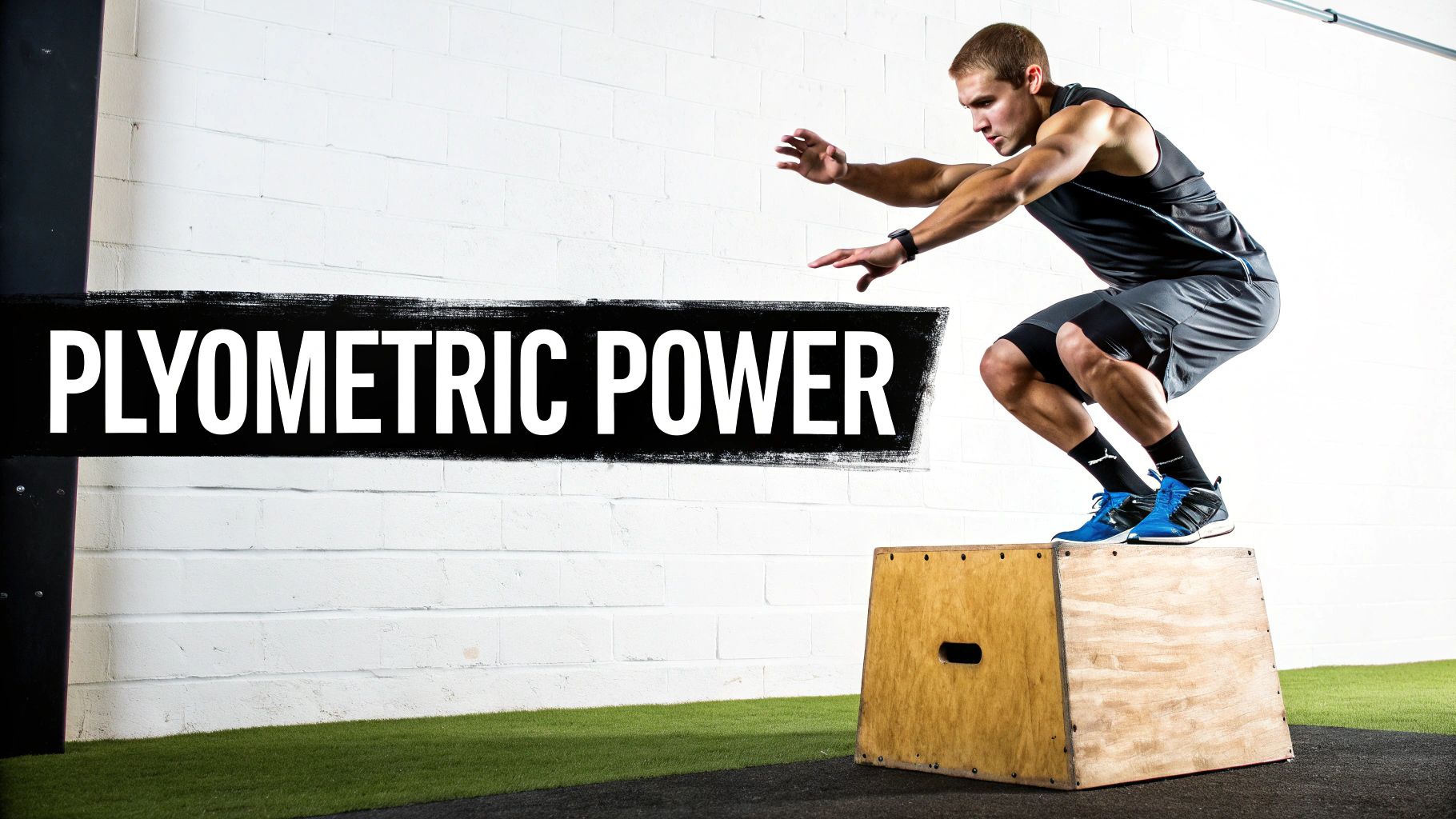
Box Jumps: This is the classic for a reason. Box jumps are fantastic for teaching you how to generate vertical force and, just as importantly, land safely. The trick is to pick a box height that's challenging but still allows you to land softly and in control. The goal is to explode up to the box, not just tuck your knees to your chest to clear it.
Broad Jumps: A phenomenal drill for building horizontal power, which has a surprising amount of carryover to your vertical. The focus should be on using a powerful arm swing and a violent hip extension to launch yourself forward. Stick the landing and absorb the impact like a cat.
Tuck Jumps: Don't let the simplicity fool you. This bodyweight drill is incredible for boosting the explosive power of your quads and hip extensors. The objective is simple: jump as high as you possibly can, pulling your knees up toward your chest at the very peak of the jump.
Start with these. They build the foundation you absolutely need before tackling the more intense stuff.
Progressing to Advanced Plyometrics
Once you feel solid with the basics and your landing mechanics are second nature, it's time to level up. These advanced drills place a much greater demand on your stretch-shortening cycle and will push your reactive ability through the roof.
Key Takeaway: With advanced plyos, the goal isn't just jumping high—it's spending as little time on the ground as possible. You want to become a pogo stick, absorbing and redirecting force almost instantly.
Depth Jumps: This is the undisputed king of exercises for improving reactive strength. You start by dropping (not jumping) off a low box, around 12-18 inches. The split second your feet make contact with the floor, you explode straight up into a maximum-effort vertical jump. This overloads the landing phase, forcing your muscles to contract with more force and speed on the rebound.
Rebound Jumps: Think of these as continuous jumps, often done over a series of low hurdles or cones. The focus here is on a rapid "touch-and-go" ground contact. You're training your body to immediately convert the force of landing into the power for your next jump.
Weaving Plyometrics into Your Training Week
How you schedule your plyometric sessions is absolutely critical for getting results and staying healthy. These drills are incredibly taxing on your central nervous system, so you must be fresh to get any benefit from them.
Here’s a smart way to structure your week:
Day | Focus | Example |
|---|---|---|
Day 1 | Strength Focus | Heavy Squats & Deadlifts |
Day 2 | Explosive Power | Plyometrics & Dynamic Effort Lifts |
Day 3 | Active Recovery | Light mobility work, stretching |
Day 4 | Strength Focus | Heavy Lunges & Posterior Chain Work |
A non-negotiable rule: Always perform plyometrics at the start of your workout, right after a thorough warm-up. This is when your nervous system is primed and ready to fire on all cylinders. Never, ever do plyos when you're already tired. That's a recipe for poor results and potential injury.
By combining that hard-earned strength with focused, high-quality explosive work, you create the perfect storm for adding serious inches to your vertical jump.
Refining Your Jump Technique and Warm-Up
All the strength and power you build in the gym can go to waste without the right mechanics. I've seen it countless times. Think of it like a sports car with misaligned wheels—you’ve got all that horsepower, but it’s not being put to the pavement efficiently. This is where we dial in your technique, ensuring every ounce of your hard-earned power translates directly into inches on your vertical.
The whole process starts before you even think about leaving the ground. A solid warm-up is non-negotiable. Its real purpose isn't to wear you out, but to wake up your nervous system and get your muscles and joints ready for the explosive work ahead.
A Dynamic Warm-Up for Explosive Action
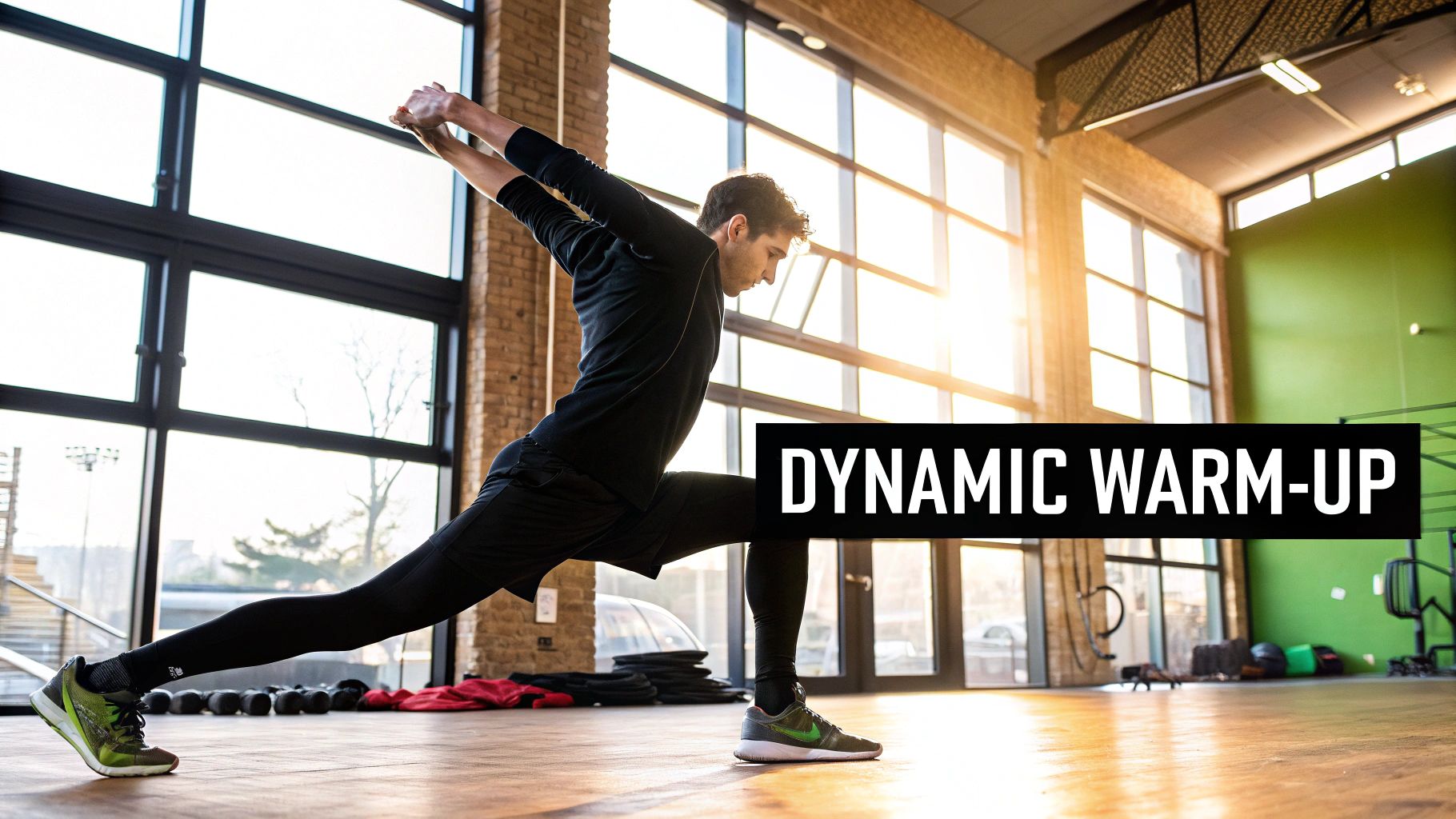
Forget about old-school static stretching where you just hold a pose for 30 seconds. That's the last thing you want to do before an explosive workout. Instead, your warm-up needs to be dynamic, built around continuous movement that gets your blood flowing, raises your core temperature, and improves the communication between your brain and your muscles.
Here are a few of my go-to's:
Leg Swings (Forward and Sideways): These are fantastic for opening up your hips and hamstrings, which is absolutely crucial for getting into a deep, powerful jump position.
Walking Lunges with a Twist: This move activates your glutes, quads, and core, all while bringing in a rotational element that you'll use in any athletic movement.
Pogo Hops: These are just short, quick jumps where the goal is to spend as little time on the ground as possible. It's the perfect way to fire up your calves and start tuning your body's natural spring-like ability.
Believe it or not, a bit of light aerobic work can also make a real difference. A fascinating 2016 study found that college-aged female athletes actually saw a significant bump in their max vertical jump after a simple two-mile run at a comfortable pace. This suggests that a moderate aerobic session of around 15-20 minutes might just be the ticket to prime your body for peak performance. If you're curious, you can read more about these findings and see how some unconventional methods can produce impressive results.
Dissecting the Perfect Jump
Once you’re warm, it’s all about technique. When it comes to a running jump, every single phase is an opportunity to squeeze out more height. Let's break it down into simple, actionable cues you can start practicing right away.
The Approach and Penultimate Step
Your approach isn't just a casual jog—it's a controlled acceleration that sets the stage for a powerful takeoff. The final two steps, however, are where the magic really happens.
That second-to-last step, what we call the penultimate step, needs to be long and low. This action deliberately lowers your center of gravity, acting like a brake to slam your horizontal momentum into the ground and convert it into vertical force. Picture yourself coiling a massive spring.
Then, your final step should be much shorter and faster, planting firmly to halt that forward motion and initiate the upward explosion.
The penultimate step is the secret ingredient that separates good jumpers from great ones. By dropping your hips on this step, you pre-load your leg muscles with elastic energy, which you'll unleash in the takeoff.
The Power of the Arm Swing
Never underestimate your arms. They are not just along for the ride; they are an engine for momentum and can contribute up to 10% of your total jump height. As you sink into that penultimate step, your arms should swing back forcefully.
Then, as you plant your final foot and begin to launch, drive those arms forward and up with everything you've got. This violent, coordinated swing helps pull the rest of your body toward the sky.
The Takeoff
This is the moment of truth. As your arms are swinging up, your hips, knees, and ankles must all extend at the exact same time. It’s a single, fluid and powerful chain reaction known as triple extension. Imagine a shockwave starting from your feet and rocketing out through your fingertips.
Your focus should be on one thing: pushing the ground away from you as hard and fast as you possibly can. A common mistake I see is athletes "reaching" for the rim or the ball. Don't do it. Your jump height is decided the instant your feet leave the floor.
Fueling and Recovery: The Other Half of the Equation
All the brutal strength work and explosive plyometrics? That's only half the battle. The real gains—the muscle repair and nervous system upgrades that actually boost your vertical—happen when you’re resting, not when you’re training. I’ve seen countless athletes grind themselves into dust but neglect this critical phase, leaving inches on the table.
Think of it like this: your workouts are the demolition crew, breaking down muscle fibers. Your fuel and recovery are the construction team that comes in overnight to build everything back bigger and stronger. Without them, you’re just left with a pile of rubble.
Fueling for Explosive Power
You wouldn't put cheap gas in a race car, so don't sabotage your hard work with a garbage diet. Good nutrition gives your body the raw materials it desperately needs to recover from one session and power through the next. This isn't about getting lost in complex meal plans; it's about nailing the basics.
Let's break down what your body needs to actually perform and repair itself.
Protein: The Building Blocks. After you train, your muscles are full of micro-tears. Protein delivers the amino acids to patch them up and build stronger fibers. You should be aiming for 1.6-2.2 grams of protein per kilogram of body weight to really maximize that muscle-building response.
Carbohydrates: Your High-Octane Fuel. Carbs are your body's go-to energy source for high-intensity stuff like jumping and lifting. They refill the glycogen stores in your muscles, making sure you have enough in the tank for your next workout.
Healthy Fats: The Hormone Regulators. Don’t shy away from fats. Quality sources like avocados, nuts, and olive oil are crucial for regulating hormones, including testosterone, which is a key player in muscle growth and recovery.
Timing your meals can also give you a slight edge. Something as simple as a banana with a scoop of peanut butter about 90 minutes before you train tops off your energy stores perfectly.
Then, after your workout, you have a prime window to kickstart the recovery process. Getting a meal or shake with fast-digesting carbs and protein within an hour or two helps immediately replenish what you've lost. Your muscles are like sponges at this point, ready to soak up those nutrients. A classic protein shake with a piece of fruit does the trick.
Advanced Recovery Strategies: Going Beyond Just Sleep
Everyone knows you need sleep, but just getting eight hours isn't the whole story if the quality is poor. Hitting the sack and waking up around the same time every day helps regulate your internal clock, which optimizes the release of growth hormone—a powerful tool for tissue repair.
Recovery isn't passive. It's an active process. The best athletes I know are just as intentional about what they do between training sessions as they are about the training itself.
Beyond just getting more shut-eye, you can actively speed up your body's recovery with a few proven techniques.
Active Recovery On your off days, doing something is often way better than doing nothing. Light activity—think a casual walk, a gentle bike ride, or some mobility drills—gets the blood flowing. This helps flush out metabolic waste and delivers fresh, nutrient-rich blood to your muscles without piling on more stress.
Foam Rolling and Mobility Work I like to think of foam rolling as a form of self-massage. It helps release tightness in the fascia, which is the connective tissue wrapping around your muscles. Rolling regularly can ease soreness, improve your flexibility, and keep your movement patterns clean—which is absolutely critical for preventing injury and keeping your jumping form sharp. Just 10-15 minutes after a workout or before bed can make a huge difference.
When you treat your nutrition and recovery with the same focus as your training, you create a complete system for high performance. This approach ensures your body doesn't just survive the tough workouts—it adapts, rebuilds, and comes back stronger every single time.
Got Questions About Your Vertical Jump? Let's Talk.
If you're serious about adding inches to your vertical, you're bound to have questions. That's a good thing. Asking the right questions is what separates athletes who make real progress from those who just spin their wheels. Let's tackle some of the most common ones I hear from athletes just like you.
"How Fast Can I Realistically Add Inches?"
This is always the first one, right? Everyone wants to know the timeline.
While there's no magic number, I can give you a solid benchmark based on my experience. If you stick to a smart, consistent program, you can absolutely expect to see noticeable gains of 2-4 inches within the first 8-12 weeks. Some people gain more, some a little less. It all depends on your starting point, genetics, and how seriously you take your training and recovery. But that 2-4 inch window is a very achievable goal.
"So, How Many Days a Week Should I Be Training?"
It's easy to fall into the "more is better" trap, but for explosive power, that thinking will kill your progress. You don't get bouncier in the gym; you get bouncier when you recover from the gym. The real gains happen between sessions.
Here’s how you should structure your week to maximize results without burning out:
Strength Training: Hit the weights 2-3 days per week. This is your foundation. It's frequent enough to force your body to adapt and get stronger, but not so much that you can't recover.
Plyometrics: These are your high-intensity jump days. Keep them to just 1-2 times per week. Plyos are incredibly taxing on your nervous system, so you must do them when you feel fresh and explosive.
Here's the bottom line: The goal isn't total annihilation in every workout. It's about high-quality, maximal-effort reps. If you're too sore to jump with 100% intent, you're just digging a hole of fatigue.
"Do I Really Need Those Expensive Jump Shoes or Fancy Gear?"
I get this one a lot. The market is full of gadgets and shoes that promise to add inches overnight. Let me be blunt: Specialized shoes provide almost no measurable benefit to your jump height.
Your vertical is built with powerful glutes, quads, and a lightning-fast nervous system—not with a springy insole.
Save your money. Invest in a solid pair of basketball or court shoes that offer good support, and put the rest of that cash toward a gym membership or stocking your fridge with quality food. That's where the real return is.
And no, you don't need a pro-level weight room to get results. You can build a phenomenal base right at home.
Building Elite Hops with Zero Equipment:
Training Goal | At-Home Exercises |
|---|---|
Strength | Pistol squats, Bulgarian split squats (use a couch), and Nordic ham curls (tuck your feet under something heavy). |
Plyometrics | Tuck jumps, broad jumps, 180-degree squat jumps, and depth drops off a sturdy chair. |
At the end of the day, consistent, max-effort training beats expensive gear every single time. Focus on the principles that work, and you'll be flying higher in no time.
At RealOminousAthlete, we're about building true athleticism, not selling quick fixes. Our gear is for the grinders, the athletes who know that grit and a relentless mindset are what separate the good from the great. Check out our apparel and join a community that values grit over gear.


Comments