
How to Improve Running Form for Faster, Safer Runs

If you’re serious about getting better at running, you’ve got to look beyond just adding more miles. The real secret weapon, the thing that separates runners who hit a plateau from those who keep getting faster and stronger, is focusing on how you run. I'm talking about your running form.
It's not about forcing yourself into some "perfect," robotic stride you saw online. It’s all about efficiency.
Your Best Defense Against Injury and Wasted Effort
Think of your body as a machine. Every time your shoulders hunch, your hips drop, or your foot slaps the ground way out in front of you, you're leaking energy. That's energy that should be pushing you forward, but instead, it’s just getting wasted. Fixing those leaks is how you run faster and farther without feeling like you’re working harder.
More importantly, good form is your number one defense against the nagging injuries that plague so many runners. There's a clear line connecting poor biomechanics to things like shin splints, IT band syndrome, and runner's knee. When you clean up your form, you spread the impact forces out evenly, so no single joint or muscle takes a beating.
The real shift happens when you stop thinking about just surviving the run and start focusing on moving with intention. You want to feel smooth, rhythmic, and powerful—not like you're just pounding the pavement.
This all comes down to a few key areas that give you the biggest bang for your buck. I've seen it time and time again with the athletes I've coached. Dial in these three things, and everything else starts to fall into place.
Here’s a quick overview of what good running form looks like before we get into the nitty-gritty of specific drills and exercises. These are the pillars we'll build on.
Quick Guide to Efficient Running Form
This table breaks down the three core pillars of running form. It highlights the common mistakes I see every day and gives you a clear target to aim for.
Form Element | Common Mistake | What to Aim For |
|---|---|---|
Posture & Core | Slouching from the shoulders; excessive bouncing. | Run tall with a slight forward lean from the ankles, not the waist. Keep your core engaged to stay stable. |
Cadence & Footstrike | Overstriding (foot lands far in front of body); heavy heel striking. | A quicker, lighter cadence of 170-180+ steps per minute. Aim for your foot to land underneath your hips. |
Arm Swing | Arms crossing the chest; tense shoulders up by the ears. | Relaxed, 90-degree arm swing from the shoulder, moving front-to-back, not side-to-side. |
Focusing on these elements is the fastest way to become a more economical and durable runner. Now, let’s get into the practical steps you can take to make these changes happen.
Mastering Posture and Core Engagement
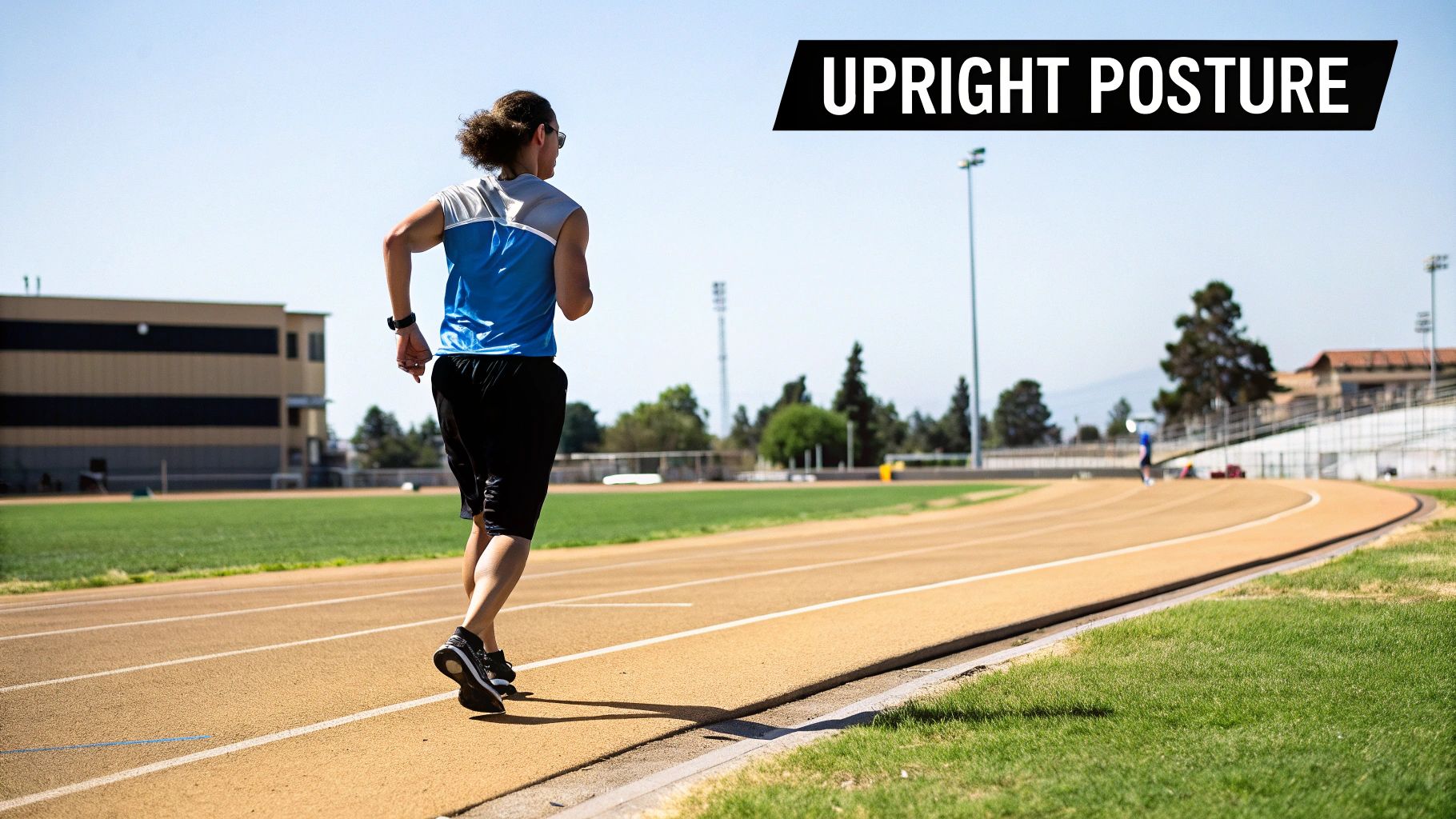
Think of your torso as the chassis of your running machine. If it's unstable or out of whack, you're just bleeding power with every single stride. Good posture isn't about being stiff and rigid; it’s about creating a strong, stable platform that lets your arms and legs swing freely and powerfully. This is a game-changer when you're learning how to improve running form.
The feeling you're aiming for is tall and powerful. I often tell runners to imagine a string gently pulling them up from the very top of their head. It's a simple mental cue, but it works wonders for straightening your spine and opening up your chest, fighting off that dreaded "runner's slouch" that creeps in when you get tired.
Once you feel tall, pair that with a slight forward lean. Here’s the critical part: this lean must come from your ankles, not from bending at your waist. Hunching over at the hips is a classic mistake that puts a ton of strain on your lower back and completely stalls your forward momentum. Leaning from the ankles lets gravity do some of the work, keeping your center of mass moving forward.
Why Your Core Is Non-Negotiable
What holds this whole framework together? Your core. A strong, engaged core is absolutely essential.
When your core muscles are weak, your body scrambles to find stability somewhere else. This usually leads to your hips swaying side-to-side or your whole body bouncing up and down—both are huge energy wasters. A locked-in core acts like a gyroscope, keeping your pelvis level and your torso quiet and steady.
This isn't just about saving energy; it's about getting faster. Biomechanical studies consistently show a direct link between core stability and running economy. One analysis found that issues like pelvic bouncing and side-to-side movement explained 39% of the difference in running economy among athletes. When looking at pure speed, a forward trunk lean and controlled pelvic movement were major factors separating elite runners from everyone else. If you want to dive deeper into the science, the folks at Scientific Triathlon have a great breakdown on how pelvic control impacts performance.
Key Takeaway: A stable core leads to a quiet upper body. When your torso is rock solid, your limbs can focus on one job: propelling you forward, not fighting to keep you balanced.
Actionable Cues for Better Posture
Building good posture takes practice. You have to actively think about it until it becomes second nature. On your next run, pick one of these cues and focus on it for a few minutes at a time.
Run with a proud chest. This simple thought prevents your shoulders from rounding and your torso from collapsing.
Keep your hips forward. Consciously think about pushing your hips forward. This promotes that neutral pelvic position and proper alignment.
Relax your shoulders. Tension loves to creep into the shoulders. Every so often, shrug them up to your ears, hold for a second, and then let them drop completely.
Look to the horizon. Your body follows your eyes. If you look down at your feet, you’ll start to slouch. Looking ahead keeps you tall and open.
Remember, the goal is relaxed strength, not tense rigidity. It’s all about creating a solid, responsive hub for all your running power.
Finding Your Ideal Foot Strike and Cadence

The never-ending debate about foot strike—whether you should land on your heel, midfoot, or forefoot—can get pretty noisy. But I’m here to tell you something that might be a relief: the part of your foot that hits the ground first isn't nearly as important as where it hits the ground in relation to your body.
The real secret to efficient running is landing your foot directly underneath your center of mass. Think of your hips as your body's central point. When your foot touches down right below them, you maintain forward momentum and glide along. It's the opposite of landing your foot way out in front of your body, which is a habit called overstriding.
Overstriding is like hitting the brakes with every single step. It doesn't just kill your speed; it sends a jolt of impact straight up your leg, putting unnecessary stress on your joints, especially your knees and hips. Nailing this one concept is a huge leap forward in improving your running form.
The Power of a Quicker Cadence
So, what's the most practical way to stop overstriding? The answer lies in your cadence, which is simply the number of steps you take per minute (spm).
Increasing your cadence naturally shortens your stride length. This makes it almost effortless to land your foot underneath your hips instead of reaching out in front of you. You'll notice your feet feel lighter and quicker, replacing that heavy, plodding sensation that often accompanies a slow step rate.
You may have heard of the "magic number" of 180 spm, but that's more of a guideline than a strict rule. A much better strategy is to figure out your current cadence and aim for a 5-10% increase. This small, manageable tweak is usually all it takes to see a real difference in your mechanics.
Don't get hung up on forcing a particular foot strike. Instead, concentrate on landing lightly with your foot underneath your center of mass. A higher cadence makes this happen almost automatically.
How to Measure and Improve Your Cadence
Figuring out your starting point is simple. On your next run, after you're properly warmed up and running at a comfortable pace, just count how many times one of your feet hits the ground in 30 seconds. Multiply that number by four, and you've got your steps per minute.
Once you have your baseline, you can start working on increasing it. Here are a few methods I've seen work for countless runners:
Use a Metronome App: There are tons of free apps that play a beat at a set tempo. Program it to be about 5% faster than your current cadence and focus on matching your footfalls to the beat.
Find the Right Playlist: Search for running playlists curated for a specific BPM (beats per minute) that lines up with your target cadence. Music is a powerful motivator.
Focus on Mental Cues: While you're running, repeat simple phrases to yourself like "quick feet" or "light on your feet." These little reminders can subconsciously help you increase your turnover.
This isn't just theory; the effect is real and measurable. Research shows a clear link between cadence and running economy. For example, a runner who goes from 155 spm to around 165-170 spm often experiences a significant drop in impact forces and pelvic instability—two major culprits behind wasted energy and injuries. As detailed by experts like Matthew Boyd Physio, real-time feedback from a tool like a metronome is incredibly effective for making this change stick.
Start by incorporating your new, faster cadence for just a few minutes at a time during your runs. As it starts to feel less awkward and more natural, you can gradually extend those intervals until it becomes your new normal.
Running Drills That Build Better Habits
Knowing you need to fix your posture or speed up your cadence is one thing. Actually doing it, without thinking, is a whole different ballgame. That's where running drills come into play.
Think of them like a basketball player practicing free throws. Drills isolate specific movements, exaggerate them, and help burn efficient patterns into your muscle memory. The goal is to make good form second nature, so you're not trying to remember it all on race day.
Foundational Drills for a Better Stride
These are the essentials. You can weave them into your pre-run warm-up or set aside a specific day for them. The focus here is always on quality over quantity. I'd much rather see a runner do a few perfect reps than a bunch of sloppy ones. Start by covering just 20-30 meters for each drill.
High Knees: This isn't just about getting your knees up. Concentrate on driving your knee up powerfully and quickly. This trains the explosive hip flexion you need for a strong push-off. Keep your torso tall and your foot flexed (toes pulled up toward your shin).
Butt Kicks: This drill is fantastic for encouraging faster leg turnover. It helps you practice actively pulling your heel up toward your glutes, getting rid of that long, trailing leg that acts like an anchor. The key is to stay tall and keep the movement quick and light.
A-Skips: A classic for a reason. This drill combines the knee drive from High Knees with a light, rhythmic skip. It’s all about teaching your body coordination and the feeling of landing your foot right under your hips, which is a hallmark of efficient running.
My biggest tip for these drills? Stay relaxed. Tension is the enemy of good form. Let your arms swing loosely from the shoulder, front-to-back. Your upper body should be stable and tall, but never stiff.
Adding Power with Plyometrics
Once you’ve got the basics down, adding some simple plyometric exercises can be a game-changer. Plyometrics train your body to absorb impact and immediately recycle that energy into a powerful forward push. This is what coaches mean when they talk about elastic energy return.
Don't just take my word for it. One study on running form adjustments found that after just six weeks, runners who added plyometric drills like skips and ankle hops to their routine saw a 5% average jump in their VO2 max and a 3% boost in their 3km race times. These aren't just marginal gains; they show how targeted drills deliver real, measurable results. You can read more about how these simple tweaks improve speed and efficiency on HumanLocomotion.com.
The image below breaks down how to apply small, consistent changes for the biggest impact.
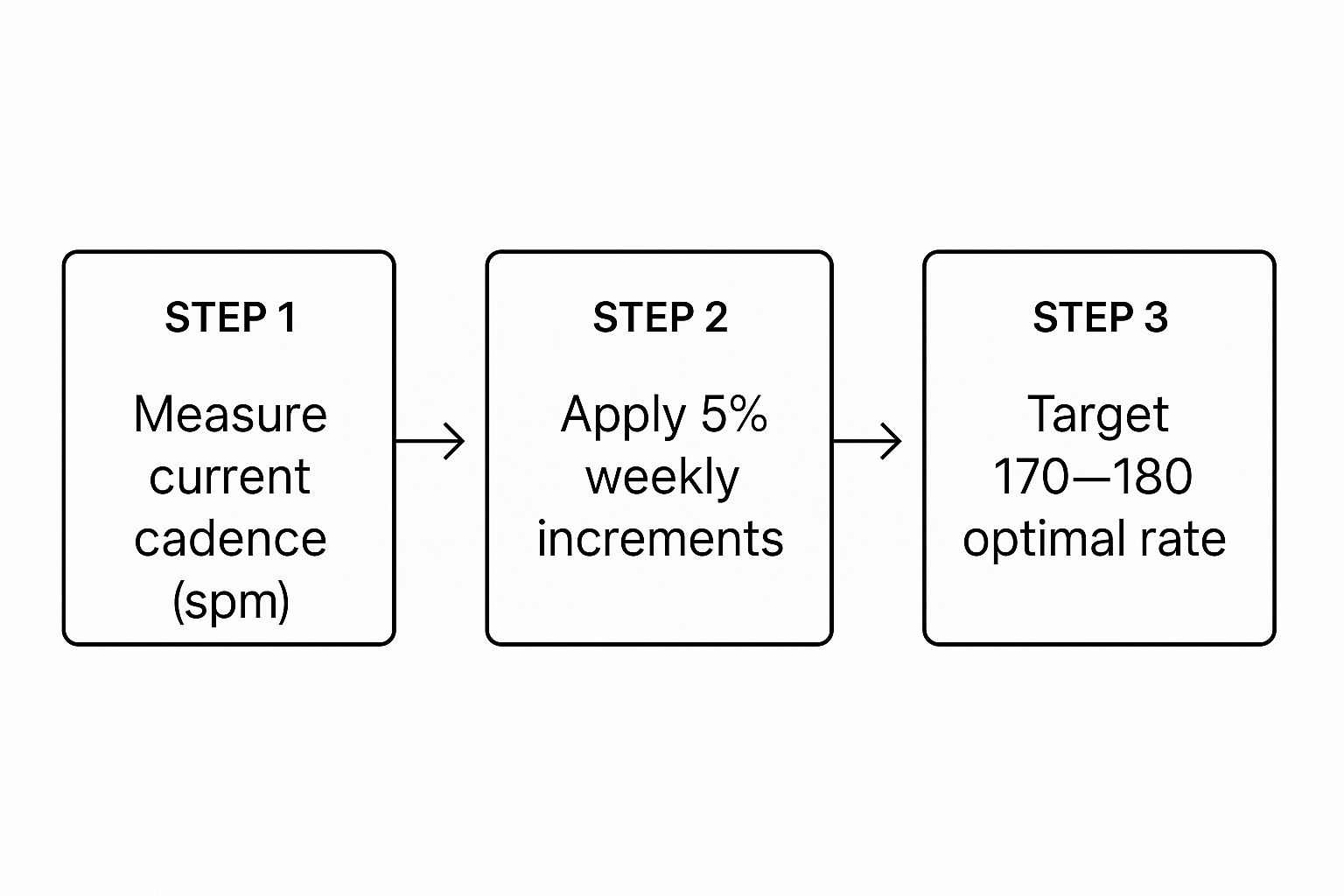
As you can see, this isn't about a complete, painful overhaul. It's about making smart, gradual adjustments that stick.
How to Schedule Your Drill Work
Consistency beats volume every time. You don't need to spend hours on drills to see a difference. Here are a couple of practical ways to fit them into your schedule.
Option 1: The Pre-Run Routine This is my preferred method for most runners. Just bake 5-10 minutes of drills into your warm-up before each run.
2 sets of High Knees (20 meters)
2 sets of Butt Kicks (20 meters)
2 sets of A-Skips (20 meters)
Option 2: The Dedicated Form Day If you have the time, dedicate one day a week to a longer session focused entirely on form.
Start with a light 10-minute jog to get warm.
Perform 3-4 sets of your foundational drills (High Knees, Butt Kicks, A-Skips).
Add 2-3 sets of a plyometric exercise, like ankle hops or bounding.
Finish it off with a short, easy cooldown run.
By making drills a regular part of your training, you're actively teaching your body the language of efficient movement. Over time, these practiced motions will translate into a smoother, faster, and more resilient running stride.
Putting It All Together on Your Runs
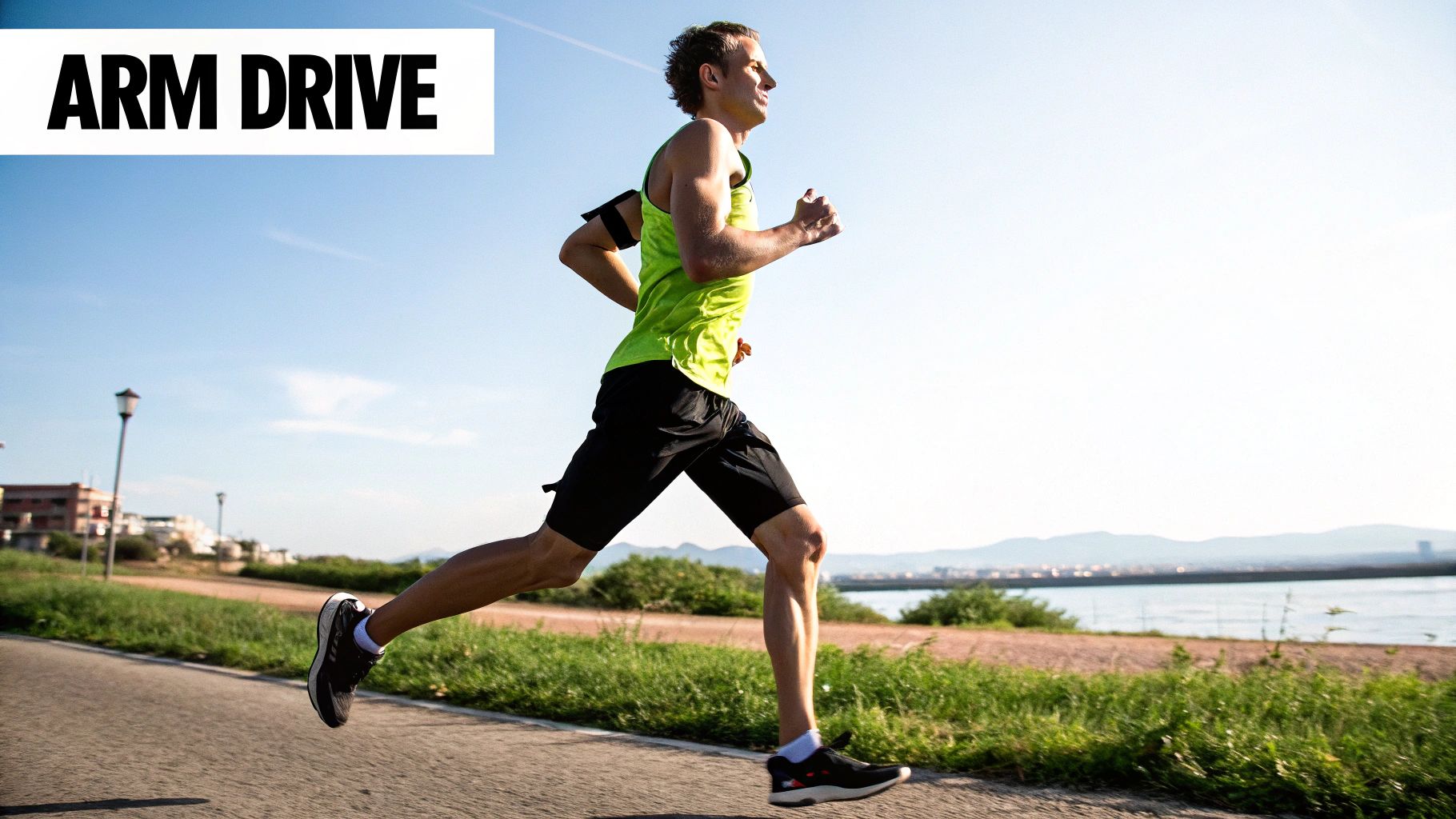
Drills are great for teaching your body new movements in a controlled setting, but the real magic happens when you take those skills out on the road. The trick is to mindfully weave these new habits into your regular runs without feeling like a robot. It's all about turning conscious, clunky effort into a smooth, unconscious habit.
This is where form cues become your best friend. A form cue is a simple, one-word reminder you can use to zero in on a single part of your technique. Let's be honest, trying to think about your posture, cadence, footstrike, and arm swing all at once is a surefire way to get frustrated. Instead, you pick one cue and dedicate small bits of your run to it.
For instance, on your next easy run, decide that the first minute of every mile is your "cadence minute." During that short window, your only thought is a cue like "quick" or "light." You're just focused on increasing your foot turnover, exactly like you did with the metronome. After the minute is up, relax and just run. This approach of "micro-dosing" your focus prevents mental burnout and makes the whole process feel much more achievable.
Patience and a Singular Focus Are Key
I've seen it time and again: the fastest way to get nowhere with your running form is by trying to fix everything at once. Real, lasting change is built slowly and deliberately. It's about layering one good habit on top of another until they become second nature.
A fantastic way to structure this is to dedicate an entire week to one, and only one, element of your form.
Week 1 Focus: Posture. Your cue for the week is "tall" or "proud." On every single run, you'll spend a few minutes here and there consciously running with a proud chest and a slight forward lean that comes from your ankles, not your waist.
Week 2 Focus: Cadence. Now, your cue becomes "quick." Building on that stable posture from last week, you’ll use the one-minute-per-mile strategy to work on a faster, lighter turnover.
Week 3 Focus: Footstrike. Your cue might be "underneath." Your goal is to feel your feet touching down directly beneath your hips, which should already feel a bit more natural after a week of practicing a quicker cadence.
The goal is to make each change feel normal before you even think about adding the next one. This patient, methodical strategy is how you build an efficient, resilient stride that actually sticks around for good.
Your Smartphone is Your Best Coach
You don't need access to a high-tech running lab to get incredible feedback on your form. In fact, one of the most powerful coaching tools you have is probably in your pocket right now. Every couple of weeks, ask a friend to film a short, 15-20 second video of you running, making sure they get a side-on view.
Watching yourself run in slow motion can be a massive "aha!" moment. You will instantly spot things your brain simply can't process in real time—maybe a slight slouch you didn't know you had, or a foot that's reaching out way further in front of you than you thought. This kind of visual feedback is honest and incredibly direct. It takes all the guesswork out of the equation and gives you a clear, actionable plan for what to focus on next.
Common Questions About Improving Your Running Form
Diving into the mechanics of your stride always sparks a few questions. It's totally normal to wonder if you're making the right changes or if all this focus on technique will actually pay off. Let’s tackle some of the most common things runners ask when they start dialing in their form.
Think of this as a conversation to help you trust the process. At the end of the day, the golden rule is to listen to your body. Consistency will always beat chasing some imaginary idea of perfection.
How Long Does It Take to See a Difference?
This is the big one, and the honest answer is, it depends. Sometimes, you'll feel a change almost immediately. I've had runners tell me they felt lighter on their feet after just one run focused on improving their cadence. But making those changes stick—turning them into second nature—takes a bit more patience.
Realistically, most people start to feel a significant, lasting shift after about 4-6 weeks of consistent effort. This means you’re not just thinking about it on one run; you’re weaving drills into your warm-ups and using those mental cues throughout your miles. It’s going to feel awkward at first. That's a good thing! It means your brain is forging new pathways.
The goal isn't a quick fix; it's a long-term upgrade to how you run. Be patient with yourself. Celebrate the small victories, like finishing a long run without your posture collapsing or feeling less achy after a hard workout.
Is There a Perfect Running Form for Everyone?
Not a chance. While the core principles of efficient running are pretty universal—like landing your foot underneath your center of mass and keeping a strong core—there’s no single “perfect” template that fits every runner. Your best form is unique to your body.
Think about it: your height, the length of your legs, and even the unique structure of your joints are all factors you can't change. They all influence how you move. So, instead of trying to perfectly mimic how an elite athlete runs, use these guidelines to discover what feels powerful and fluid for you.
Can Better Form Actually Fix My Knee Pain?
For many runners, the answer is a resounding yes. A huge number of common running pains, especially the dreaded runner's knee, are rooted in biomechanics. The number one culprit I see is overstriding—letting your foot land way out in front of your body. This acts like a brake with every step, sending a jolt of force straight up your leg and into your knee.
By improving your form, particularly by increasing your cadence to encourage a shorter, quicker stride, you dramatically reduce those harsh impact forces. A stable core also plays a huge role by preventing your hips from dropping side-to-side, which takes a ton of stress off your IT band and knees. While it's not a silver bullet for every injury, solid running form is one of your best tools for building a more resilient body.
Should I Change My Shoes When I Change My Form?
That’s a fantastic question. As your running form evolves, your footwear needs might, too. For instance, once you stop overstriding and start landing more on your midfoot, you might find that you don't need a shoe with a massive, highly-cushioned heel anymore.
My advice? Don't rush out and buy a pair of minimalist shoes tomorrow. That can be a huge shock to your feet and calves. The best approach is to make the form changes first. Once those new movement patterns feel natural, then it’s a great time to visit a specialty running shop to get reassessed. They can help you find a shoe that complements your new, efficient stride instead of one that just compensates for old habits.
At RealOminousAthlete, we believe that the right gear should support your best performance. Our innovative sportswear is designed to move with you, giving you the confidence to push your limits. Discover the collection that’s built for every athlete at bearcapes.store.


Comments