
How to Improve Golf Swing: Tips for Better Performance
- Epic Brilliance
- Jul 3, 2025
- 16 min read

Every great golf swing is built on a solid foundation. Forget about all the complex swing thoughts for a moment. If you want real, lasting improvement, you have to start with the two things that connect you to the ground and the club: your grip and your stance.
Get these fundamentals right, and you’re building a repeatable, athletic motion. Get them wrong, and you’ll be fighting your swing every step of the way.
Building Your Swing From the Ground Up
Before you even dream about generating lag or hitting a perfect draw, your pre-shot setup has to be second nature. So many amateur golfers get caught up in the flashy parts of the swing, but I’ve seen countless high-handicappers transform their game just by mastering how they address the ball.
Think of your setup not as a static pose, but as the "ready" position for an explosive, athletic move. It’s about creating a stable platform that allows your body to rotate with power and freedom. From the width of your feet to the angle of your spine, every piece matters.
Finding Your Perfect Grip
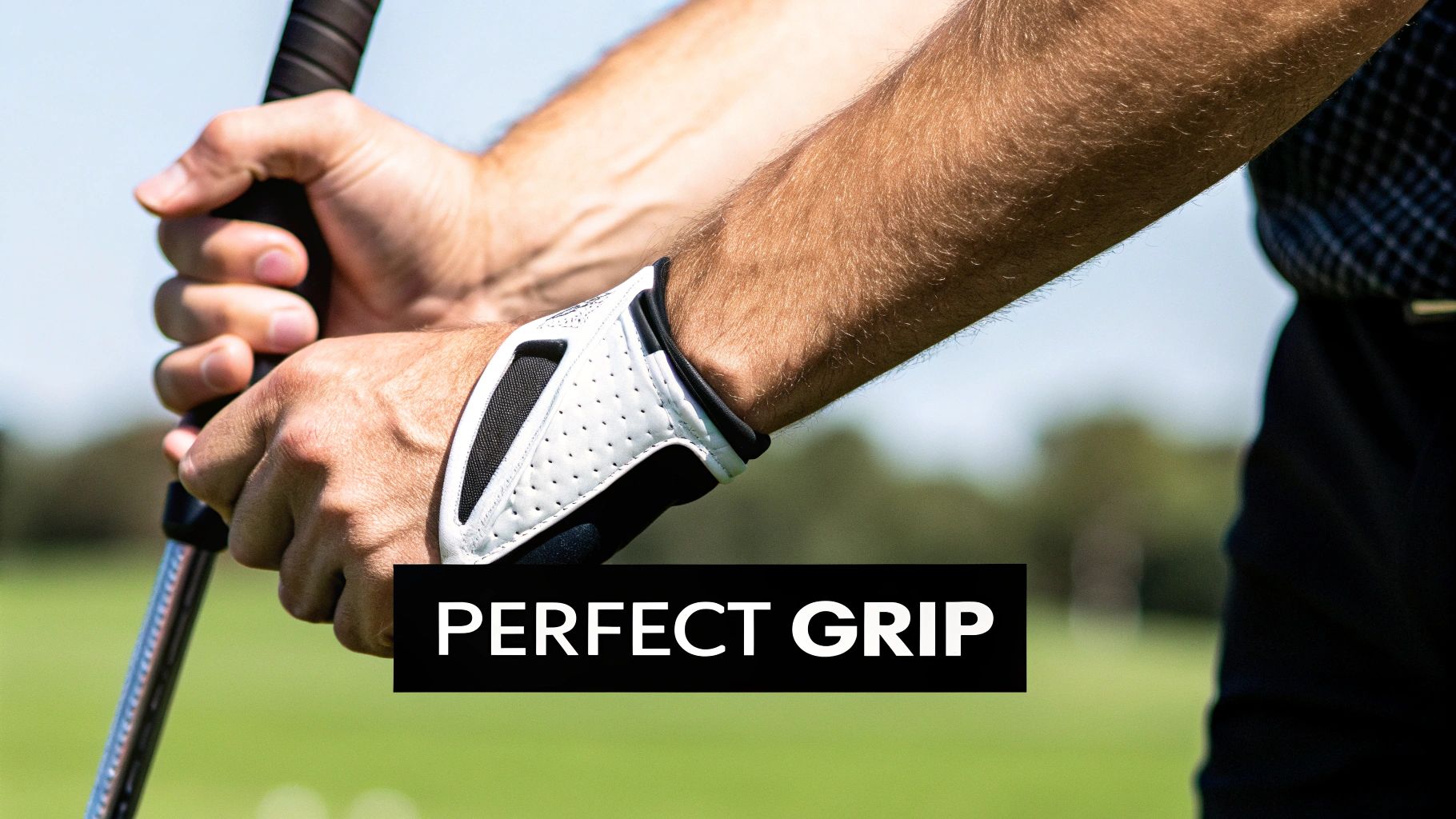
Your grip is your only connection to the golf club. It’s everything. So, it needs to feel secure and natural, not like you’re strangling it. While there’s no single "right" way to hold the club, there is a grip that will be right for you. The ultimate goal is to find a hold that lets you control the clubface without creating unnecessary tension in your hands, wrists, and forearms.
Let’s look at the three most common options:
Interlocking Grip: This is the one you’ve seen Tiger Woods use. The pinky of your trail hand hooks together with the index finger of your lead hand. It's fantastic for golfers who want to feel like their hands are truly locked together as one unit, especially if you have smaller hands.
Overlapping (Vardon) Grip: By far the most popular grip on professional tours. Here, your trail hand's pinky finger rests comfortably in the channel between the index and middle fingers of your lead hand. It’s a solid, reliable choice for the vast majority of players.
Ten-Finger (Baseball) Grip: Don't let anyone tell you this grip is "wrong." It's perfect for beginners, juniors, and players who need a little extra strength and leverage. All ten fingers are on the club, just like holding a baseball bat, which can give you a real sense of power.
No matter which style you choose, the key is holding the club more in your fingers than deep in your palms. This is what allows your wrists to hinge correctly and gives you that crucial clubface control. As a starting point, aim for a "neutral" grip, where the 'V's formed by your thumb and index finger on both hands point roughly toward your trail shoulder.
Establishing an Athletic Stance
Once the grip is sorted, your stance creates the balance and stability needed for the entire swing. An athletic stance isn't stiff or rigid; it’s poised and ready for action.
For a mid-iron, a good rule of thumb is to set your feet about shoulder-width apart, ensuring your weight is balanced evenly. Then, you’ll want to bend slightly from your knees and, more importantly, tilt forward from your hips while keeping your back relatively straight. This creates the posture that allows you to turn.
Thankfully, dialing in these fundamentals is easier today than ever before. It's no surprise that the golf training aids market was valued at USD 827.1 million in 2022 and continues to climb. We’re all looking for that edge.
Modern technology gives you incredible feedback that was once only available to tour pros. For instance, innovative tools like Sportsbox AI use 3D motion analysis on your phone to give you instant feedback on your setup. Similarly, a device like the HackMotion wrist sensor can help you perfect those crucial wrist angles that all start with a good grip and stance. You can learn more about these market trends and how they’re impacting golf training.
Before you hit your next shot, run through this quick mental checklist. It only takes a few seconds but can save you from a lot of common swing faults that start before you even take the club back.
Essential Pre-Swing Setup Checklist
Element | Key Checkpoint | Common Mistake to Avoid |
|---|---|---|
Grip Pressure | Hold the club like a tube of toothpaste—firmly, but not squeezing it out. | A "death grip" that creates tension in the arms and shoulders. |
Ball Position | Forward of center for driver/woods; center for mid-irons; slightly back for wedges. | Playing every club from the exact same spot in your stance. |
Foot Width | Shoulder-width for mid-irons; slightly wider for driver; narrower for wedges. | A stance that's too wide (restricts hip turn) or too narrow (lacks stability). |
Posture | Tilt from the hips, keeping your spine relatively straight. Let your arms hang. | Slouching over the ball or bending too much from the knees. |
Alignment | Feet, hips, and shoulders are parallel to your target line. | Aiming your body at the target instead of parallel to the line. |
Making this checklist a consistent part of your pre-shot routine will help bake these fundamentals into your muscle memory, leading to a much more reliable swing on the course.
Mastering the Backswing Sequence
Think of the backswing as the engine room of your golf swing. It’s where you coil up and store all the power you're about to unleash on the ball. Yet, I see so many well-intentioned golfers get this part completely wrong. They fall into the trap of just lifting the club with their arms, which leads to a weak, disconnected motion that bleeds both power and consistency.
The real secret isn’t lifting—it’s coiling.
Picture yourself winding up a powerful spring. A good backswing is a smooth, unified motion where your hands, arms, chest, and club all start moving away from the ball as a single unit. This creates a powerful feeling of connection and width, which is the exact opposite of letting your arms fly off on their own. The goal here is to feel your chest and shoulders turning away from the target, not just your arms yanking the club into the air.
The Connected Takeaway
The first couple of feet of your backswing really set the stage for everything else. One of the most common mistakes I see on the range is snatching the club back with a quick, handsy move. This immediately throws the club off its proper path, and honestly, it’s a nightmare to try and recover from that.
So, what's the fix? Focus on a "one-piece" takeaway.
The Feeling: For the first few feet, try to maintain the triangle formed by your shoulders and arms. It should feel like the clubhead is staying low to the ground and just outside your hands.
The Visual: Imagine your chest rotation is what's pushing the clubhead straight back from the ball, right along your target line.
A smooth start like this gets your swing on the right track from the get-go, making it so much easier to stay on plane all the way to the top. When you nail the takeaway, it flows naturally into a powerful shoulder turn.
Expert Tip: Your backswing should feel wide. A great mental key is to feel like you're getting your hands as far away from your head as you can at the top. This width is a huge source of leverage and effortless power.
The Full Shoulder Turn
As the club continues its journey back, your focus should shift to making a full and complete turn with your shoulders. This is exactly where most amateur golfers leave a ton of yardage on the table. They stop turning their body and start lifting their arms to finish the swing, which is a classic recipe for a steep, over-the-top downswing.
A proper shoulder turn means rotating your back toward the target. When you reach the top, your lead shoulder should be pointing down toward where the ball was, and your back should be almost entirely facing your target. This deep coil is what stretches the big, powerful muscles in your back and core, loading them up with potential energy.
The image below shows how a solid, athletic stance is the foundation for this kind of rotation.
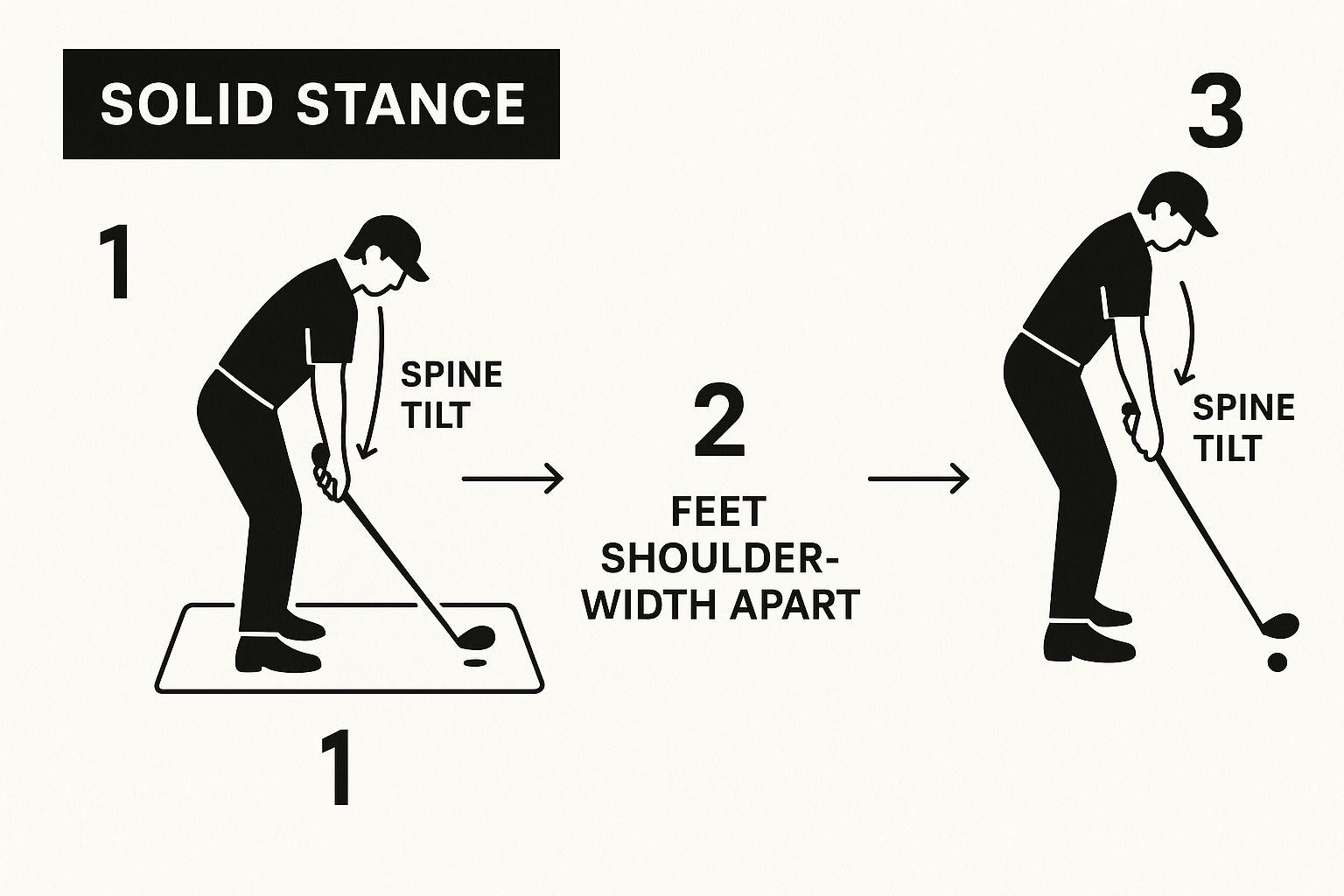
As you can see, everything is built from the ground up. Without that stable base, trying to get a full turn without losing your balance is nearly impossible.
Setting the Club at the Top
The final piece of this backswing puzzle is knowing when to stop. You want to set the club at the top without letting it get away from you in an overswing. This usually happens when the club travels past parallel to the ground, a clear sign that the arms have disconnected from the body's rotation.
While the ideal position is a lot about feel, a fantastic checkpoint is to stop turning when your lead shoulder feels tucked right under your chin. At this point, the club should be roughly parallel to the ground and pointing down your target line. This position confirms you’ve made a full turn without losing control—the perfect spot to transition into a powerful downswing.
Unleashing Power Through Impact

The downswing is where a great backswing truly pays off. This is the moment of truth—the dynamic sequence that separates golfers who struggle for consistency from those who strike the ball purely, time after time. When you get it right, a proper downswing feels less like a violent effort and more like an effortless release of stored energy.
It all starts from the ground up, not with your arms or hands. This is a common sticking point for so many players who try to muscle the club down from the top. Instead, your very first move should be a subtle shift of your lower body toward the target. It’s a strange feeling at first, but it’s the non-negotiable key to unlocking real power and getting the club on the correct inside path.
Initiating the Downswing Correctly
Forget about yanking the club handle down. As you transition from backswing to downswing, your first thought should be your lead hip. Just imagine it starting to rotate open, gently pulling everything else along for the ride. This creates a natural chain reaction.
Lower Body Leads: Your hips begin to unwind toward the target.
Torso Follows: Your chest and shoulders naturally start to follow the rotation of your hips.
Arms Drop: As your body rotates, your arms have no choice but to drop into the "slot"—that powerful inside position you hear so much about.
Getting this sequence right is everything. By starting with the lower body, you prevent that dreaded "over-the-top" move where the arms and shoulders take over, which almost always leads to a weak slice.
The goal is to feel like your arms are just passive passengers in the early part of the downswing. They are simply responding to the powerful rotation of your core and hips, saving up all that energy for the moment that matters: impact.
Maintaining Lag for Explosive Speed
As your lower body gets the downswing started, you automatically create a powerful angle between your lead arm and the club shaft. We call this lag, and it’s a primary source of clubhead speed. Here's a trap many golfers fall into: they try to create lag by consciously holding onto this angle with their wrists. This usually just leads to tension and terrible timing.
Real lag is a result, not an action. When your lower body starts the downswing while your upper body and arms are still near the top, lag just... happens. The secret is to fight that instinct to throw the clubhead at the ball with your hands right from the top.
Modern data has completely changed how we understand swing mechanics. Take GOLFTEC’s SwingTRU Motion Study, for example. They analyzed about 90 million swings from pros and amateurs and found that many old-school teachings don't line up with what the best players actually do. The data helps us pinpoint the exact movements that build a powerful and repeatable swing. You can dive into the fascinating results from this massive golf swing study to see how data is transforming golf instruction.
Releasing the Club Through Impact
As the club drops into the slot and approaches the ball from this inside path, it’s finally time to let go of all that stored energy. This isn't a forceful hit at the ball, but a powerful release through the ball. Your wrists unhinge naturally, and the clubhead accelerates rapidly through the impact zone.
The feeling you're chasing is compression. With your irons, this means striking the ball first, then taking a shallow divot just in front of it. That pure, satisfying "thump" of a well-hit shot? That’s the sound of a fundamentally sound impact, powered by a perfectly sequenced downswing.
Drills That Actually Build a Better Swing
Reading about swing theory is one thing, but getting your body to actually do it on the course, under pressure, is a whole different ball game. You can’t think your way to a better swing. You have to feel it. That’s what drills are for—they're not about banging out a huge bucket of balls, but about deliberately engraving the right movements into your muscle memory.
The whole point is to take the mechanical thoughts out of your head so you can swing freely. Here are a few of my go-to drills that you can practice at the range or even in your living room. Each one targets a very common swing flaw and helps you replace it with a much better feeling.
The Headcover Drill: Kill That Slice for Good
If there’s one move that wrecks scorecards, it’s coming "over the top." This is when your club attacks the ball from an outside-in path, leading to that nasty slice or a weak pull-left. This drill is a fantastic way to physically force yourself onto the correct inside path.
How to set it up: Just place your driver's headcover on the ground about a foot outside your golf ball and a few inches behind it. A rolled-up towel or even a water bottle will do the trick if you don't have a spare headcover.
What to do: Now, just try to hit the ball without hitting the headcover. It’s that simple. To avoid the obstacle, you’ll have no choice but to let the club drop "into the slot" on the downswing, coming at the ball from the inside.
The feeling you're chasing: When you get it right, you’ll feel your arms and hands drop closer to your body as you start your downswing, instead of casting them out and away. That sensation is the key to a powerful, inside-out swing path.
The Split-Hand Drill: Finally Feel the Clubface
A lot of amateur golfers have no idea what their clubface is doing during the swing. Is it open? Is it closed? Who knows! This drill gives you instant, undeniable feedback on how to square the clubface through impact.
First, take your normal grip, then slide your trail hand down the shaft about three to four inches, creating a gap between your hands.
Now, take some slow, easy half-swings. With your hands separated like this, you’ll immediately feel how your forearms have to rotate to get that clubface square. If you leave it open, the ball will flutter weakly to the right. If you shut it too fast, it'll hook left.
This drill is brilliant because it makes flipping your wrists at the ball almost impossible. It teaches you to rotate your body to deliver the club, letting your arms and hands release naturally. This is how you hit those solid, straight shots you're looking for.
The Feet-Together Drill: Find Your Balance and Rhythm
When we try to hit the ball hard, the first thing to go is usually our balance. A wild, off-kilter swing is almost always caused by the body getting out of sync in a desperate attempt to create power. This drill dials everything back and helps you find a smooth, centered motion.
Just stand with your feet completely together and take some swings with a 7-iron. That's it.
You'll find that if you swing too aggressively or if your arms get separated from your body, you’ll stumble and lose your balance immediately. This drill forces you to swing with a much smoother tempo, keeping everything connected. Hit about 10 shots this way, then go back to your normal stance. I bet you'll feel more stable and in control than ever before.
Getting Rid of Your Most Common Swing Faults
Every single golfer I've ever coached, from tour pros to guys who only play a few times a year, has a swing fault they battle. It's that nagging slice that always seems to show up on the back nine, or the sudden bout of fat shots that derails an otherwise great round. Trust me, these aren't just bad luck. They're symptoms, and they point to a specific, fixable issue in your swing.
Think of this section as your personal on-course troubleshooter. We’re going to dig into the real reasons you hit those bad shots and, more importantly, give you some concrete fixes to get your game back where it should be. The moment you understand why you’re hitting a certain shot, you’re halfway to fixing it for good.
The Slice: Curing the Over-The-Top Move
Ah, the slice. That big, curving shot is the absolute bane of most amateur golfers. I’d say 90% of the time, the culprit is an "over-the-top" swing path. This is a fancy way of saying your first move down from the top of your swing is to lunge at the ball with your arms and shoulders, forcing the club to cut across the ball from the outside-in.
What's Really Happening: Your upper body is too eager. Instead of letting your lower body lead the way, your arms and shoulders take over, immediately putting the club on a steep, outside path that's destined to produce a slice.
How to Fix It: You need to feel the downswing start from the ground up. Seriously. The very first move from the top shouldn't be with your hands, but a subtle bump of your weight onto your lead foot as your lead hip starts to open toward the target. This simple sequence gives the club no choice but to drop down "into the slot" on a proper inside path, setting you up for a powerful draw instead of a weak slice.
Here's a mental image that works wonders for my students: Feel like you’re trying to pull-start a lawnmower, but you're pulling the cord with your lead hip. This promotes the correct sequencing and stops your upper body from jumping the gun.
The Hook: When You Get "Stuck"
On the other side of the spectrum is the hook—that low, diving shot that shoots hard left (for a righty). This usually happens when the club gets too far behind you on the downswing, forcing your hands to flip over like crazy just to make contact.
What's Really Happening: Your arms are getting "stuck" behind your body's rotation. With no room to swing, your only option is to roll your wrists over to square the clubface, which often leads to it being shut tight at impact. This creates a severe in-to-out path and that signature sharp hook.
How to Fix It: The key is creating more space on the downswing. A great thought is to focus on rotating your chest all the way through the shot until it faces the target in your finish position. This body rotation will naturally pull your arms and the club through with it, so they never get trapped and you won't feel the need to flip your hands.
Fat and Thin Shots: The Low Point Problem
Hitting the ground before the ball (a fat shot) or catching only its equator (a thin shot) feel like opposite problems, but they're two sides of the same coin. Both are symptoms of poor control over the low point of your swing arc.
What's Really Happening: The bottom of your swing is in the wrong place. If you hit it fat, your weight is probably hanging back on your trail foot, causing the club to bottom out too early. If you hit it thin, you might be lifting your chest and head up through the shot, raising the entire swing arc.
How to Fix It: Good iron players always strike the ball first, then the turf. To make this happen, you have to get your weight transferred to your lead foot before you hit the ball. Here's a fantastic drill I use all the time: place a towel on the ground just a few inches behind your ball. Your one and only goal is to hit the ball cleanly without touching the towel. It physically forces you to shift forward and create that downward strike you’re looking for.
Answering Your Top Golf Swing Questions
You're going to have questions as you start making these changes to your swing. That's not just normal; it's a good sign. It means you're paying attention and thinking about what you're doing. Let's tackle some of the most common questions I hear from golfers who are serious about getting better.
It’s no secret that golfers are always looking for an edge. The market for golf swing trainers, valued at around USD 1.2 billion in 2023, is proof of that. That number is expected to more than double by 2032, which just shows how many of us are turning to new tools and tech to fine-tune our game. You can actually read more about the growth of the golf training market to see where things are headed.
How Long Until I See Real Improvement?
This is the million-dollar question, isn't it? While everyone's journey is different, I find that with consistent, focused practice, most golfers start to see real, tangible changes in their ball flight and consistency within four to six weeks. That means getting out there two or three times a week.
The key word here is "focused." Just showing up and beating a bucket of balls into the void won't do much. You need to walk into every practice session with a plan—a specific feel or a drill you're working on.
True improvement comes from quality, not quantity. A focused 30-minute session with a specific drill is far more valuable than mindlessly hitting 200 balls. Progress is measured by better contact and tighter shot dispersion, not just time spent on the range.
Should I Focus on Swing Speed or Accuracy First?
Accuracy. Always. Start with solid fundamentals and a swing that produces a reliable, predictable ball flight. A smooth, controlled swing is a weapon on the course; a fast, wild one is a liability.
Trying to bolt on more speed to a swing that’s already flawed is just a recipe for disaster. It magnifies every single mistake. Think of it like building a house—you pour the foundation before you even think about putting on the roof. Once your swing mechanics are solid and your timing is repeatable, you'll find that power and speed start to show up naturally, and in a way you can actually control.
Is It Better to Get Lessons or Learn on My Own?
Look, the internet is an amazing resource with a ton of great information. But nothing can truly replace the trained eye of a qualified PGA professional. A good coach can spot the root cause of your issue in a handful of swings—something that might take you months of frustrating guesswork to figure out on your own.
A coach gives you drills designed specifically for your swing, not someone else's. More importantly, they stop you from cementing bad habits that could take years to unlearn. While you can certainly make progress on your own, working with a coach is almost always the fastest and most efficient path to a better golf swing.
What Is the Most Important Part of the Golf Swing?
If I absolutely had to pick one single moment, it's impact. That's where the club meets the ball, after all. But here's the catch: you can't have a great impact position without everything leading up to it being correct. A pure strike is the result of a good grip, a balanced setup, a properly sequenced backswing, and a smooth transition.
Instead of getting hung up on one "most important" part, I encourage my students to think of the swing as a chain. Every single link—from your grip and stance all the way to your follow-through—is equally important. When every link in that chain is strong and works in concert with the others, the whole thing works beautifully.
At RealOminousAthlete, we believe that the right mindset, paired with high-performance gear, is the key to unlocking your best game. Our sportswear is designed to give you the confidence and comfort to focus on what matters most—your swing. Check out our collection and find your game-changing gear today.


Comments