
How to Improve Basketball Shooting: Tips to Elevate Your Game
- Epic Brilliance
- Jul 1, 2025
- 15 min read

If you want to become a better shooter, the secret isn't a secret at all. It's about building a rock-solid, repeatable shooting form that you can trust in any situation. The goal is to make your shot so automatic that you don't even have to think about it.
This isn't about some rigid, one-size-fits-all checklist. It's about understanding the core principles that every great shooter uses to transfer energy efficiently from the ground up, right through their fingertips.
Building Your Shot: A Foundation-First Approach
Think of your shot as a chain. If one link is weak, the whole thing falls apart. Power and accuracy flow directly from your feet, through your legs and core, and finally out of your hand. A hitch in your feet or a flare in your elbow can be the difference between a swish and a brick. Let's break down how to build that chain, starting from the ground.
Your Base Is Everything
Your shot doesn't start with your hands; it starts with your feet. How you set your base determines your balance, power, and alignment.
For a right-handed shooter, your feet shouldn't be squared up directly at the basket. Instead, try a slight turn, pointing them somewhere between 10 and 11 o'clock if the rim is at 12. This subtle shift helps naturally align your shooting hip, elbow, and shoulder in a straight line toward your target. This is the single most important element for accuracy.
Keep your feet about shoulder-width apart. You want to feel athletic and balanced, ready to spring up, not flat-footed or wobbly. This stable platform is where your power comes from, especially when you start backing up behind the arc.
A Quick Tip: A lot of players are taught to square their shoulders completely to the hoop. For most people, this actually creates tension and forces the shooting elbow to stick out, which is a classic cause for shots missing left or right. A slight body turn feels more natural and is often more accurate.
The infographic here really drives home how these pieces connect.
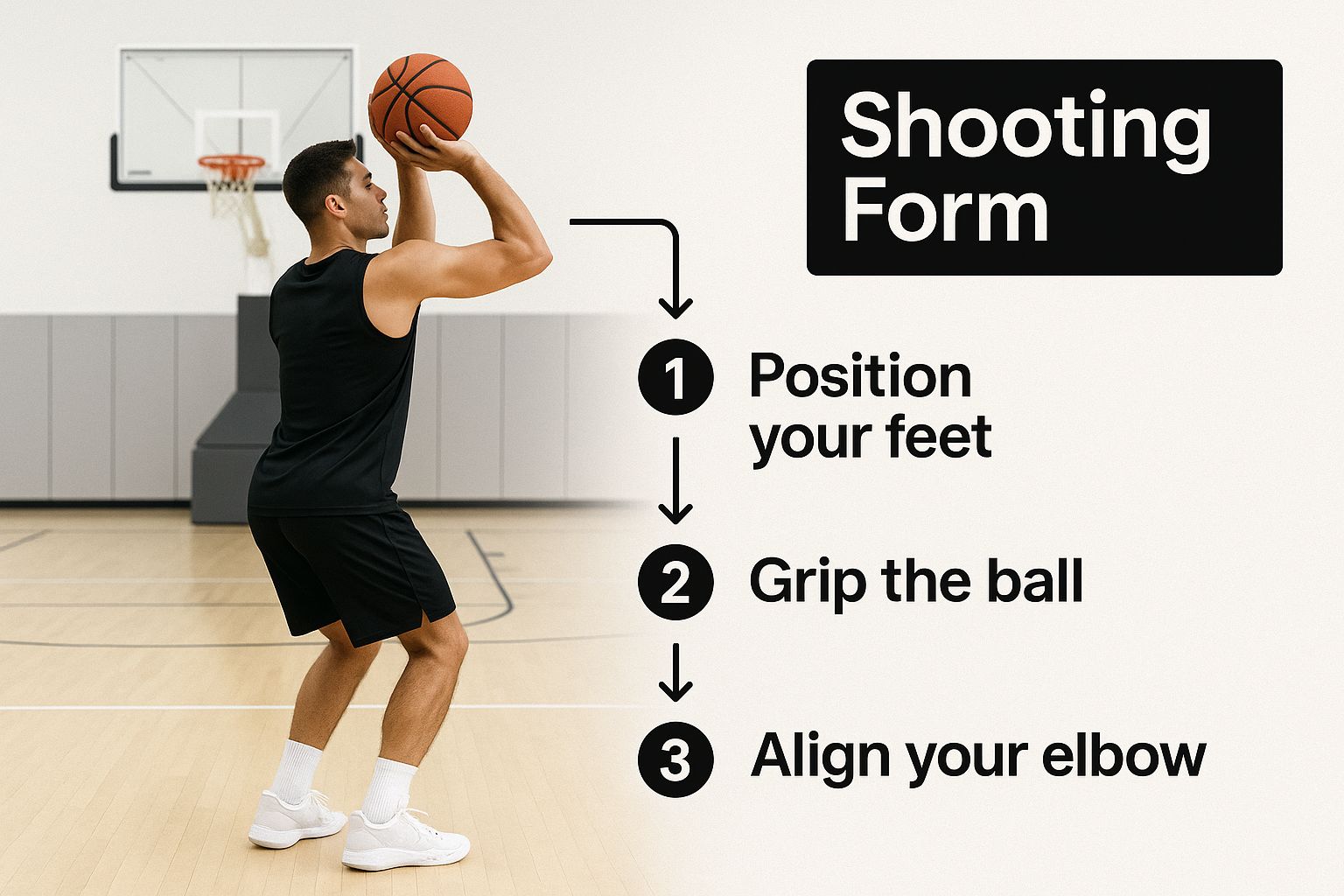
Seeing the alignment visually can help you feel it in your own body when you practice.
Essential Shooting Form Checklist
To make this even clearer, here's a quick-reference table. Use it to audit your own form or to keep key points in mind during your next shooting workout.
Component | What to Focus On | A Common Mistake to Fix |
|---|---|---|
Feet & Stance | Shoulder-width apart, slight turn toward non-shooting side for alignment. | Squaring up perfectly to the basket, which can cause tension and elbow flare. |
Shot Pocket | A comfortable, consistent spot (waist to chest) to start the upward motion. | Bringing the ball behind your head or too far from your body, creating a "hitch." |
Energy Transfer | One fluid motion; power comes from the legs and flows straight up. | "Catapulting" the ball by pushing it out instead of up, losing power and arc. |
Elbow & Arm | Keep the shooting elbow tucked under the ball, creating an "L" shape. | Letting the elbow flare out to the side, causing inconsistent side-to-side misses. |
Follow-Through | Hold your follow-through high until the ball hits the rim. "Reach into the cookie jar." | Dropping your shooting hand immediately after release, which kills rotation and arc. |
Think of this table as your mental checklist before every shot in practice. Over time, you won't need it—the feeling will become second nature.
The Smooth Flow of Energy
With your feet set, the next piece is generating power smoothly. Your shot should be one seamless movement, not a clunky, two-part motion.
As you catch the ball (or dip it before a free throw), bend your knees and hips. This loads your legs with potential energy. The ball should come into your "shot pocket"—that sweet spot somewhere between your waist and chest where the shot feels most natural to begin.
From this loaded position, the energy transfer begins. As you extend your legs to jump, the ball should travel in a straight line up your body. Imagine it's on an elevator rising to your release point. Don't push the ball out from your chest and then up. That's a "push shot," and it's a huge power leak. The "up, not out" path is key to an effortless and powerful release.
Fine-Tuning Your Shooting Mechanics
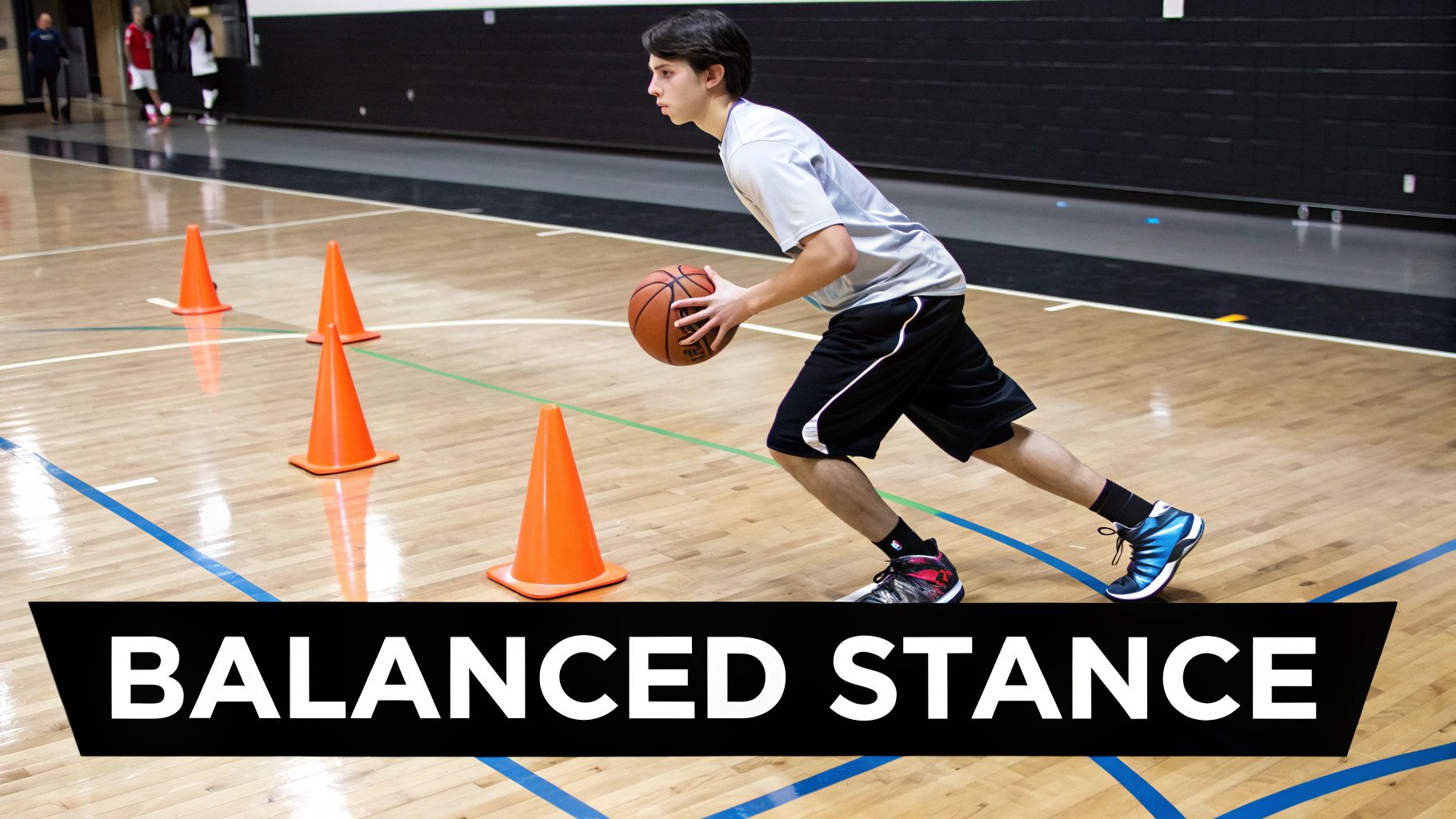
Once you've got a solid foundation, the real fun begins. This is where we get into the details—the small, almost imperceptible tweaks that turn a decent shot into a deadly one. It’s these subtleties that separate the good shooters from the elite, creating that effortless power, perfect ball rotation, and unwavering consistency every player craves.
Think of it less as a checklist and more as an art form. Let's break down the critical upper-body mechanics that really make the difference between a make and a miss.
The Dip, Lift, and Set Point
The best jump shots have a rhythm, a continuous flow of energy that starts from the floor and ends at your fingertips. The dip is where that rhythm begins. As you catch the ball or gather to shoot, you'll see great shooters bring the ball down slightly to their waist or chest. This isn't a hitch; it’s a crucial timing mechanism that syncs your upper and lower body, loading everything up for a smooth, powerful transfer of energy.
From that dip, the ball needs to travel on a straight lift path right up the front of your body. Imagine it’s on an elevator track. A common mistake I see all the time is players letting the ball swing out away from them. This "catapult" motion kills your power and makes your shot incredibly easy for a defender to block. Keep it tight.
Your set point is simply the peak of that lift, the spot right before you start your forward push to the rim. For most players, the sweet spot is somewhere just above the shooting eye. The key is finding a set point that is comfortable and, more importantly, consistent. This ensures you're shooting from the exact same launch position every single time, which is the bedrock of muscle memory.
One-Motion vs. Two-Motion Shots
Every shooter is different, and shots generally fall into two categories. Figuring out which one you are is key to unlocking your potential, not fighting against your natural mechanics.
One-Motion Shot: This is a fluid, continuous movement where the lift and release just blend together. The ball never really stops; it flows right through the set point. Think Stephen Curry. This style is typically quicker and generates power more easily from distance, making it a weapon from three-point range.
Two-Motion Shot: This style has a more distinct pause at the set point before the final upward push and release. Michael Jordan and Kawhi Leonard are prime examples. It offers fantastic control and is incredibly effective for mid-range pull-ups, where you need to rise up over a defender and shoot at the peak of your jump.
Let me be clear: neither style is better than the other. The best one for you is the one that feels natural and repeatable. Don't try to force a one-motion shot if your body instinctively wants to pause.
Great shooters don’t fight their natural tendencies; they refine them. Whether you have a one-motion or two-motion shot, the principles of a straight lift path and a high release remain the same.
The Release and Follow-Through
This is the moment of truth. This is where all that groundwork pays off in accuracy. As the ball leaves your hand, the final point of contact should be your index and middle fingers. You want them to roll straight down the middle of the ball, imparting perfect backspin. That spin is what gives you a "soft" shot and those friendly bounces off the rim.
Now, let's talk about your guide hand. It has one job and one job only: to stabilize the ball on its way up. It’s a silent partner. Just before you release, it needs to come straight off the side of the ball without adding any force, spin, or push. A thumb-flick from the guide hand is one of the most common causes of inconsistent misses.
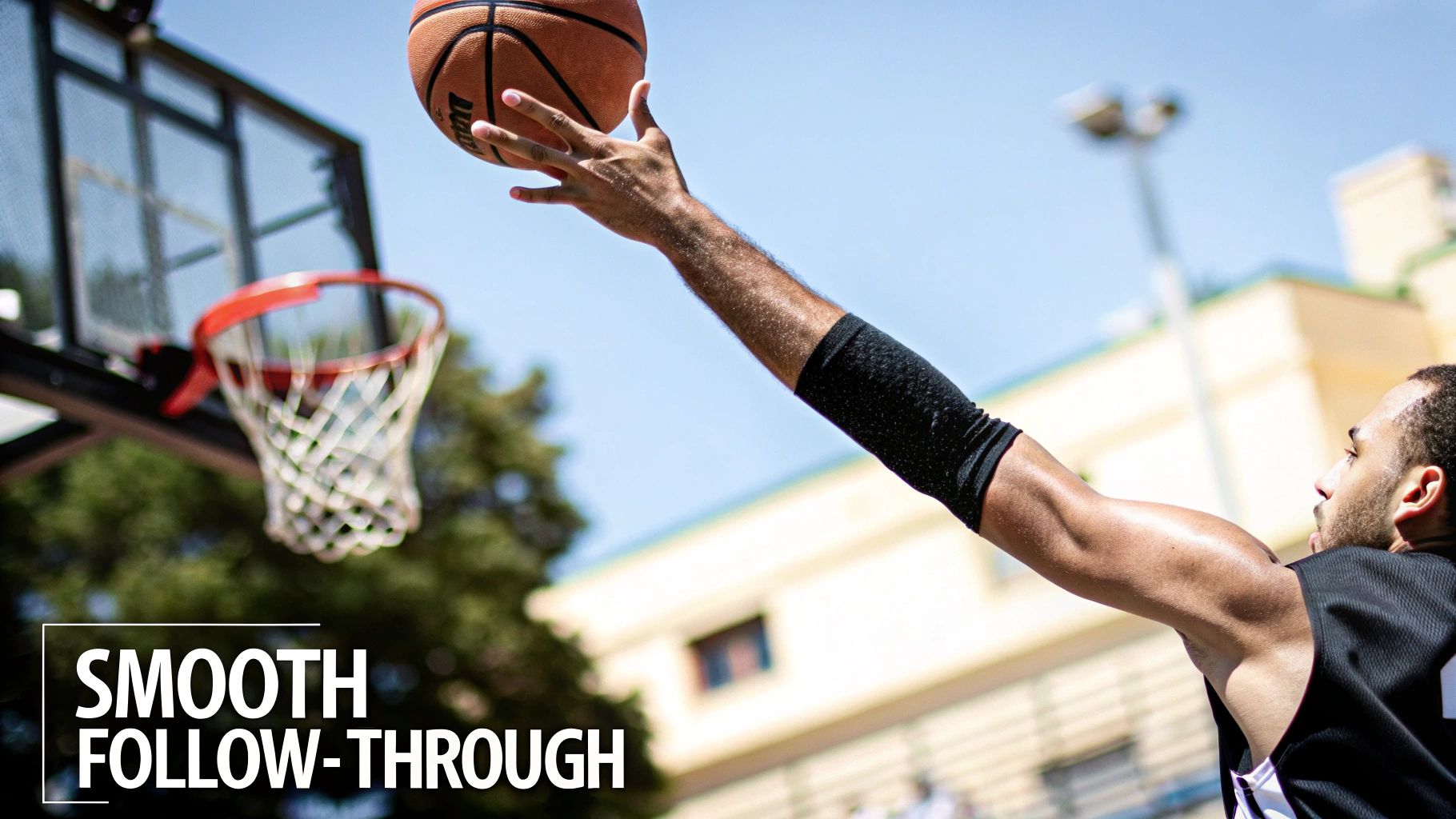
And finally, the follow-through. This is completely non-negotiable. After the ball is gone, hold your form. Keep that shooting arm extended high, like you’re reaching into a cookie jar on the top shelf. Your elbow should finish above your eye with your wrist snapped and floppy. Don't just drop your arm—hold that pose until the ball hits the rim. It's more than just for show; it's your personal guarantee that you've completed the full shooting motion and given the ball the arc it needs to go in.
Developing a Lethal Three-Point Shot
In today's game, the three-point line is far more than just paint on the floor—it's the great equalizer. Being able to consistently knock down shots from behind the arc makes you a constant problem for the defense. You create space, break down zones, and instantly become a more valuable scorer.
A lot of players trying to add distance to their jumper make the same mistake: they try to "muscle" the ball to the rim with their arms. This is a recipe for disaster. It leads to a flat, ugly shot, bad misses, and a tired shooting arm by the second quarter.
True range doesn't come from your shoulders; it comes from the ground up. The power is generated in your legs and hips, flowing like a wave through your core and out through your fingertips. Your form from 15 feet should look almost identical to your form from 23 feet. The only real change is how much force you put into the floor—a deeper knee bend and a more explosive jump.
Generating Power Without Wrecking Your Form
So, how do you extend your range without messing up your mechanics? The secret is to add power efficiently, not forcefully. Don’t just step behind the arc and start launching prayers.
Instead, start your shooting workout just inside the arc, where you know you can make shots comfortably. After you hit five in a row, take one small step back. As you move farther from the basket, zero in on these three things:
A Deeper Dip: As you catch the ball and get into your shot pocket, let your knees and hips sink a little lower than you would for a mid-range shot. You're essentially loading a spring with more energy.
Full Body Sync: This is critical. Your upward motion has to be one fluid movement. The power from your legs needs to transfer seamlessly into your lift and release. If there's any pause or hitch, you lose all that energy.
Accelerated Release: A quick release isn't just about beating a defender's closeout. It actually helps transfer that lower-body power into the ball. A slow, deliberate wind-up from deep almost always turns into a push-shot and a miss.
A quick, compact motion is what makes a great shooter in practice and in games.
The goal isn't just to make threes in an empty gym. It's to become a threat. A player who can shoot from deep fundamentally changes the geometry of the court, pulling defenders out and creating wide-open driving lanes for teammates.
The Math Behind the Arc
Ever wonder why the three-pointer completely took over basketball? The answer is in the analytics, specifically a concept called points per shot (PPS). This simple metric shows exactly why the long two-pointer is the worst shot in basketball.
Think about it: a player shooting an elite 50% on mid-range jumpers is generating 1.0 PPS. To get the same value, a three-point shooter only needs to make 33.3% of their attempts. This efficiency calculation has fundamentally shifted offensive strategy at every level of the game. For a deeper dive, you can explore more about how analytics changed shooting strategy in this detailed study.
This is why improving your shot from distance isn't just a bonus anymore; it's a necessity for any serious player.
Adjusting Your Shot Arc for Distance
As you move farther out, the arc of your shot becomes more and more important. A flat shot has almost no margin for error when it gets to the rim—it has to be perfect. A higher arc, on the other hand, gives the ball a much better chance of dropping in, even on an imperfect shot.
To get more arc on your threes:
Focus on Lift: Think "up, not out." Your primary force should be directed vertically, getting the ball up and over the front of the rim.
High Follow-Through: This is a classic coaching tip for a reason. Exaggerate holding your follow-through high, keeping your elbow above your eye until the ball hits the net. This physical cue naturally encourages a softer, higher trajectory.
Mastering the three-point shot takes time and thousands of reps. But it all starts with understanding how to generate power the right way and appreciating the massive strategic advantage it gives you. Get these fundamentals down, and you're on your way to becoming a true perimeter threat.
Drills That Build Unconscious Consistency
Solid mechanics give you the blueprint for a great shot, but drills are where you build the house. It’s through thousands of purposeful reps that a technically sound shot becomes an unconscious, automatic weapon on the court. The real goal here is to get past just standing still and shooting. We need to practice drills that replicate the speed and chaos of a real game.
This isn't about mindlessly getting shots up. It's about making every single repetition count. Your practice sessions have to simulate the pressure, movement, and footwork you’ll actually use when a defender is closing out hard. This is how you build a jumper that shows up when the lights are on, not just in an empty gym.
Mastering Catch-and-Shoot Scenarios
The catch-and-shoot jumper is the bread and butter of almost every great scorer. To really get it down, you have to practice receiving the ball while you’re already moving.
A fantastic drill for this is "Shooting on the Move." It's simple, but effective.
Start right under the basket.
Jog out to one of the wings behind the three-point line.
As the pass is coming, plant your inside foot first, then your outside foot. This footwork squares you up to the rim as you catch the ball.
Go right from the catch into your shot. No hesitation.
Mix it up. Alternate between jogging, running, and sprinting out to different spots all over the floor. This drill forces your body to find its balance and alignment on the fly, a non-negotiable skill for hitting shots off a teammate's pass.
The key is to make your footwork completely automatic. Elite shooters don't think about their feet; their feet just know where to go. By practicing movement into your shot, you're engraving that muscle memory for game-speed situations.
Developing a Shot off the Dribble
Creating your own shot is a different animal altogether. It’s all about a seamless transition from handling the rock to rising up for a clean shot.
The "One-Dribble Pull-Up" drill is absolutely fundamental here.
Location: Start at the top of the key.
Action: Take one hard, explosive dribble to your right or left.
Execution: As you gather the ball after that single dribble, push off your back foot and rise straight up into your jump shot. Your dribble and gather need to feel like one fluid, powerful motion.
Your main focus should be getting your feet set directly underneath you as you pick up the ball. A common mistake is drifting sideways on pull-ups, which absolutely kills your accuracy. Practice stopping on a dime, going straight up, and holding that follow-through.
Blocked Practice vs. Random Practice
To make sure your hard work actually translates to the game, you need to understand two different ways to train.
Blocked practice is when you repeat the exact same drill over and over. Think of making 10 catch-and-shoot threes from the exact same spot. This is incredibly useful for burning in a new mechanical feel or fixing a bad habit.
But to make your skills stick under pressure, you have to incorporate random practice. This just means mixing up your shots constantly, forcing your brain to adapt. A quick random practice sequence could look like this:
Two catch-and-shoot threes from the right wing.
One pull-up jumper from the left elbow.
A transition pull-up from the top of the key.
Then, repeat that same sequence but from different spots on the floor.
This random structure prevents you from going into "robot mode" and forces your mind and body to adjust on every single rep, just like you have to in a game. Research has shown this approach leads to much better skill retention and in-game performance. Your workouts should always have a healthy mix of both blocked and random practice to build a truly reliable and versatile shot.
Forging an Unshakeable Shooter's Mindset
Perfect mechanics will get you a spot on the team, but a strong mind wins championships. The mental side of shooting is what separates the good from the great, especially when the game is on the line. It’s that unshakeable belief that lets you step up for a huge shot, regardless of whether your last five clanked off the rim.
Real shooting confidence isn't about hitting every single shot—that's impossible. It's about resilience. It’s the deep-down trust you've earned through countless hours of practice, knowing your work will pay off when it matters most. This is the foundation that gets you through the inevitable slumps every player faces. It's that little voice in your head that always says, "The next one's going in."
Master Your Pre-Shot Ritual
Watch any elite shooter, and you'll see them go through a quick, consistent routine before every shot. This isn't just a nervous tick or superstition; it’s a powerful tool for creating a mental anchor in high-pressure moments. A solid routine tells your brain, "Okay, forget the noise. It's time to do that thing we've done ten thousand times."
Your routine doesn't need to be complicated. In fact, simpler is often better. It might just be:
Finding the seams of the ball.
Taking one deep, centering breath.
Locking your eyes on a specific part of the rim.
Flowing into your shot.
What matters isn't the specific sequence, but its consistency. It could be a single dribble, a quick shoulder shrug, or a quiet word to yourself. Find what feels natural, and then own it. This ritual becomes your personal reset button, allowing you to block out the roaring crowd, the scoreboard, and any flicker of self-doubt.
The Power of a Short Memory
The best shooters I've ever coached treat every single shot as its own unique event. The last bucket you made doesn't guarantee the next one, and that ugly miss from a minute ago has absolutely zero bearing on the one you're about to take. This is what we call having a short memory.
Steph Curry, arguably the greatest shooter of all time, perfectly captures this mindset. After a rare off-night, he once said, "I doubt this will happen again... one game is not going to make me stop shooting or alter my confidence at all." He knows that slumps happen, but his belief in his process never wavers.
When you miss, give yourself a split second to figure out why. Was it a forced shot? Did you rush your feet? Learn the lesson, and then let it go immediately. Dwelling on a miss is like trying to drive forward while staring in the rearview mirror—it only breeds hesitation, and hesitation is a shooter's worst enemy.
The same goes for makes. Don't get too high. Stay focused, stay level, and get ready for the next play. Mastering this mental discipline is the secret to how to improve basketball shooting under pressure and ensures you’re always ready when your team needs you most.
Got a Nagging Question About Your Jumpshot?
Every single shooter, from a kid in their driveway to an NBA All-Star, hits a plateau. You're putting in the hours, but the ball just isn't dropping the way you want it to. It's frustrating, but it's also a completely normal part of getting better.
Let's cut through the noise and get straight to some of the most common shooting questions I hear from players. Sometimes, a simple shift in perspective is all it takes to get you back on track.
How Long Does It Really Take to See Improvement?
This is the million-dollar question, isn't it? The honest answer is that it all comes down to the quality of your practice, not just the quantity. If you're just mindlessly chucking up shots, you could practice for months and see little to no change.
But if you commit to purposeful practice 3-4 times a week, you can realistically expect to feel a noticeable difference in your consistency and confidence within 4-6 weeks.
What's purposeful practice? It means every rep has a goal. Maybe today is all about keeping your elbow in for 100 shots. Or maybe you're only focusing on your follow-through. It’s better to make 100-200 perfect reps than 500 sloppy ones. Building that deep, in-game muscle memory takes months, but tracking your makes will prove the work is paying off.
What's the Secret to Increasing My Shooting Range?
It's not your arm. Let me say that again: your range comes from your legs and core. The biggest mistake I see is players trying to "push" the ball harder with their arm and shoulder to shoot from deep. That just creates a flat, ugly shot and completely wrecks your form.
Think of it this way: build your perfect shot from close range first, where it feels effortless. Then, take small, deliberate steps back. As you move farther from the hoop, the only things that should change are:
A Deeper Knee Bend: You need to load your legs with more potential energy. Get lower in your stance before you explode upwards.
A Smoother Energy Transfer: The motion has to be one fluid wave. Power flows from your toes, through your core, and out of your fingertips. Any hitch or pause drains that power.
Your shot from 23 feet should look identical to your shot from 15 feet. The only real difference is the amount of force you generate from your lower body. Get serious about squats and core work, and you'll find that "effortless" range you're looking for.
My Shot Is Always a Flat Line-Drive. How Do I Get More Arc?
A flat shot is a low-percentage shot. It has a tiny window to go in. This problem almost always stems from pushing the ball forward at the rim instead of lifting it up and over it. The fix comes down to two things: your release point and your follow-through.
You want a high release. A great mental cue is to imagine you're reaching up to put a cookie on a shelf that's just out of reach. Your elbow should finish above your eye level. You're lifting, not just extending.
Here's a fantastic drill: Stand a few feet from the rim and practice shooting the ball over the backboard so it still drops through the net. This drill physically forces you to shoot with a high arc. It’s an eye-opener that instantly teaches your body what a soft, high shot is supposed to feel like.
How Do I Stop My Guide Hand From Messing Up My Shot?
Your guide hand has one job: to keep the ball stable on the way up. That's it. It’s a silent partner. It should never push, flick its thumb, or add any spin. If your shots are consistently missing left or right, there's a good chance your guide hand is the culprit.
To kill this bad habit, you have to go back to the beginning. Spend serious time doing one-handed form shooting, starting right under the basket. This retrains your shooting arm to do all the work and find the proper path to the hoop.
When you bring the guide hand back, just place it gently on the side of the ball. As you shoot, make a conscious effort to feel it come straight off the side without influencing the ball's flight.
At RealOminousAthlete, we know that unlocking your peak performance is about having the right gear and an even better mindset. Our products are built for dedicated athletes who are ready to put in the work. Equip yourself for success and discover your true potential.


Comments