
How to Get Better at Basketball Fast
- Epic Brilliance
- Jul 2, 2025
- 14 min read

If you want to get serious about improving your basketball game, you have to move beyond just playing pickup games. The real work, the kind that translates to better performance when it counts, is all about practicing with a clear purpose. It boils down to a simple formula: build your foundation with smart drills and then track your progress to stay on the right path.
Build Your Game from the Ground Up
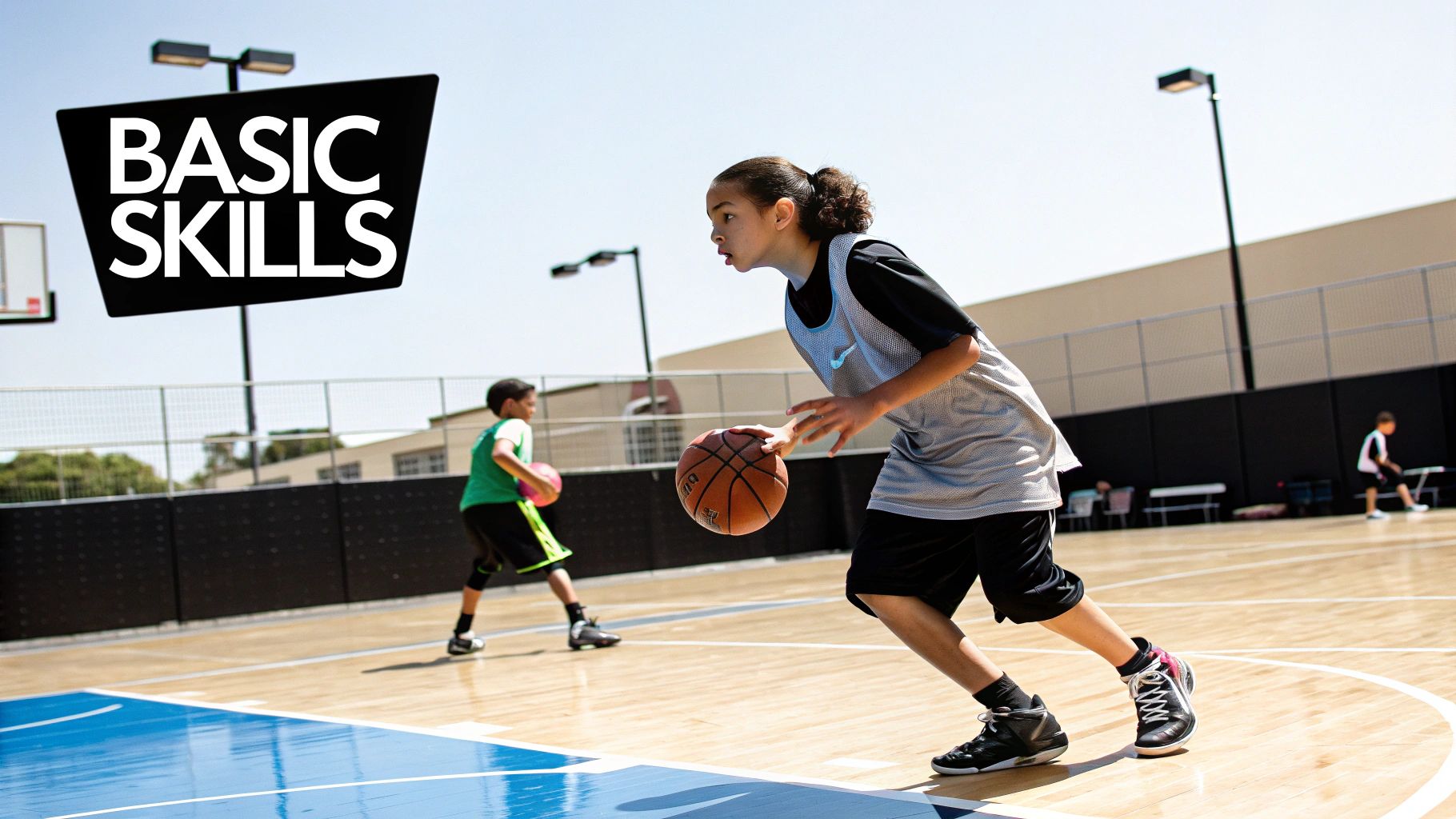
The secret to making a real, lasting leap in your basketball ability isn't some magic trick. It's a deep commitment to the fundamentals. Every single great player you can think of, from the local legend at the park to NBA hall-of-famers, built their game on a rock-solid base forged through thousands of hours of focused practice.
This means you have to get intentional. Stop just aimlessly chucking up shots or playing endless pickup where bad habits get reinforced. True improvement comes from drills designed to attack your weaknesses and sharpen your strengths until they’re pure instinct. You're building a skill set that won't fall apart when the pressure is on.
Mastering the Core Skills
To build a game you can rely on, you've got to master three fundamental areas: ball-handling, shooting, and finishing. These are the pillars holding up everything else you do on the court. Trying to build an advanced move without them is like trying to put a roof on a house with no foundation—it's just going to collapse.
Ball-Handling: Your ability to control the ball is everything. It’s the source of your confidence on the floor. You simply can't create plays for yourself or your teammates if you’re constantly worried about turning it over.
Shooting Mechanics: Consistent scoring is born from repeatable, sound shooting form. Every time you practice, you should be reinforcing proper mechanics, from your footwork to your follow-through. It needs to be automatic.
Finishing at the Rim: Scoring in the paint, through contact and traffic, is non-negotiable. This is so much more than basic layups; it’s about having a package of floaters, crafty footwork, and knowing how to use your body to shield the ball.
Adopt the 1% Better Mindset
Big jumps in skill don't happen in a single practice. They're the product of small, consistent efforts that stack up day after day. This idea was famously used by the legendary coach Pat Riley and his "Career Best Effort" (CBE) system. He would establish a player's baseline stats and then challenge them to improve by just 1% over the season. That tiny, manageable target led to massive collective and individual growth. You can discover more about this powerful approach to incremental improvement and apply it to your own game.
The goal isn't to be perfect overnight. The goal is to be slightly better today than you were yesterday. That tiny 1% improvement, when repeated daily, leads to incredible results that you can depend on when the game is on the line.
To put this into practice, start tracking your drill performance. If you made 5 out of 10 shots from a certain spot last time, your goal for the next session isn't to suddenly hit all 10. It’s to hit 6. This simple shift keeps you focused on achievable progress and prevents you from getting discouraged on the inevitable off days.
To help you get started, here is a simple weekly plan to structure your foundational skill work.
Weekly Foundational Skills Training Plan
This sample schedule focuses on core skill development, balancing different aspects of the game for well-rounded improvement.
Day | Primary Focus (30 Mins) | Secondary Focus (20 Mins) | Game Simulation (10 Mins) |
|---|---|---|---|
Monday | Stationary Dribbling Drills | Form Shooting (Close Range) | Free Throws Under Fatigue |
Wednesday | Shooting off the Dribble | Finishing Moves (Layups) | 1-on-1 Moves to the Basket |
Friday | Full-Court Dribbling | Spot-Up Shooting (3-Pointers) | Simulated Game-Winning Shots |
Sunday | Active Recovery / Film Study | Light Form Shooting | Mental Visualization |
Treat this table as a starting point. The key is dedicating time to focused, intentional practice that chips away at that 1% improvement across your entire game. Consistency is what separates the good from the great.
Adapt Your Skills for the Modern Game
Let’s be real—the game your parents grew up watching isn't the same game being played today. Basketball is always evolving. The slow, methodical, back-to-the-basket style of past eras has been replaced by a lightning-fast, wide-open game built on floor spacing and relentless three-point attacks. If you're serious about getting better, your skills have to evolve right along with it.
What made a player great twenty years ago might only make them average now. Today, coaches and teams hunt for players who can stretch the defense with a deadly outside shot and have the versatility to guard multiple positions on the perimeter. These aren't just bonus skills anymore; they're the price of admission for making a genuine impact on the court.
The Evolution of Offensive Strategy
Modern basketball is driven by analytics, and the numbers don't lie: the three-point shot reigns supreme. This isn't just a trend; it's a strategic revolution powered by data proving its insane efficiency. A quick look at the history of the game shows a seismic shift—team three-point attempts have skyrocketed from a mere 2.8 per game in 1980 to over 34 per game today. You can explore the data behind these basketball strategy shifts for yourself and see just how much the court has changed.
This new reality completely redefines what an effective offense looks like and which skills truly matter.
The players who change games today are the ones who can create and exploit space. When you can consistently knock down shots from deep, you pull defenders away from the hoop, which opens up everything—driving lanes for you and cutting lanes for your teammates.
This shot chart breaks down shooting percentages from different spots on the floor. It's a perfect visual for why extending your range is no longer optional.
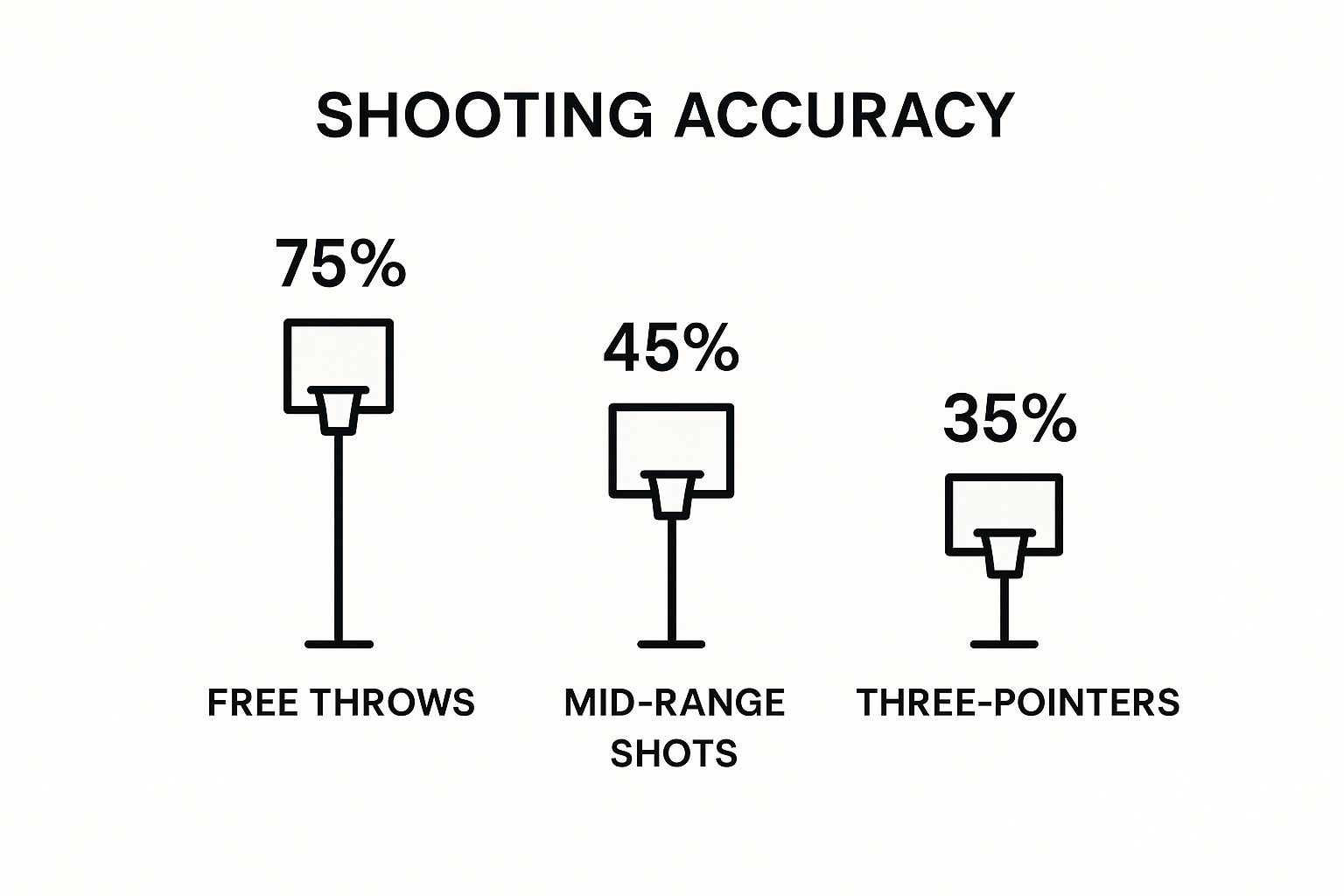
Even though the percentage is lower from three, the extra point makes it one of the most valuable weapons in any offensive system.
To see this shift clearly, let's compare what traditional training used to prioritize versus what the modern game demands.
Traditional Skills vs Modern Skills Emphasis
Skill Area | Traditional Focus | Modern Emphasis |
|---|---|---|
Shooting | Mid-range jumpers, post moves | Three-point shooting (off the catch & dribble), deep range |
Ball Handling | Protect the ball, set up plays | Create space, attack closeouts, handle pressure full-court |
Defense | Man-to-man post defense, help-side rotation | Switching onto multiple positions, closing out on shooters, perimeter containment |
Player Archetype | The defined "big man" or "point guard" | Versatile, positionless players ("3-and-D" wings, playmaking forwards) |
This comparison highlights a clear message: versatility is the new currency in basketball. Players who can shoot, handle the ball, and defend on the perimeter are more valuable than ever.
Drills for Modern Skill Development
To thrive in this environment, your training has to mirror the demands of the modern game. That means putting in serious, focused time on extending your shooting range and becoming a lockdown perimeter defender.
Here are a few drills I’ve seen work wonders for players trying to make that leap:
Three-Point Form Shooting: Forget just hoisting up threes. Start right under the hoop, focusing on nothing but perfect form. After you swish 5-10 in a row, take a step back. Repeat this process, moving back incrementally, until you're comfortably behind the arc with the same flawless mechanics. This builds the muscle memory you need for a consistent deep ball.
Star Drill for Shooting on the Move: Game shots aren't static. Place five cones around the arc—corners, wings, and top of the key. Start under the rim, sprint to a cone, receive a pass (or just pick up a ball), and shoot in one fluid motion. Immediately sprint back to the paint and then explode out to the next cone. This drill is fantastic for simulating the constant movement needed to get open.
Defensive Slides with Resistance: Grab a resistance band and put it around your thighs. Now, practice your defensive slides back and forth along the three-point line. The key is to stay low in your stance, keep your chest up, and never, ever cross your feet. This builds the lateral quickness and core strength essential for staying in front of shifty guards.
Focusing on drills like these directly builds the skills of a "3-and-D" player—the exact type of player every single team is looking for. When you can be a threat on offense and a stopper on defense, you become an indispensable part of any roster.
Train Your Body for On-Court Dominance
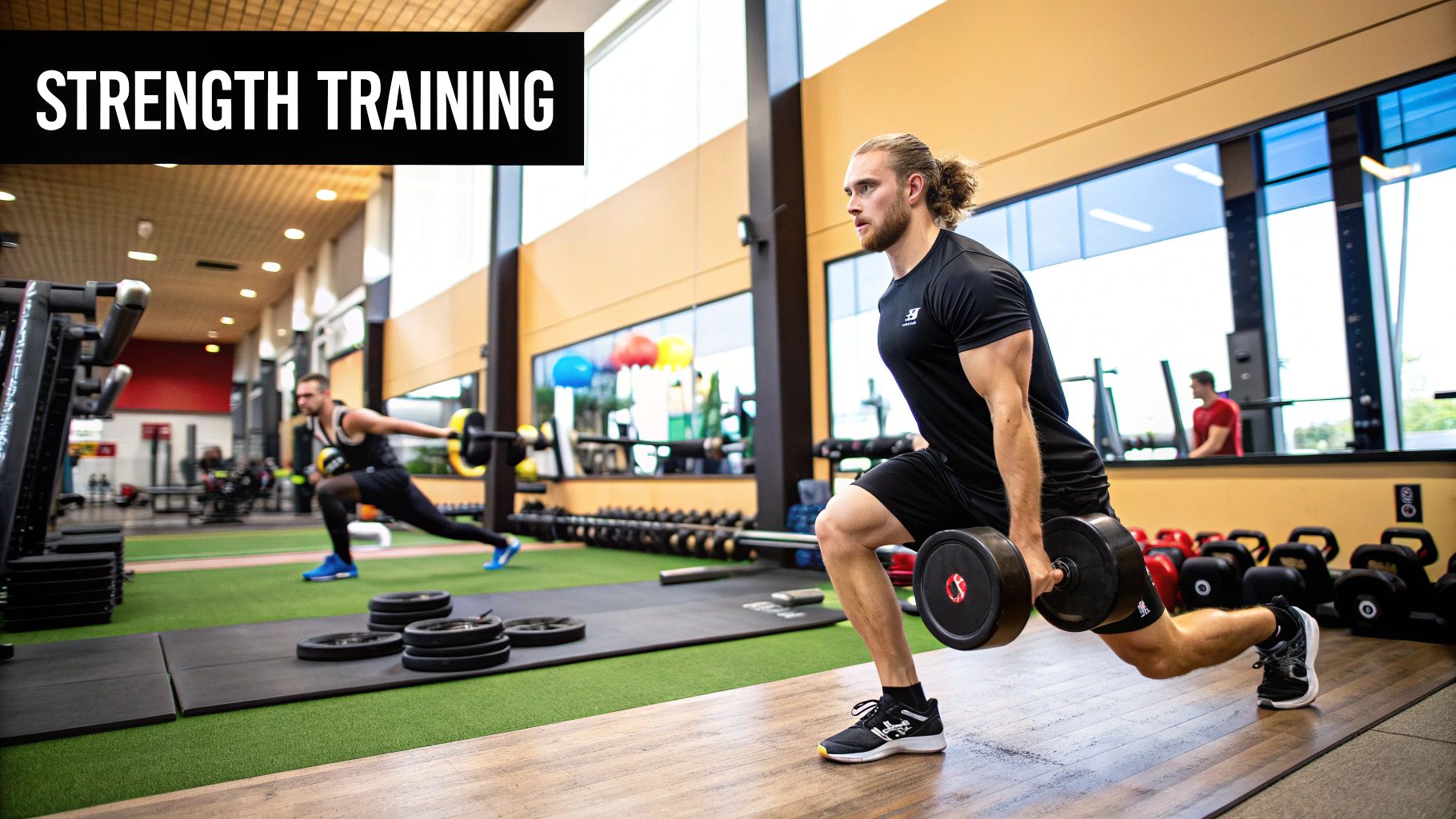
Let's be real. You can have the prettiest jumper in the gym or the quickest crossover, but none of it matters if you're completely gassed in the fourth quarter. Your skills are only as good as the engine that powers them. To truly get better at basketball, you need a body built for the grind—not just strong, but explosive, agile, and resilient.
Forget what you see bodybuilders doing. Your goal isn't just to move heavy weight; it's to move your body with explosive power, to change directions on a dime, and to still have your legs under you for a late-game free throw. Think about the actual movements in a game: short sprints, defensive slides, explosive jumps. That's what your conditioning needs to mirror.
Building a Basketball-Specific Engine
Your time in the gym should directly translate to what you do on the hardwood. Focus on building strength that fuels game-specific actions. This creates a body ready for the intense, stop-and-go chaos of a real game.
Here are a few of my go-to exercises that build a solid foundation:
Box Jumps: These are pure gold for building the explosive power you need for grabbing boards over bigger players and finishing strong at the rim. The key is landing softly, like a cat, and resetting for the next jump.
Lateral Lunges: Basketball is a game of angles and lateral movement. Lateral lunges build strength in your hips and inner thighs, which is absolutely crucial for locking down an opponent on defense or exploding out of a crossover.
Medicine Ball Slams: This is all about raw, full-body power and core stability. It's the same kind of explosive effort you need to rip down a rebound in traffic or finish through contact on a layup.
A targeted approach like this means every rep in the weight room pays dividends on the court.
Your physical conditioning is the ultimate tie-breaker. When skills are equal, the player who can maintain their explosiveness and speed late in the game will always have the upper hand.
Understanding Your Athletic Prime
It's also smart to understand how athletic careers typically progress. Some fascinating research on NBA player career trajectories shows that most athletes hit their peak between the ages of 24 and 27. After age 29, performance often plateaus and begins a slow decline. This highlights just how critical those developmental years are.
Now, this doesn't mean you can't get better if you're older than 27 or that you're a finished product at 16. What it does mean is that dedicated, smart training in your teens and early twenties builds an athletic foundation that can last a lifetime.
The work you put into your body now is an investment. It builds the physical capital you'll draw from for your entire playing career, no matter what level you play at.
Develop a Higher Basketball IQ
Physical talent gets you noticed, but what separates the good players from the truly great ones is often what happens between their ears. A high basketball IQ is the "it" factor—that invisible skill that makes every dribble, pass, and shot more effective. It's about seeing the game in slow motion while everyone else is moving at full speed.
When you think the game at a higher level, you see plays developing before they happen and consistently make the right decision under pressure. Training your mind needs to be just as much a priority as training your body. I've seen it a hundred times: a freakishly athletic player gets completely shut down by a smarter opponent who baits them into mistakes and exploits their predictable habits. If you want to be invaluable to any team, you have to become a student of the game.
Become a Student of the Game
The fastest way to boost your basketball IQ is to start watching games with a purpose. Forget the highlight reels for a minute. When you're watching a pro or college game, consciously shift your focus away from the ball and observe the other nine players on the court.
Pay attention to the little things. How do players move without the ball to create space? Where are the help defenders positioned? Watch how an elite point guard uses their eyes to manipulate the defense before whipping a pass to a seemingly covered teammate. This kind of active viewing rewires your brain to recognize patterns you can then apply to your own game.
Once you’ve started watching the pros, it’s time to turn the camera on yourself. It can be a little tough to watch at first, but recording your own practices and games is one of the most powerful development tools out there. Suddenly, you’ll see the open teammate you missed, the lazy closeout on defense, or a bad habit you never knew you had.
The game film doesn't lie. It’s the most honest coach you'll ever have, showing you the raw truth of what happened on the court, not just what you thought happened.
Think the Game in Real Time
After you've sharpened your observation skills off the court, the next step is to translate that knowledge into split-second decisions during a game. This is where you move from simply reacting to what's in front of you to anticipating what's coming next.
Here are a few mental habits to build during live play:
Read the Defense Instantly: Before the ball even touches your hands, take a quick mental snapshot. Is your defender sagging off or playing tight? Is the help defense cheating over? That one-second scan tells you whether your best option is to shoot, drive, or pass.
Think a Pass Ahead: Good players make the simple pass. Great players are already thinking about the pass after that. If you see a teammate cutting, don't just focus on getting them the ball. Anticipate how the defense will rotate to cover the cut—and who that rotation will leave wide open. That's how you create easy buckets.
Master Key Situations: Truly understand the options in common plays like the pick-and-roll. As the ball handler, you have multiple reads. Are you coming off the screen looking to score? Are you trying to draw the big man's defender so you can dump it to your rolling teammate? Or is the real goal to suck in the defense and kick it out to a shooter in the corner? Knowing all your options makes you a nightmare to guard.
Building a high basketball IQ isn't something you achieve overnight. It’s a continuous process of staying curious, always asking "why," and learning from every single game you play and watch. It's the one skill that will keep you effective on the court long after your athleticism starts to fade.
Master Your Mental Game and Recovery
Talent and conditioning will get you on the court, sure. But what keeps you there, playing at a high level day in and day out? That comes down to two things often overlooked: mental toughness and smart recovery. You can have all the physical skills in the world, but they’ll fall apart if your head isn't right or your body is worn down.
I’ve seen it a hundred times. A player drops 27 points one night, then goes out and struggles to get 6 the next. That inconsistency is maddening, but it's a part of the game for everyone. The difference between good and great players is how they react. The goal isn't to never have a bad game; it's to stop one bad game from turning into two.
Build an Unshakeable Mindset
The best players I know all have a short memory. They miss a shot, turn it over, or get beat on a backdoor cut, and by the time they’ve crossed half-court, it's gone. They’re already locked in on the next play. This isn't some innate gift; it's a skill they’ve deliberately practiced.
So, you had a rough shooting night. Don't let that one game live in your head rent-free. If you've been putting in the work consistently, a bad performance is usually just an outlier, a blip on the radar. Trust the law of averages. An off night actually makes a great shooting night more likely to be right around the corner. Thinking this way can flip your anxiety into genuine anticipation for your next shot.
A bad offensive performance only means what you decide it means in your mind after the game. It’s all about choosing where you put your attention. If you put in the work, trust the work.
This is huge during a game, too. Let's say you start 1-for-4 from the field. The wrong thought is, "Man, I'm having an off night." The right thought is, "Okay, the next couple are probably going in." That quiet confidence, built on thousands of practice reps, is a weapon.
Prioritize Smart Physical Recovery
Playing hard and training intensely puts a ton of stress on your body. If you aren't deliberate about recovery, you're not just setting yourself up for a slump in performance—you're opening the door for injuries. Think of recovery as being just as important as your shooting drills.
Recovery is the process that makes all your hard work actually stick. It's when your muscles heal, repair, and grow stronger. Skipping recovery is like cramming for a huge exam and then pulling an all-nighter; your brain won't hang on to the information. Your body works the same way.
Here are the non-negotiables for basketball recovery. Don't treat these as suggestions; make them habits.
Sleep: This is your primary recovery tool. You need 8-10 hours a night, period. Sleep is when your body releases the growth hormones that repair muscle tissue.
Nutrition: Feed your body what it needs to rebuild. That means lean protein for your muscles, complex carbs to restock your energy stores, and healthy fats. What you eat has a direct line to your energy and how fast you bounce back.
Hydration: Water is vital for just about everything your body does, from flushing out toxins to keeping your muscles from cramping. Being even slightly dehydrated is a surefire way to feel fatigued.
Active Recovery: An off day shouldn't mean being glued to the couch. Gentle movement—like stretching, foam rolling, or even just going for a walk—gets the blood flowing. This helps clear out lactic acid and reduces that next-day soreness, getting you back to 100% faster.
Answering Your Top Questions About Getting Better at Basketball
When you decide to really commit to improving your basketball game, a lot of questions pop up. It's only natural. Knowing what to expect helps you set smart goals and put your energy into what truly works. Let's tackle some of the most common things players ask when they get serious.
How Long Does It Take to Get Good at Basketball?
This is the big one, and the honest answer is… it depends. There’s no set schedule for getting good.
That said, with consistent, focused work—I'm talking 4-5 dedicated sessions a week—you can expect to see real, tangible improvement in your basic skills in about 3 to 6 months. This is that sweet spot where your dribbling starts to feel more natural and your shooting form begins to click.
Now, reaching a level of true mastery, where your skills are automatic even with a defender in your face? That’s a journey that takes years. The trick is to stop worrying about the final destination and start loving the process. Celebrate the small victories—like finally nailing a crossover consistently or seeing your free-throw percentage tick up. Those little wins are what fuel you for the long run.
One thing to remember: there's a huge difference between just playing and practicing. An hour of focused, intentional skill work is worth more than three hours of casual pickup games where you might just be cementing bad habits.
Want to speed things up? Go all-in on the fundamentals. Nothing will accelerate your growth faster than building a rock-solid foundation in ball-handling and shooting mechanics.
What’s More Important: Dribbling or Shooting?
For any player who wants to be a real threat on the court, this is a trick question. They are both equally critical. Think of it this way: dribbling is what gets you where you need to go, and shooting is what you do when you get there. You can’t be effective without both.
The best approach, especially when you're starting out, is a balanced one. Here’s a simple way to split your time in a solo workout:
Dribbling (20-30 minutes): Start with stationary drills to get a feel for the ball. Then, get moving. Practice changing speeds and direction, just like you would in a game.
Shooting (20-30 minutes): Begin right under the hoop with form shooting. This is all about perfecting your mechanics. Slowly increase your distance, but always make perfect technique the priority over just getting the ball in the basket.
This 50/50 split ensures you aren't building a lopsided game.
Can I Get Better at Basketball by Myself?
Yes, 100%. A huge chunk of your development happens when it’s just you, the ball, and the hoop.
Solo workouts are your personal lab. It's where you can repeat a move a thousand times, fix that little hitch in your jumper, or master a complex dribble combo without any game pressure. This is where you build the muscle memory that becomes the bedrock of your entire game.
But, while solo work is where you forge your skills, playing against others is where you learn to wield them. Games teach you what you can't learn alone: timing, spacing, reading defenders, and making split-second decisions. The perfect plan mixes both. Use your individual time to sharpen your tools, and use games and team practices to learn how to use them to win.
Ready to match your ambition with the right gear? RealOminousAthlete makes game-changing products for players who are serious about getting better. Find what you need to take your performance to the next level.


Comments