
A Modern Football Training Program for Peak Performance

A truly effective football training program is much more than a collection of drills. It’s a complete roadmap—a living document that builds technical skill, sharpens tactical intelligence, forges physical power, and hardens mental resilience. The best plans I've ever seen or been a part of always start with a clear philosophy, set goals you can actually hit, and weave everything together, from what happens on the pitch to recovery and nutrition off it.
Building Your Foundational Training Philosophy
Before you even think about setting up cones, you need to build the bedrock of your program. This is your coaching philosophy—the core beliefs that will guide every single decision you make. This isn't about just copying what a world-class manager does on TV. It’s about figuring out what success really means for your players, in your unique situation. It becomes the "why" behind every drill, every conditioning run, and every team talk.
A powerful philosophy looks past the win-loss column. It's all about long-term player development and fostering a positive yet demanding culture where athletes genuinely want to improve. When you have this North Star, your program gains a clear sense of direction and purpose, which makes planning your sessions and communicating your expectations a whole lot easier.
Setting Meaningful and Realistic Goals
Once your philosophy is locked in, you need to turn those big ideas into tangible goals. For these goals to mean anything, they absolutely have to be tailored to the specific age, position, and current skill level of your players. It’s pointless to ask a U12 team to master a complex zonal marking scheme. A much smarter goal would be improving their first touch or understanding of personal space.
I find it helpful to break goals down into a few key areas:
Technical Goals: Maybe you want to see a 15% improvement in passing accuracy during the pre-season, or you want every defender comfortable clearing the ball with their weaker foot.
Tactical Goals: This could be mastering the triggers for a high press or simply improving communication on defensive corners.
Physical Goals: You might aim to increase the team's average sprint speed or build endurance so players can maintain high intensity for the full 90 minutes.
This specific approach makes progress easy to track and keeps players bought in. For example, a winger might have a personal target to successfully complete 70% of their take-ons in a match—a clear, measurable goal that directly helps the team.
Conducting Crucial Baseline Assessments
You wouldn’t start a road trip without knowing your starting location, and coaching is no different. Baseline assessments are absolutely essential for getting a clear picture of each player's technical, physical, and tactical abilities before the season really kicks into gear. This isn't just about finding weaknesses, either. It’s just as important for spotting hidden strengths you can build on.
A few simple, well-chosen tests at the start of pre-season can give you a wealth of information.
A great baseline assessment uncovers the raw material you have to work with. It's the difference between guessing what your team needs and knowing exactly where to focus your coaching energy for maximum impact.
For instance, timing a 40-yard dash gives you a raw speed metric, while a T-test is fantastic for gauging agility and how quickly players can change direction. On the technical side, you could run a standardized passing drill and track completion percentages. This initial data gives you a benchmark you can constantly refer back to, offering concrete proof that your football training program is working.
Embedding a Holistic Development Approach
The best modern football programs treat athletes as whole people, not just players on a team sheet. Things like nutrition, mental conditioning, and injury prevention shouldn't be afterthoughts; they need to be woven into the fabric of your plan from day one. This holistic perspective is what truly separates good programs from the great ones.
You can build powerful habits with simple actions. Try starting each session with a quick five-minute chat about proper hydration or ending with a guided cool-down that specifically targets injury prevention. Introducing mental skills like visualization or positive self-talk helps build fortitude, which is just as vital as any technical skill on the pitch. It's this comprehensive approach that creates more resilient, durable, and focused athletes who are ready for anything the game throws at them.
The Four Pillars of Elite On-Field Performance

A truly dominant football player isn't just good at one thing. They're a complete package. I've seen it time and again: a player with blistering speed but a poor first touch gets shut down, or a tactical genius gets outmuscled. The best athletes are built on four interconnected pillars: technical mastery, tactical intelligence, physical power, and mental fortitude.
When these four areas are developed in harmony, you get a player who can adapt to anything a match throws at them. It's a far cry from the old days of just running laps and shooting at an empty net. The game has evolved, and so has our understanding of how to build elite players. We've moved from gut feelings to a more scientific, pillar-based approach that really works. If you're curious, you can explore more on the history of football training to see just how far we've come.
So, let's get into the nitty-gritty of developing each of these crucial areas in your training.
Forging Technical Mastery
Technical skill is your foundation. It’s a player’s raw ability to manipulate the ball, especially when a defender is breathing down their neck. This isn't just about passing and shooting in a vacuum; modern training has to mirror the beautiful chaos of a real game.
Forget neat passing lines. To really hone technique, you need to create drills in tight spaces. I love using a 10x10 yard box where players have to use quick, multi-touch control to evade defenders. It forces creativity, sharpens their first touch, and teaches them to instinctively shield the ball.
Here are the key skills to drill into every session:
First-Touch Reliability: Design drills where players receive passes from all angles and speeds. The goal is instant control and a seamless setup for their next action.
Finishing Under Duress: Stop practicing on an empty goal. Add a defender chasing them down or a strict time limit to replicate the pressure of a real scoring chance.
Weak-Foot Competence: This is a non-negotiable. Dedicate 10-15 minutes of every single practice to drills that force players onto their non-dominant foot. The payoff is enormous.
Cultivating Tactical Intelligence
This is what we coaches often call "game IQ." It’s the X-factor that separates the good from the great—the ability to read the game, anticipate plays, and make brilliant decisions without the ball. Formations are a starting point, but true tactical development is about teaching players how to think on the pitch.
A huge part of this is dynamic off-ball movement. A player is without the ball for over 98% of a match, so what they do during that time is everything. Instead of static positional drills, use small-sided games (think 4v4 or 7v7). These games naturally encourage constant movement, communication, and intelligent positioning to create space.
The smartest players on the field aren't always the fastest or the strongest. They're the ones who see the game one or two steps ahead of everyone else, making the right run or the right pass before the opportunity even seems to exist.
Building Football-Specific Physical Power
Conditioning for football isn’t about looking like a bodybuilder or running a marathon. It’s about building explosive, functional power that directly translates to the pitch. Every conditioning drill should mimic the stop-start, multi-directional nature of the game.
Your workouts should be built around these three areas:
Explosive Acceleration: Use drills like short sprints from different starting positions—lying down, standing, even back-pedaling—to build that critical first-step quickness.
Agility and Change of Direction: Get the cones and agility ladders out. Focus on exercises that force players to decelerate, plant, and re-accelerate in a new direction on a dime.
Core Strength: The core is the engine for all athletic movement. Integrate planks, medicine ball throws, and rotational work to build the stability needed for powerful shots, strong tackles, and shielding the ball.
Hardening Mental Fortitude
At the highest levels, the game is won and lost between the ears. Mental fortitude is the ability to stay locked in during chaotic moments, shake off mistakes instantly, and perform when the pressure is immense. This pillar is the easiest to neglect, but it’s the glue that holds everything else together.
You can—and should—actively train mental resilience. For instance, after a player misses a shot in practice, have them perform a "reset routine." This could be a quick physical cue, like tapping their cleats, paired with a positive phrase like "next one." It trains the brain to move on from errors immediately.
Ultimately, building this unshakeable confidence requires a culture where players feel safe to fail and are pushed to learn from those failures. It’s about fostering a growth mindset, where challenges become opportunities. When all four of these pillars are strong, you don't just have a player; you have a complete and formidable competitor.
If you want your team to perform at its best when it matters most, you can't just train hard—you have to train smart. This is where a well-structured plan for the entire year, known as periodization, comes into play. It's the framework that elite coaches use to map out training, ensuring players peak for competition while sidestepping burnout and nagging injuries.
Think of it as the master blueprint for your season. Instead of a chaotic mix of drills, you strategically cycle through different training goals and intensities. This approach builds players up systematically, keeping them fresh and powerful throughout a long, demanding campaign.
The Foundational Off-Season
This is where titles are truly won. The off-season isn't a long holiday; it's the engine room for the entire year. Spanning roughly 8-12 weeks after the post-season break, this phase is all about building a rock-solid athletic base without the constant pressure of upcoming matches.
The main focus here is raw physical development. We're talking about building strength in the gym, improving general endurance, and correcting any imbalances that cropped up during the previous season. This is the prime time for heavy lifting and conditioning work that establishes a foundation of power—a quality that's much harder to build once the games start.
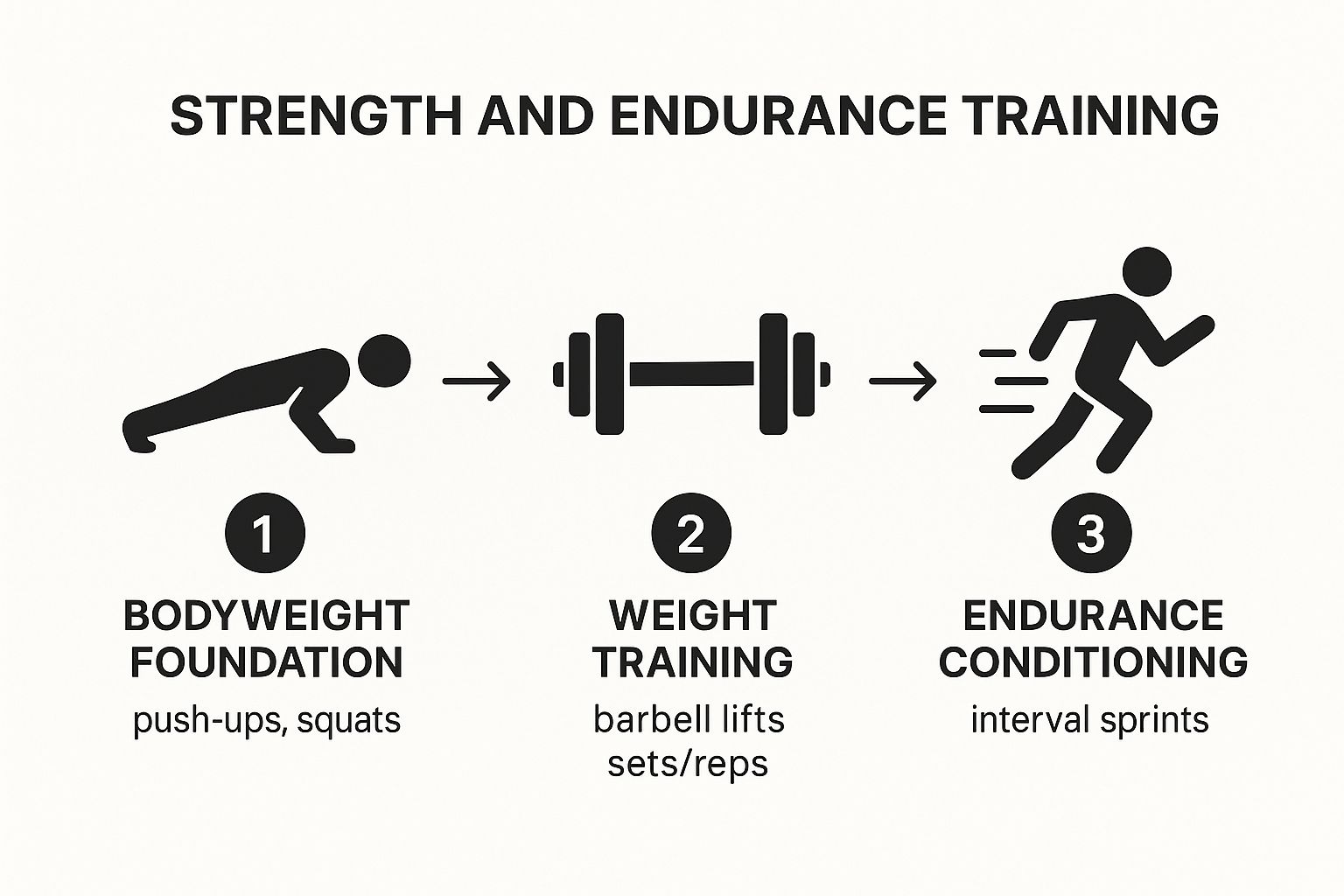
A logical progression is key. As this graphic shows, players should master fundamental movements first, then gradually introduce heavier loads and sport-specific intensity to build a resilient athletic profile.
The Sharpening Pre-Season
As we roll into the 4-6 weeks before the season opener, the training focus shifts dramatically. The pre-season is all about converting that raw off-season power into football-specific fitness. The general conditioning makes way for sessions that replicate the explosive, start-stop nature of a real match.
Intensity skyrockets here. We bring back high-intensity interval training (HIIT), pour time into complex agility drills, and dive deep into tactical work. Small-sided games and friendly matches become the bread and butter of your sessions, helping players sharpen their touch, timing, and on-field chemistry. The objective is simple: arrive at the first competitive match feeling sharp, fit, and ready to go.
A huge mistake I see coaches make is treating the pre-season as just more off-season. You have to pivot. The goal is no longer building general fitness; it’s honing game-ready sharpness. Your players should feel their touch and tactical instincts clicking back into place with every session.
The Maintenance In-Season
Once the season kicks off, the whole training philosophy flips on its head. The primary goal is no longer to build new fitness but to maintain the high level you've already achieved. It's a delicate balancing act of managing fatigue and keeping players fresh for match day. Training volume naturally decreases, but the intensity stays high in short, targeted bursts.
A typical in-season week is meticulously planned around the next game. Here's a quick look at how you might structure it:
Recovery & Analysis: The day or two after a match are for active recovery, like a pool session or light technical work, combined with video analysis.
Peak Intensity: Mid-week is usually when you'll have your toughest session. This is where you work on the tactical game plan for the next opponent, using high-intensity drills to simulate match conditions.
Taper & Polish: As the next game approaches, training becomes very light and sharp. Sessions might focus on set pieces or a quick walk-through of final tactical points to keep minds fresh and legs snappy.
Ignoring this phase-based structure is a recipe for disaster. You'll end up with tired legs, mentally drained players, and a surge in soft-tissue injuries right when you need your squad most.
To give you a clearer picture, here's a sample schedule for a typical in-season week. It balances high-intensity work with crucial recovery to keep players performing at their peak.
Sample Weekly In-Season Microcycle Plan
Day | Primary Focus | Intensity | Example Activities |
|---|---|---|---|
Match Day +1 | Active Recovery | Very Low | Light jogging, stretching, mobility work, pool session |
Match Day +2 | Rest / Technical | Low | Day off or very light technical drills, video analysis |
Match Day +3 | Strength & Tactical | Moderate | Gym session (strength maintenance), tactical shape, possession games |
Match Day +4 | High Intensity & Tactical | High | Small-sided games (4v4, 7v7), high-speed drills, pressing scenarios |
Match Day -2 | Taper & Activation | Low | Sharp passing drills, final tactical review, set-piece practice |
Match Day -1 | Pre-Match Activation | Very Low | Short, sharp movements, light ball work, travel |
Match Day | Competition | Maximum | Game |
This cycle ensures that players' bodies are stressed enough mid-week to maintain fitness but have ample time to recover and feel explosive on match day.
The Crucial Transition Phase
After that final whistle blows on the season, everyone needs a break—but that doesn't mean doing nothing. This 2-4 week period, often called the transition or active recovery phase, is vital for physical and mental regeneration. It's about stepping away from the rigid structure of football while keeping the body moving.
Encourage your players to get involved in other sports they enjoy. Swimming, cycling, basketball, or tennis are all fantastic options. This helps them maintain a baseline of fitness and avoids the "de-training" effect, so they aren't starting from square one in the off-season. More importantly, it gives them a mental reset, ensuring they come back hungry and ready to go again.
Using Technology and Data to Sharpen Your Edge
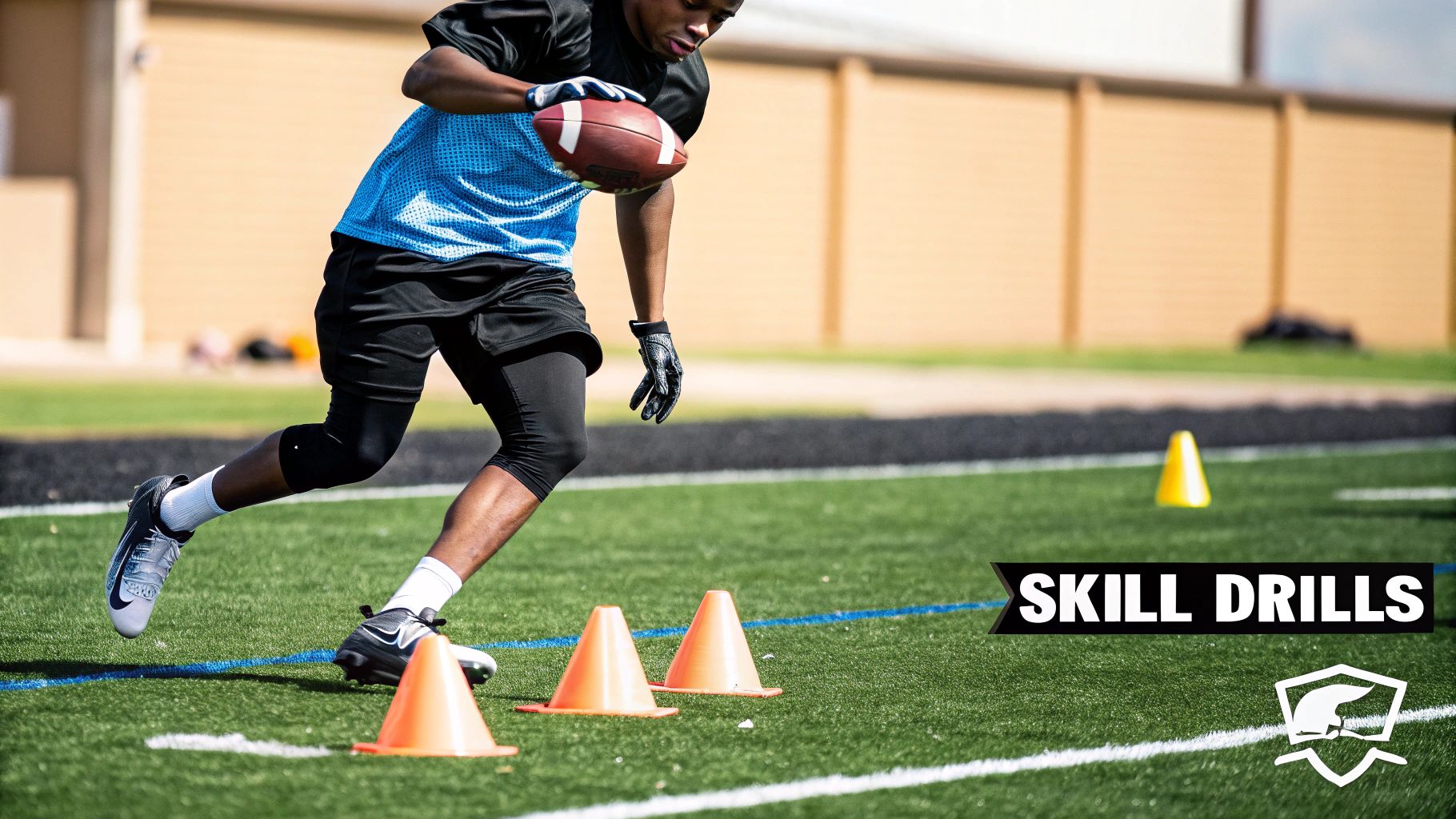
Gut feelings and the "eye test" will always have their place in football. You can't replace a coach's intuition. But the modern game is now driven by data, and the most successful teams make smarter decisions because they have the objective numbers to back them up.
Bringing accessible tech into your football training program isn't just for the pros anymore. It's become a critical tool for finding that competitive advantage, no matter what level you coach at. This isn't about collecting flashy stats; it’s about turning raw data into real-world insights that shape how you condition and prepare your players.
Harnessing Wearable GPS Technology
One of the biggest game-changers has been wearable GPS technology. You've probably seen players wearing them—small devices tucked into a vest between the shoulder blades. These things are a goldmine of objective information on a player's physical output.
Instead of just guessing if a player is working hard based on how they look, you get hard metrics. You can see their total distance covered, how many high-intensity sprints they made, their top speed, and even their acceleration patterns. This data is priceless for managing player load.
By tracking a player's physical output over time, you can spot the warning signs of fatigue long before an injury happens. It's the ultimate form of proactive injury prevention.
Let’s say your star winger’s sprint numbers suddenly drop 15% below their weekly average. That’s a massive red flag. Now you can have an informed conversation about recovery or pull them back in the next session, keeping them healthy and on the pitch for the long haul.
This data-driven approach has totally changed how teams evaluate players. What started with basic stats like goals and assists has evolved into a deep-dive analysis of everything from pass completion to distances run. To learn more about this evolution, check out this great article on how big data became a game-changer in football on oliversports.ai.
Making Video Analysis Practical
Video analysis sounds expensive and high-tech, but it’s never been more accessible. Forget the professional broadcast cameras; your smartphone or a tablet is all you really need to get started.
Filming your training sessions and games gives you concrete proof you can use to teach. It's one thing to tell a defender their positioning was off. It's another thing entirely to show them the exact moment on video, pausing it to break down what happened. That kind of visual feedback is what makes concepts click.
Here are a few simple ways to put video to work:
Positional Discipline: Pause the footage and draw right on the screen to show a player where they should have been in relation to the ball and their teammates.
Tactical Opportunities: Scour game film to find your opponent's patterns. Do they always build up on the left side? Is their keeper slow off his line? These are the little details that win tight matches.
Individual Technique: Use slow-motion to break down a player's shooting form or defensive stance. You can pinpoint tiny technical flaws they can immediately work on.
The final piece of the puzzle is turning this analysis into action. After a game, don't just create a blooper reel. Instead, find 2-3 key teaching moments—both good and bad—and design a quick drill around them for your very next training session. This closes the loop and turns data into real, tangible improvement.
Mastering Recovery and Injury Prevention

Let's be honest. The most grueling training plan and brilliant tactics are useless if your best players are watching from the sidelines. An athlete's ability to stay on the pitch is everything. That’s why recovery and injury prevention aren't just add-ons—they are the very foundation of a successful football training program.
It’s about being proactive. The teams that consistently perform are the ones that build a culture where smart recovery is respected as much as hard work. This mindset is what keeps players healthy, sharp, and available when it counts.
Priming the Body with Smart Warm-Ups
Forget the old-school routine of holding a few static stretches. A modern warm-up has to be dynamic. Its job is to prep the body for the explosive, unpredictable movements of a real match. We're talking about increasing blood flow, firing up the central nervous system, and unlocking mobility in key joints.
The key is movement. A proper warm-up should gradually build in intensity, shifting from general activity to football-specific actions that get both body and mind in the game.
General Movement (5 mins): Get the blood pumping with light jogging, side shuffles, and high knees. The goal here is simply to raise the core body temperature.
Dynamic Stretching (5 mins): Now, open up the joints. Think leg swings (forward and side-to-side), walking lunges with a torso twist, and big hip circles.
Activation & Speed (5 mins): Finally, bring in the ball. Finish with short sprints, quick-feet ladder drills, and simple passing patterns to get those fast-twitch fibers firing.
This logical progression makes sure players are truly ready for intense work, drastically cutting the risk of those frustrating muscle pulls and other soft-tissue injuries.
The Science of an Effective Cool-Down
What happens after the final whistle is just as important as what happens before the first. A player’s body is flooded with stress hormones and metabolic byproducts post-session. A deliberate cool-down is the first step in flushing that out and kick-starting the repair process.
It doesn’t take long—a dedicated 10 minutes will do. Start with a light jog to bring the heart rate down gradually. Then, move into static stretching, holding each stretch for a good 20-30 seconds. You'll want to focus on the workhorses of football: the hamstrings, quads, glutes, and calves.
A proper cool-down isn't the end of today's session. It's the beginning of the next one.
This simple habit sends a clear signal to the body: it's time to shift from "perform" mode to "repair" mode. It lays the groundwork for a much more effective recovery overnight.
Recognizing and Managing Player Load
One of the biggest breakthroughs in modern coaching is a deep understanding of load management. This is all about monitoring the total stress—physical, mental, and emotional—that a player is under. Pushing too hard for too long without enough rest is a surefire recipe for overtraining, burnout, and injury.
You have to learn to spot the subtle signs. Is a player's performance dipping? Are they complaining of constant muscle soreness? Have they become moody or lost their usual drive? These are red flags. When you see them, it's time to step in. That might mean swapping a tough session for a lighter one, giving them an extra day off, or focusing on active recovery like foam rolling or a sports massage.
The way we approach player wellness has evolved dramatically. Since the mid-20th century, technology has completely changed the game, from conditioning to recovery. Back in the 1950s, clubs were using early heat therapy devices. Fast forward to the 1990s, and heart rate monitors became essential for managing workload. Today, these data-driven approaches are what help us maximize a player's health and career longevity. You can discover more on the history of training technology in football at Rezzil.com.
Common Questions About Football Training Programs
Even the most buttoned-up training plan will spark questions. It’s only natural. Building a truly effective football training program is less about a rigid script and more about knowing how to adapt on the fly. Let's tackle some of the most common questions I hear from coaches and players to help you fine-tune your approach for real results.
How Many Days a Week Should a Player Train?
This is the classic "it depends" question, but we can get more specific than that. The right training frequency is a careful balancing act between a player's age, their level of competition, and, most importantly, the time of year.
For younger athletes, say anyone under 14, two or three sessions a week plus a game on the weekend is a great rhythm. It pushes skill development forward without risking the physical and mental burnout that can turn kids away from the sport. Once you get to competitive high school or adult amateur levels, stepping it up to three or four weekly sessions usually hits the sweet spot for making progress while allowing for recovery.
Of course, elite pros are often on the pitch daily, but their schedules are professionally managed down to the minute, with dedicated time for recovery that most programs can't replicate.
The real game-changer here is the season. In the off-season, you can crank up the volume to 4-5 days a week to build that crucial foundation of strength and endurance. But once you're in-season, the mission changes. It’s all about maintaining sharpness, which makes 2-3 high-quality team sessions plus game day the gold standard.
How Do You Adapt a Program for Different Age Groups?
You simply can’t run the same practice for a 10-year-old that you would for an 18-year-old. It's not just ineffective; it can be unsafe. Tailoring your plan to the developmental stage of your players is non-negotiable.
With young kids (ages 6-12), every session needs to have one ingredient above all else: fun. Forget rigid, standing-in-line drills. The focus should be on building fundamental motor skills and getting comfortable with the ball through imaginative games. You’re building a love for football first and foremost.
As players hit their teenage years (13-18), their capacity for more complex information explodes. Now's the time to introduce advanced tactical ideas, get specific about positional roles, and carefully integrate age-appropriate strength and conditioning. Their bodies are ready for a greater physical challenge.
When you're working with adults, you have to account for a wide range of fitness levels and the reality that recovery takes longer. The training tends to zero in on sophisticated team tactics, game-realistic conditioning drills, and a serious emphasis on injury prevention.
What Are the Best Ways to Track Player Progress?
If you want to know if your program is actually working, you have to look beyond the win-loss column. Meaningful progress tracking is a blend of hard numbers and what your own eyes tell you.
Technical Skill Benchmarks: Don't just assume passing is improving—measure it. Set up timed dribbling courses or run drills where you can calculate passing accuracy percentages. Seeing those numbers go up is a huge motivator.
Physical Metrics: You need to test. Simple as that. Check core metrics like the 40-yard dash, vertical jump, and an agility test (like the T-test) 3-4 times a season. This is your proof that the physical work is paying off.
Tactical Understanding: Video is your best friend. There's no hiding on film. Reviewing game footage is the only truly objective way to assess a player's positioning, decision-making, and movement off the ball.
Player Feedback: Never underestimate the value of asking your players how they feel. A simple training log where they can jot down their energy levels, soreness, and how they think they performed gives you incredible insight into fatigue and helps you make small, smart adjustments.
At RealOminousAthlete, we believe a winning mindset is built on smart training and premium gear. Equip yourself for peak performance with our game-changing sportswear, designed for athletes who demand the best. Explore the collection at bearcapes.store.


Comments