
8 Essential Basketball Warm Up Exercises for 2025

Stepping onto the basketball court cold is like starting a race in first gear; you're immediately at a disadvantage. A proper warm-up isn't just about avoiding injury; it's a strategic ritual that primes your body and mind for peak performance. It activates key muscle groups, elevates your heart rate, and sharpens your neuromuscular connections, ensuring your first dribble, shot, and defensive slide are as explosive as your last. This guide moves beyond generic stretches to provide a detailed breakdown of the eight most effective basketball warm up exercises that elite athletes use to gain a competitive edge.
From enhancing hip mobility for quicker cuts to activating the shoulder complex for a smoother shooting motion, these dynamic movements are your blueprint for starting strong and staying dominant. We'll explore the specific mechanics, benefits, and common mistakes for each exercise, giving you the actionable tools to build a pre-game routine that translates directly to better play. Forget jogging a lap and taking a few half-hearted jumpers. This is how you systematically prepare your body to perform at its highest level from the opening tip-off. Let's get your body game-ready.
1. Dynamic Leg Swings
Dynamic leg swings are a foundational component of any effective basketball warm up. This exercise involves controlled, momentum-based movements of the leg through its full range of motion, preparing the lower body for the explosive actions required on the court. Unlike static stretching, which involves holding a stretch for a period, dynamic movements actively warm up the muscles and lubricate the joints, making them more pliable and ready for performance. This is crucial for basketball players who rely on quick, powerful movements.
This exercise directly targets the key muscle groups used in basketball: the hip flexors, hamstrings, glutes, and adductors/abductors. By activating these muscles before a game or practice, players can improve their agility, power, and speed. The movement is a staple in warm-up routines from youth leagues to the highest professional levels, including NBA pre-game preparations, because of its efficiency in enhancing hip mobility and reducing injury risk.
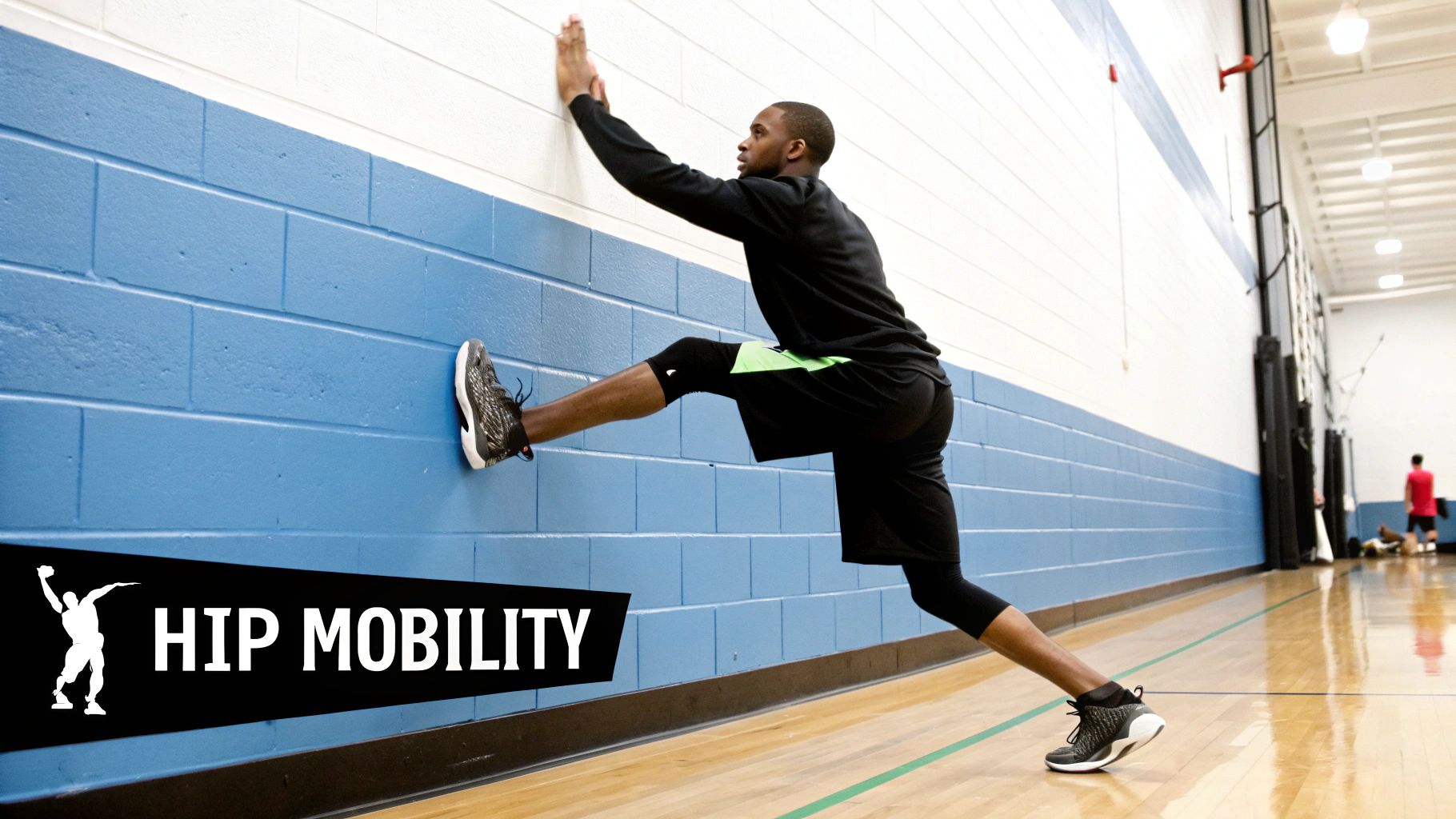
How to Perform Dynamic Leg Swings
Executing leg swings correctly is essential for reaping their full benefits. You can perform two primary variations: forward-backward and side-to-side.
Forward-Backward Swings: Stand next to a wall or sturdy object for balance, placing a hand on it for support. Keeping your torso upright and core engaged, swing one leg forward as high as is comfortable, then let it swing back behind you. The movement should be fluid, like a pendulum.
Side-to-Side (Lateral) Swings: Face the wall, placing both hands on it for support. Swing one leg out to the side, then across your body in front of your supporting leg. This variation targets the adductor and abductor muscles of the inner and outer thigh.
Key Insight: The goal is controlled momentum, not a violent kick. A smooth, rhythmic swing activates the muscle spindles, which are sensory receptors that help improve neuromuscular coordination.
Actionable Tips for Implementation
Start Small: Begin with a small range of motion and gradually increase the height and arc of the swing as your muscles warm up.
Maintain Posture: Keep your chest up and avoid arching your back. The movement should originate from the hip, not the spine.
Focus on Reps, Not Speed: Aim for 10-15 controlled swings per leg in each direction (forward-backward and side-to-side).
Breathe: Coordinate your breathing with the movement, exhaling as you swing the leg up and inhaling as it comes down.
By incorporating dynamic leg swings into your routine, you are performing one of the most effective basketball warm up exercises for preparing your body for the demands of the game.
2. High Knees
High knees are a classic dynamic warm-up exercise that serves as an essential part of pre-game preparation for basketball players. This movement involves running in place or moving forward while driving the knees up towards the chest, effectively mimicking an exaggerated running motion. It is a fantastic tool for elevating the heart rate, increasing blood flow to the muscles, and preparing the body for the high-intensity nature of basketball. This exercise activates key muscle groups while simultaneously improving coordination and cardiovascular readiness.
The primary benefit of high knees is its direct translation to on-court movements. It activates the hip flexors, quads, glutes, and calves, which are all critical for sprinting, jumping, and shuffling. By performing this exercise, players are not just warming up; they are priming the specific neuromuscular pathways needed for explosive actions. You’ll see this drill used everywhere from youth basketball clinics to NBA training camps because it efficiently combines cardiovascular conditioning with sport-specific muscle activation, making it one of the most effective basketball warm up exercises.
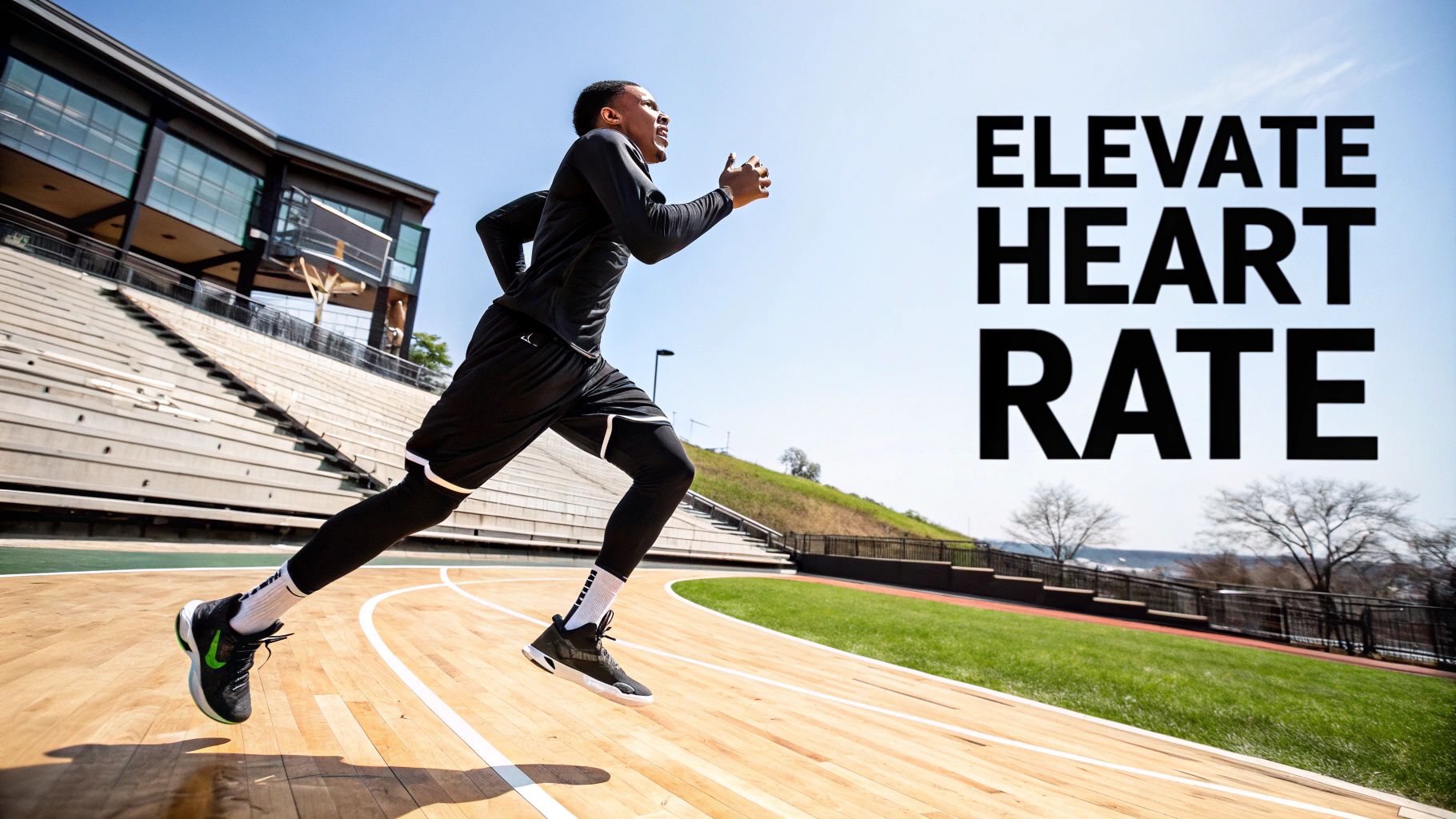
How to Perform High Knees
Proper form is crucial to maximize the benefits of high knees and prevent strain. The goal is to perform the movement with control and rhythm, not just speed.
Starting Position: Stand with your feet hip-width apart and your arms at your sides, bent at a 90-degree angle.
Execution: Begin by jogging in place. Drive your right knee up toward your chest, aiming for it to reach at least hip height. Simultaneously, pump your left arm forward. As your right foot returns to the ground, immediately drive your left knee up while pumping your right arm forward. Continue this alternating motion.
Key Insight: Landing softly on the balls of your feet is critical. This technique minimizes impact on your joints (ankles, knees, hips) and engages the calf muscles, improving your footwork and ability to absorb force during a game.
Actionable Tips for Implementation
Maintain Upright Posture: Keep your chest up and your back straight. Avoid leaning back as you lift your knees. Engaging your core will help maintain stability.
Rhythmic Arm Movement: Actively pump your arms in sync with your legs. This helps drive the movement, maintain balance, and simulate proper running mechanics.
Set a Duration, Not Reps: Aim to perform high knees for a set time, such as 20-30 seconds per set, at a moderate intensity. Focus on quality of movement over quantity.
Focus on Height: Concentrate on driving your knees upward. The "high" in high knees is the most important part of the exercise for activating the hip flexors.
3. Butt Kicks
Butt kicks are a classic dynamic stretching exercise that is essential for any comprehensive basketball warm up. This movement involves jogging in place or moving forward while actively kicking your heels up towards your glutes. It primarily serves to warm up the hamstrings and dynamically stretch the quadriceps, preparing the muscles for the rapid acceleration and deceleration that defines basketball gameplay. This activation is vital for generating explosive power for jumping and sprinting.
This exercise is a staple in basketball programs at every level, from youth leagues to professional training camps, because of its direct impact on lower-body readiness. It effectively prepares the posterior chain and improves neuromuscular coordination, which is the communication between your brain and muscles. By performing butt kicks, players actively engage the muscles responsible for sprinting and jumping, helping to reduce the risk of common injuries like hamstring strains and quad pulls.
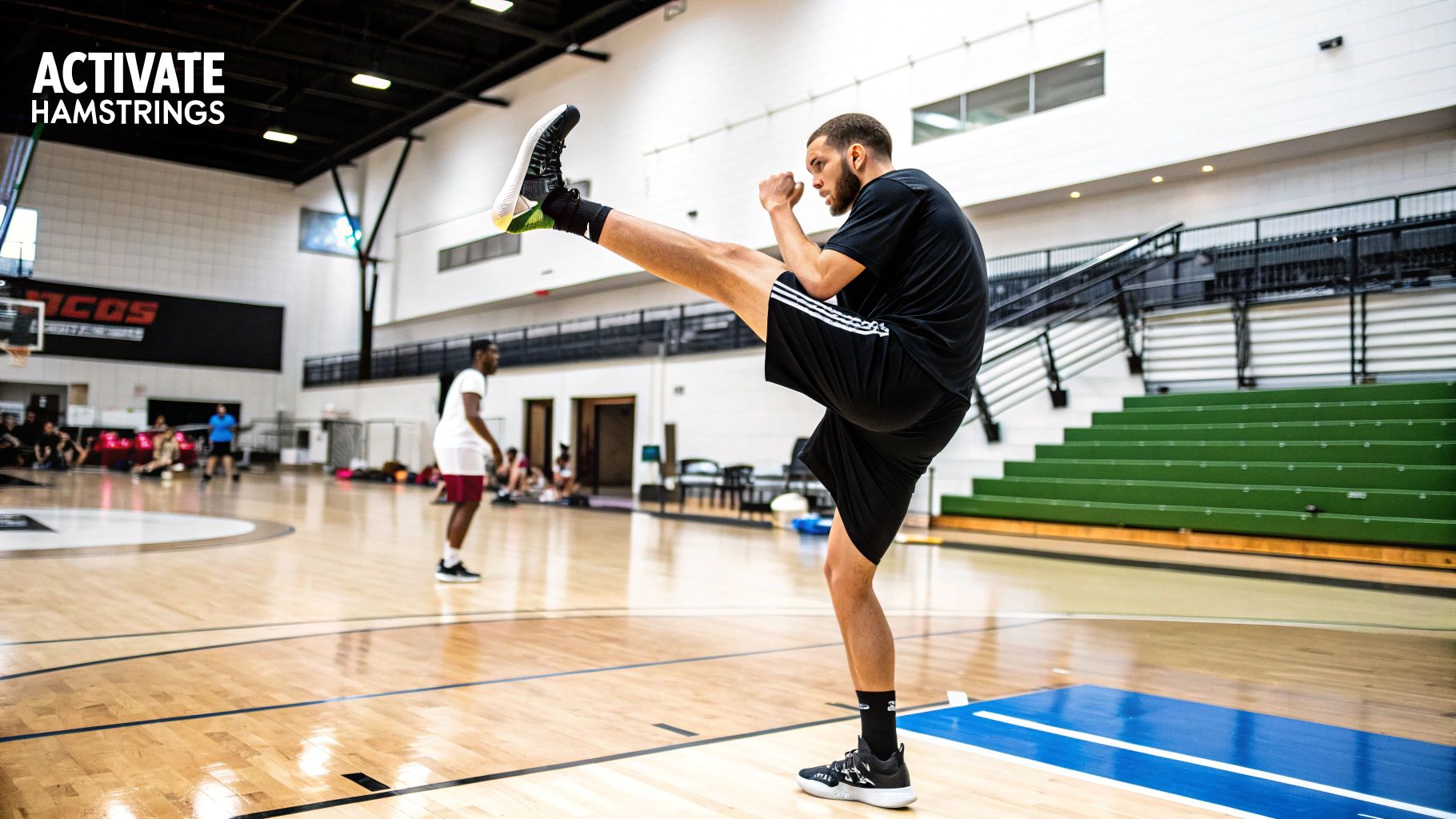
How to Perform Butt Kicks
Proper form is crucial to maximize the benefits and prevent inefficient movement. You can perform butt kicks while stationary or moving slowly across the court.
Execution: Begin by jogging lightly in place or moving forward. With each step, kick one heel directly up towards your glute, aiming for light contact. The opposite arm should swing forward naturally, similar to a regular running motion.
Focus: The emphasis should be on the speed of the leg cycle, pulling the heel up quickly rather than just letting it trail behind. This active pull engages the hamstring muscles.
Key Insight: The goal isn't just to bend your knee, but to actively contract your hamstring to pull your heel towards your glute. This active contraction is what warms up the muscle and prepares it for explosive movements.
Actionable Tips for Implementation
Posture is Key: Maintain an upright torso with a slight forward lean from the ankles. Avoid bending at the waist or arching your back.
Knee Position: Keep your knees pointing towards the ground as you kick your heel up. Allowing your knees to flare forward turns the exercise into a simple run instead of a targeted hamstring warm-up.
Coordinate Arms: Use your arms to drive the movement and maintain balance. A coordinated arm swing reinforces proper running mechanics.
Focus on Cadence: Aim for a quick, rhythmic tempo. Perform the exercise for a set distance, like 20 yards, or for a set time, such as 30 seconds.
By integrating butt kicks into your routine, you are using one of the most effective basketball warm up exercises for activating your hamstrings and improving your running form before hitting the court.
4. Lateral Lunges
Lateral lunges are a critical dynamic stretch for any basketball player, directly mimicking the side-to-side movements fundamental to the sport. This exercise involves stepping out to one side and lowering into a lunge, which prepares the body for defensive slides, quick cuts, and establishing a wide base for rebounding. Unlike forward lunges, lateral lunges specifically target the muscles responsible for stability and power in the frontal plane of motion, which is constantly used on the basketball court.
This movement is a cornerstone of professional conditioning for a reason. It is heavily emphasized in NBA player development programs and is a standard component of college basketball warm-ups. The exercise effectively activates the groin (adductors), outer hips (abductors), glutes, and quadriceps. By preparing these muscle groups, players can enhance their lateral quickness and significantly reduce the risk of common injuries like groin strains.
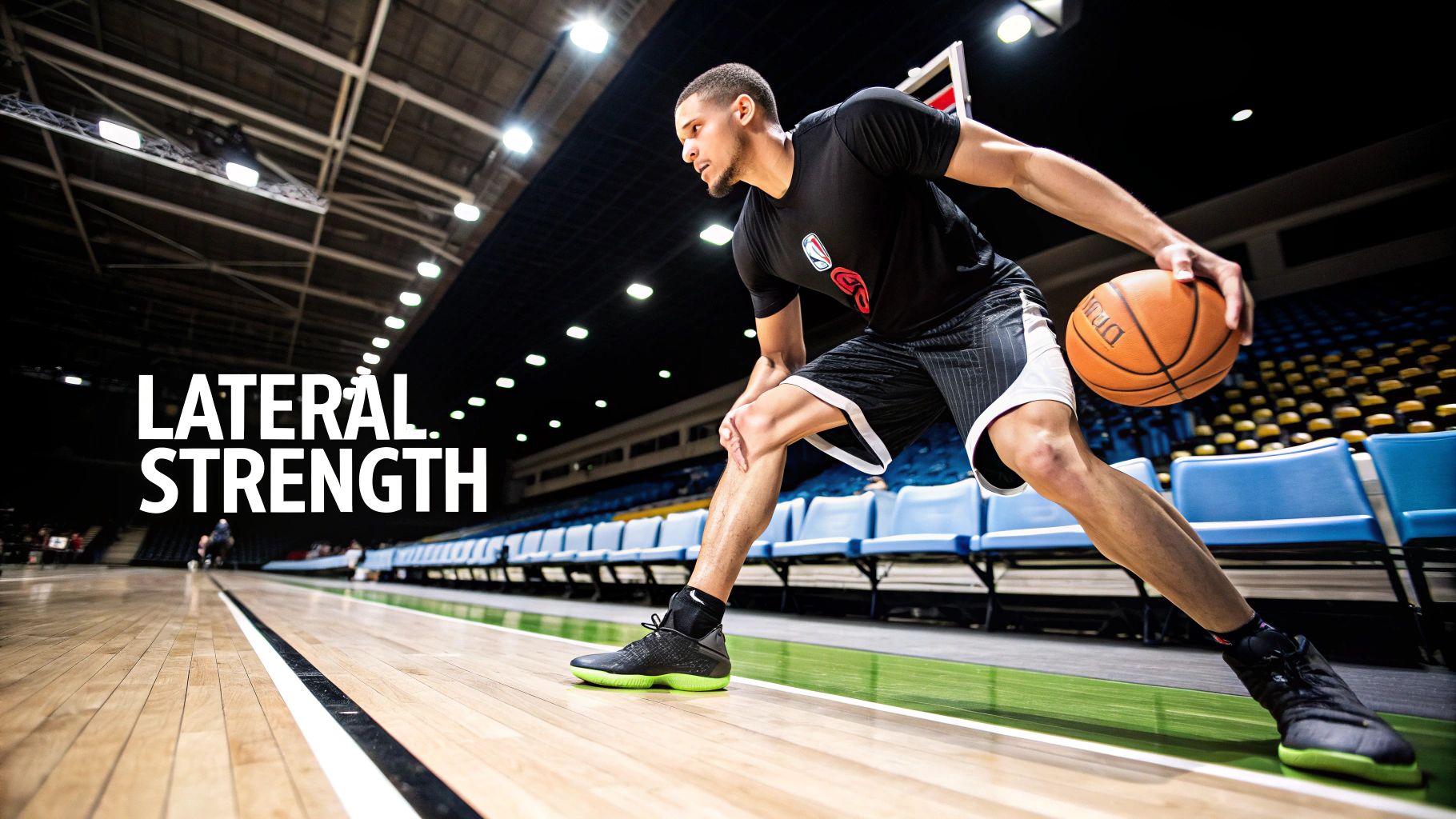
How to Perform Lateral Lunges
Proper form is key to activating the right muscles and preventing strain. The movement should be controlled and deliberate, focusing on depth and stability.
Starting Position: Stand with your feet hip-width apart, keeping your chest up and your core engaged.
The Lunge: Take a wide step out to one side. As your foot plants, push your hips back and bend your knee, lowering your body as if sitting into a chair. Your other leg should remain straight, with your foot firmly on the ground.
Return to Center: Push off with your lunging leg to return to the starting position with your feet together. You can then alternate to the other side.
Key Insight: The emphasis should be on pushing your hips backward, not just bending your knee. This ensures proper glute and hamstring activation and protects the knee joint from excessive forward pressure.
Actionable Tips for Implementation
Maintain Upright Posture: Keep your chest lifted and your back straight throughout the entire movement. Avoid rounding your shoulders or leaning too far forward.
Foot Placement is Key: On the straight leg, ensure your entire foot stays planted on the floor to maximize the stretch in your inner thigh.
Control the Movement: Perform the exercise in a slow, controlled manner. Avoid using momentum to swing from side to side.
Start with Bodyweight: Aim for 8-12 reps per side. Once you have mastered the form, you can progress to holding a light weight for added resistance.
Including lateral lunges in your routine is one of the most effective basketball warm up exercises you can do to prepare for the specific demands of the game.
5. Arm Circles and Shoulder Rolls
The shoulder joint is one of the most mobile and complex joints in the body, making it essential to prepare it for the high-velocity actions of basketball. Arm circles and shoulder rolls are fundamental dynamic movements designed to increase blood flow, warm up the rotator cuff muscles, and improve the overall mobility of the shoulder girdle. This preparation is vital for shooting accuracy, passing strength, and defensive positioning, as a mobile shoulder can generate more power with less strain.
This exercise directly targets the deltoids, rotator cuff, trapezius, and surrounding muscles of the upper back and chest. By activating this entire complex, players lubricate the glenohumeral joint, enhancing its range of motion and stability. The simplicity and effectiveness of arm circles and shoulder rolls make them a non-negotiable part of basketball warm up exercises, commonly seen in everything from youth practice drills to professional pre-game routines and physical therapy rehabilitation programs.
How to Perform Arm Circles and Shoulder Rolls
Proper execution ensures that the right muscles are activated without placing undue stress on the joint. The movements should be deliberate and controlled.
Arm Circles: Stand with your feet shoulder-width apart and extend your arms straight out to your sides, parallel to the floor. Begin by making small, controlled circles in a forward direction. Gradually increase the size of the circles until you are making large, sweeping motions. After completing your reps, reverse the direction and repeat the process, starting small and progressing to larger backward circles.
Shoulder Rolls: After completing arm circles, let your arms hang loosely at your sides. Gently lift your shoulders up toward your ears, then roll them backward and down, squeezing your shoulder blades together. Then, reverse the motion by rolling them forward and down.
Key Insight: The combination is crucial. Arm circles warm up the larger muscles, while shoulder rolls specifically target the scapulae (shoulder blades), which are the foundation for all shoulder movement.
Actionable Tips for Implementation
Progressive Sizing: Always start with small, tight circles and gradually expand. This controlled progression safely warms the muscles and prevents strain.
Control Over Speed: The focus should be on smooth, continuous movement, not speed. Rushing the exercise can lead to jerky motions and potential injury.
Isolate the Shoulders: When performing arm circles, try to keep your torso stable. The movement should originate from the shoulder joint itself.
Combine and Breathe: Perform a set of 10-15 forward circles, followed by a few shoulder rolls, then 10-15 backward circles. Breathe rhythmically throughout the entire sequence.
6. Walking Quad Stretch
The walking quad stretch is an essential dynamic movement that bridges the gap between static stretching and active warm-ups. It involves a controlled stretch of the quadriceps while maintaining forward momentum, which actively prepares the muscles and joints for the demands of basketball. Unlike a stationary quad stretch, this dynamic version keeps the body in motion, elevating heart rate and increasing blood flow to the key leg muscles used for jumping, sprinting, and defensive shuffles.
This exercise is particularly effective because it targets the quadriceps and hip flexors, two muscle groups that are heavily relied upon for explosive power and quick directional changes on the court. Activating these areas dynamically helps improve flexibility and reduce the risk of common basketball injuries like muscle strains. The walking quad stretch is a standard practice in pre-game routines from youth leagues all the way to professional training camps, valued for its ability to combine mobility with functional movement.
How to Perform the Walking Quad Stretch
Proper form is crucial to maximize the benefits of the walking quad stretch and prevent injury. The key is to integrate the stretch smoothly into a walking cadence.
Step and Reach: Take a step forward with your left foot. As you plant your foot, reach back with your right hand to grasp your right ankle.
Pull and Hold: Gently pull your right heel towards your glutes until you feel a comfortable stretch in the front of your thigh. Keep your knees close together and your torso upright to isolate the quadriceps.
Release and Repeat: Hold the stretch for 2-3 seconds, then release your foot, take a step with your right foot, and repeat the motion on the other side by reaching back for your left ankle with your left hand. Continue this alternating pattern as you walk forward.
Key Insight: Focusing on keeping your knees aligned (not letting the stretching leg's knee flare out to the side) ensures the stretch is concentrated on the quadriceps and hip flexors, rather than putting strain on the knee joint.
Actionable Tips for Implementation
Grip the Ankle, Not the Foot: Holding your ankle provides a more stable grip and prevents you from putting awkward torque on your foot and knee.
Maintain Upright Posture: Avoid leaning forward or arching your back. Engage your core to keep your spine neutral and your chest up.
Synchronize Movement: Coordinate the stretch with your walking rhythm. The movement should be fluid, not jerky or rushed.
Control the Stretch: This is not about pulling as hard as possible. The goal is a gentle, active stretch to awaken the muscle, not force it into a deep, static hold.
By including the walking quad stretch, you are adding one of the most functional basketball warm up exercises to your routine, ensuring your legs are primed for peak performance.
7. Carioca (Grapevine)
The Carioca, often called the grapevine, is a staple lateral movement drill in any comprehensive list of basketball warm up exercises. It involves a rhythmic, coordinated sideways movement where you cross one foot in front of the other, and then behind. This exercise is exceptional for preparing an athlete for the defensive demands of basketball, where quick, controlled lateral shuffles and slides are paramount. Unlike simple side shuffles, the Carioca adds a crucial element of hip rotation, warming up the hip sockets and activating the surrounding muscles.
This dynamic drill directly enhances lateral agility, footwork, and coordination, which are critical for staying in front of an opponent or quickly changing direction on offense. The twisting motion through the core and hips prepares the body for the rotational forces experienced during play. For this reason, the Carioca is a fixture in athletic performance programs, from youth basketball camps to the pre-game routines of NBA players, as it efficiently boosts defensive readiness and hip mobility.
How to Perform the Carioca
Mastering the Carioca's rhythm is key to unlocking its benefits. The movement is a continuous, fluid sequence of steps performed while moving sideways.
Step 1: Start in a slight athletic stance, with knees bent. To move to your right, step your left foot across and in front of your right foot.
Step 2: Step your right foot out to the side to uncross your legs.
Step 3: Step your left foot across and behind your right foot.
Step 4: Step your right foot out to the side again to uncross your legs and return to the starting position, but further to the right. Continue this pattern down the court and then repeat in the opposite direction.
Key Insight: The power and coordination come from the hips. Focus on swiveling your hips as you cross your feet over. This rotation, not just the leg movement, is what improves mobility and prepares your core for in-game action.
Actionable Tips for Implementation
Start Slow: Begin at a walking pace to learn the footwork pattern. As you get comfortable, gradually increase your speed.
Stay on the Balls of Your Feet: This promotes quickness and agility, mimicking the foot posture needed for explosive defensive slides.
Keep Shoulders Square: Try to keep your shoulders facing forward as much as possible while your hips rotate. This separation between the upper and lower body is crucial for athletic movement.
Maintain Rhythm: Focus on a smooth, consistent "in-front, side, behind, side" rhythm. This ensures the movement remains coordinated and effective. Perform the drill for a set distance, like the width of the basketball court, and repeat 2-3 times in each direction.
8. Light Jogging with Backpedaling
Light jogging with integrated backpedaling is a fundamental cardiovascular warm-up that elevates heart rate and core body temperature gradually. This exercise directly mimics the constant transition between offense and defense, preparing the body for the game's multi-directional demands. Instead of just jogging in a straight line, incorporating backward movement engages different muscle groups and improves coordination, making it one of the most practical basketball warm up exercises.
This combination activates the quadriceps, hamstrings, glutes, and calves while also challenging neuromuscular control. The shift from forward to backward motion enhances proprioception, your body's awareness in space, which is critical for maintaining balance while defending or retreating on a fast break. This drill is a standard in almost every team practice and conditioning program, from youth leagues to professional training camps, because it safely prepares the cardiovascular and musculoskeletal systems for more intense activity.
How to Perform Light Jogging with Backpedaling
Proper form is crucial for maximizing benefits and preventing strain. The goal is fluid movement, not abrupt, jerky transitions.
Forward Jog: Begin with a light jog, running at about 30-40% of your maximum speed. Focus on a relaxed posture, with your arms swinging naturally and your feet landing softly.
Transition to Backpedal: After jogging a set distance, like half the court, smoothly transition into a backpedal. Lower your hips slightly into an athletic stance, keep your chest up, and push off the balls of your feet. Avoid leaning too far back or clicking your heels together.
Key Insight: While backpedaling, keep your head up and eyes forward as you would in a game. This trains you to see the court and react to plays even when moving backward, directly translating to better defensive awareness.
Actionable Tips for Implementation
Maintain Upright Posture: Avoid hunching over or leaning too far back during the backpedal. A slight bend in the knees and a low center of gravity is ideal.
Land Softly: Whether jogging forward or backpedaling, land on the balls of your feet. This cushions the impact on your joints and promotes quicker, more efficient movement.
Gradual Pace Increase: Start the warm-up at a slow, controlled pace. As your body warms up, you can gradually increase the speed of both your jog and backpedal.
Use the Full Court: A great way to implement this is by jogging the length of the court and then backpedaling back to your starting point. Repeat this 2-3 times.
Basketball Warm-Up Exercises Comparison
Exercise | 🔄 Implementation Complexity | 💡 Resource Requirements | 📊 Expected Outcomes | ⭐ Key Advantages | ⚡ Ideal Use Cases |
|---|---|---|---|---|---|
Dynamic Leg Swings | Moderate — requires balance and control | Minimal — just a wall or support | Improved hip mobility, muscle activation, injury risk reduction | Quick hip flexibility gains, multi-plane activation | Warm-ups, mobility focus |
High Knees | Low — simple running motion | None — bodyweight only | Elevated heart rate, improved running mechanics, coordination | Rapid cardiovascular activation, neuromuscular coordination | Cardiovascular warm-up, rhythm training |
Butt Kicks | Low to Moderate — requires rhythm control | None — bodyweight only | Hamstring activation, quadriceps stretch, improved running form | Effective posterior chain activation, blood flow enhancement | Warm-ups focused on posterior chain |
Lateral Lunges | Moderate — balance and unilateral strength | None — bodyweight only | Enhanced lateral mobility, balance, muscle activation | Directly mimics basketball lateral movements | Basketball-specific movement prep |
Arm Circles and Shoulder Rolls | Very Low — simple arm movements | None | Improved shoulder mobility, rotator cuff activation | Prepares shoulders for shooting, easy to perform | Upper body warm-up, rehab |
Walking Quad Stretch | Moderate — requires balance and coordination | None | Quadriceps and hip flexor stretching, improved balance | Dynamic stretch with movement, functional | Dynamic stretching, balance improvement |
Carioca (Grapevine) | Moderate to High — complex footwork | Requires adequate floor space | Improved lateral agility, coordination, hip mobility | Mimics defensive slides, enhances rhythm and coordination | Agility drills, multi-directional warm-up |
Light Jogging with Backpedaling | Low — basic jogging/backpedaling skills | None | Cardiovascular preparation, multi-directional movement prep | Gradual warm-up intensity, directional adaptability | General warm-up, active recovery |
Integrating Your Warm-Up: From Routine to Ritual
You have now explored a foundational toolkit of dynamic basketball warm up exercises, each designed to prepare your body for the specific demands of the game. From the hip mobility granted by Dynamic Leg Swings and Lateral Lunges to the neuromuscular activation sparked by High Knees and Butt Kicks, this sequence is your blueprint for peak performance readiness. The goal is no longer just to "get loose"; it's to systematically prime your body for explosive, multi-directional movement.
Moving beyond a simple checklist of exercises requires a shift in mindset. A powerful warm-up is not a chore to be rushed through but a critical ritual that sets the tone for your entire session. Each movement is an investment in your athletic future, directly contributing to injury prevention, enhanced agility, and greater power on the court.
Weaving the Elements into a Cohesive Flow
The true power of these exercises is unlocked when they are combined into a seamless, progressive sequence. Your objective is to build a personalized warm-up flow that transitions smoothly from one movement to the next, gradually increasing in intensity and complexity.
Consider structuring your routine in this order:
General Activation: Start with a light jog combined with backpedaling to increase blood flow and core temperature.
Dynamic Mobility: Move into Dynamic Leg Swings and Arm Circles to open up the hips and shoulders.
Movement Patterning: Incorporate Lateral Lunges and Carioca to prepare your body for side-to-side shuffling and defensive stances.
Neuromuscular Firing: Finish with explosive, quick-twitch movements like High Knees and Butt Kicks to switch on your nervous system for game-speed actions.
By dedicating just 10-15 minutes to this structured sequence, you are sending a clear signal to your body: it's time to compete. You're not just preventing hamstring pulls or ankle sprains; you're building a foundation of resilience that allows you to play harder and longer, season after season.
Key Takeaway: The difference between a good and a great player often lies in their preparation. Transforming these basketball warm up exercises from a routine into a non-negotiable ritual is the first step toward dominating every aspect of the game, from the opening tip to the final buzzer.
This commitment to preparation ensures you step onto the court with your muscles firing, your joints mobile, and your mind focused. You will feel more explosive in your first step, more stable in your defensive slide, and more confident in your ability to react to the unpredictable nature of basketball. This isn't just a warm-up; it's your competitive edge.
As you elevate your preparation with elite-level warm-ups, ensure your gear matches your commitment to performance. The specialized apparel from RealOminousAthlete is engineered for athletes who demand the best, providing the comfort and functionality needed to execute every movement with precision. Shop RealOminousAthlete today and equip yourself with the gear that supports your journey to on-court dominance.


Comments